
Helsinki Accords
The Helsinki Accords confirmed Europe's postwar borders in 1975 and included human rights pledges that dissidents used to challenge the Soviet Union.
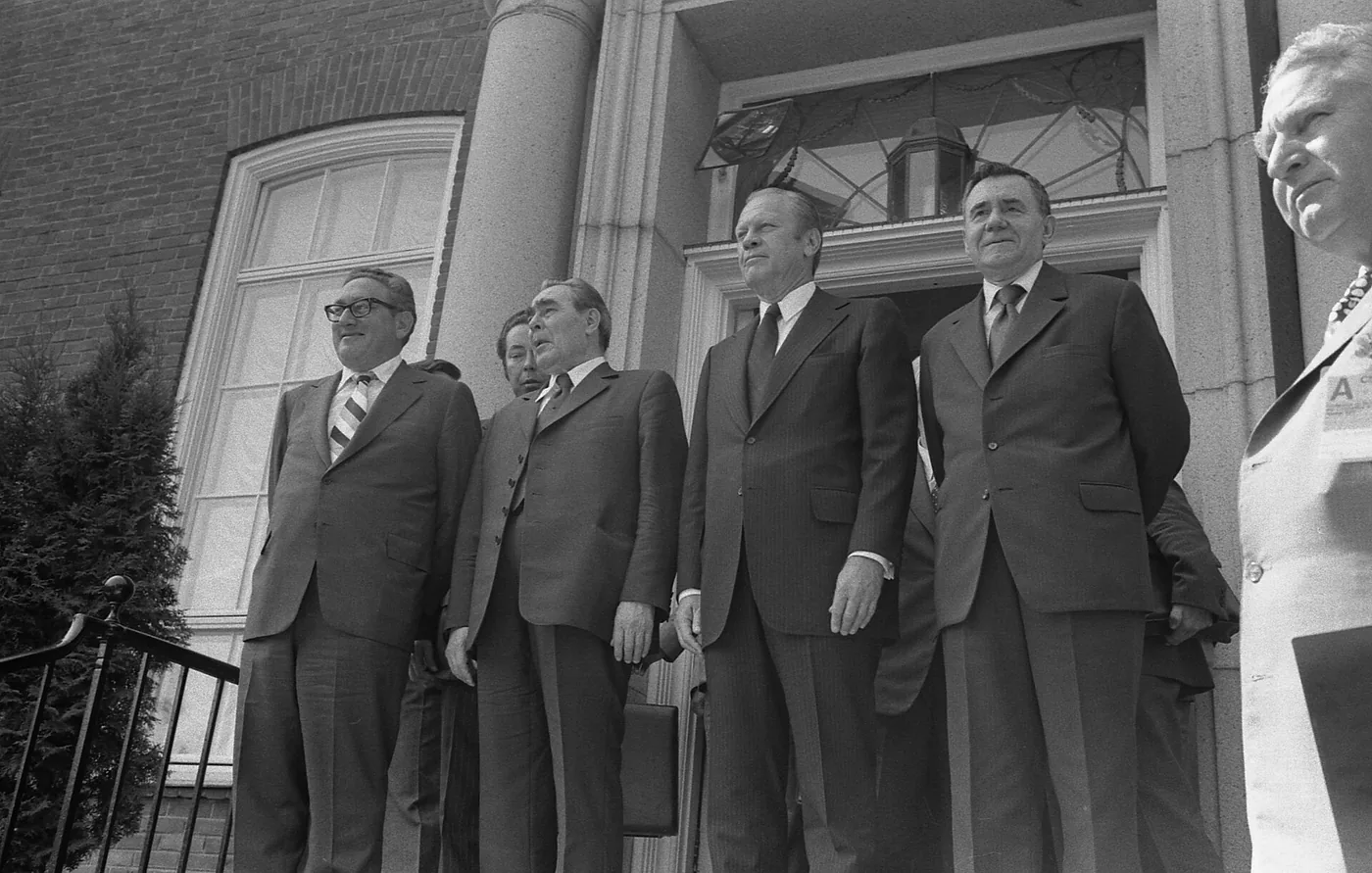
The Helsinki Accords were a political declaration signed on August 1, 1975, by the leaders of 35 countries. The signatories included all of Europe's states except Albania, along with the United States and Canada. The document carried no legal force. The Soviet Union wanted it to lock in the borders drawn after World War II, above all the partition of Germany and Poland's redrawn western frontier. Western governments accepted that, but in return they won provisions on human rights, family reunification, and the movement of people and information across borders. Soviet leader Leonid Brezhnev saw the deal as the high point of his career in foreign affairs. He ordered the full text printed in Pravda. Within a decade, the human rights clauses gave Eastern European dissidents a way to challenge their own governments from within.
How the Helsinki Accords were negotiated
Moscow had called for a pan-European security summit since the 1950s. Detente in the early 1970s made such an agreement possible. Negotiations took years and involved all the signatory states, with neutral countries acting as brokers between the Western and Soviet blocs.
The agreement was organized into three sections, called baskets. Basket I covered security. It declared that Europe's postwar frontiers could not be altered by force and that no state would interfere in another's domestic affairs. Basket I also listed ten guiding principles, among them a pledge to respect human rights, including freedom of thought, conscience, and religion.
Basket II addressed economic and trade relations. Basket III, which smaller Western European states fought hardest for, covered humanitarian issues: reunification for families divided by borders, easier travel and information sharing across the blocs, protections for journalists working abroad, and wider cultural and educational contact.
A final section set up review conferences to check whether the signatories were keeping their commitments.
How dissidents turned the Helsinki Accords against the Soviet Union
Many Western critics saw the agreement as a giveaway to Moscow. Ronald Reagan campaigned against it. The writer Aleksandr Solzhenitsyn called it the burial of Eastern Europe. But neither side foresaw what would happen when a one-party state published a list of rights.
The Helsinki Accords were a document that the Soviet government itself had published and that the general secretary had put his name on. Citizens who asked their government to honor the agreement were pointing to promises the state itself had put in writing. They were not importing foreign ideas, and that made them harder to silence.
In May 1976, the physicist Yuri Orlov founded the Moscow Helsinki Group to record violations and make them public. Its members included Natan Sharansky, Yelena Bonner, and Lyudmila Alekseyeva. Sister groups soon appeared in Ukraine, Georgia, Armenia, and Lithuania. On January 1, 1977, a circle of intellectuals in Czechoslovakia published Charter 77. Its authors included the playwright Vaclav Havel. The document argued that Czechoslovakia had pledged to protect basic freedoms and was breaking those pledges daily. In Poland, the Workers' Defense Committee, founded in 1976, helped lay the groundwork for what became Solidarity.
The KGB arrested the monitors. Within a few years, most of the original leaders were in prison camps or forced into exile. But the movements outlasted the crackdown, and their members gained international recognition. In America, a support organization launched as Helsinki Watch in 1978 and eventually became Human Rights Watch.
What did the Helsinki Accords achieve?
The Helsinki Accords reshaped how human rights worked in Cold War diplomacy. Review conferences in Belgrade, Madrid, and Vienna created a regular forum where Western governments could name specific political prisoners and press for their release. Human rights became a permanent item in relations between East and West, and jailing well-known dissidents now carried a diplomatic cost.
When the communist regimes of Eastern Europe collapsed in 1989, Helsinki monitors and Charter 77 signatories were among those who led the revolutions. Vaclav Havel became president of Czechoslovakia. The agreement had never been enforceable. It worked because it gave people arguments their own governments had already signed, and those arguments could not easily be dismissed.
The Helsinki Accords and the OSCE today
In 1995, the conference process became a permanent institution called the OSCE (Organization for Security and Cooperation in Europe). It now has 57 member states. Its founding principle is that borders in Europe cannot be changed by force.
When Russia seized Crimea in 2014, it directly violated that principle. Ukraine had earlier given up its nuclear arsenal in exchange for written assurances about its borders. Since Russia's full-scale invasion of Ukraine in 2022, the OSCE has struggled to enforce the commitments the Helsinki process was built on. Switzerland chairs the organization in 2026, and its members approved a unified budget for the first time in five years. But the core promise of the Helsinki Accords, that European borders cannot be changed by force, remains broken.