
Solidarity
Solidarity was a Polish trade union that grew to ten million members and won the 1989 elections that began the end of communist rule in Europe.
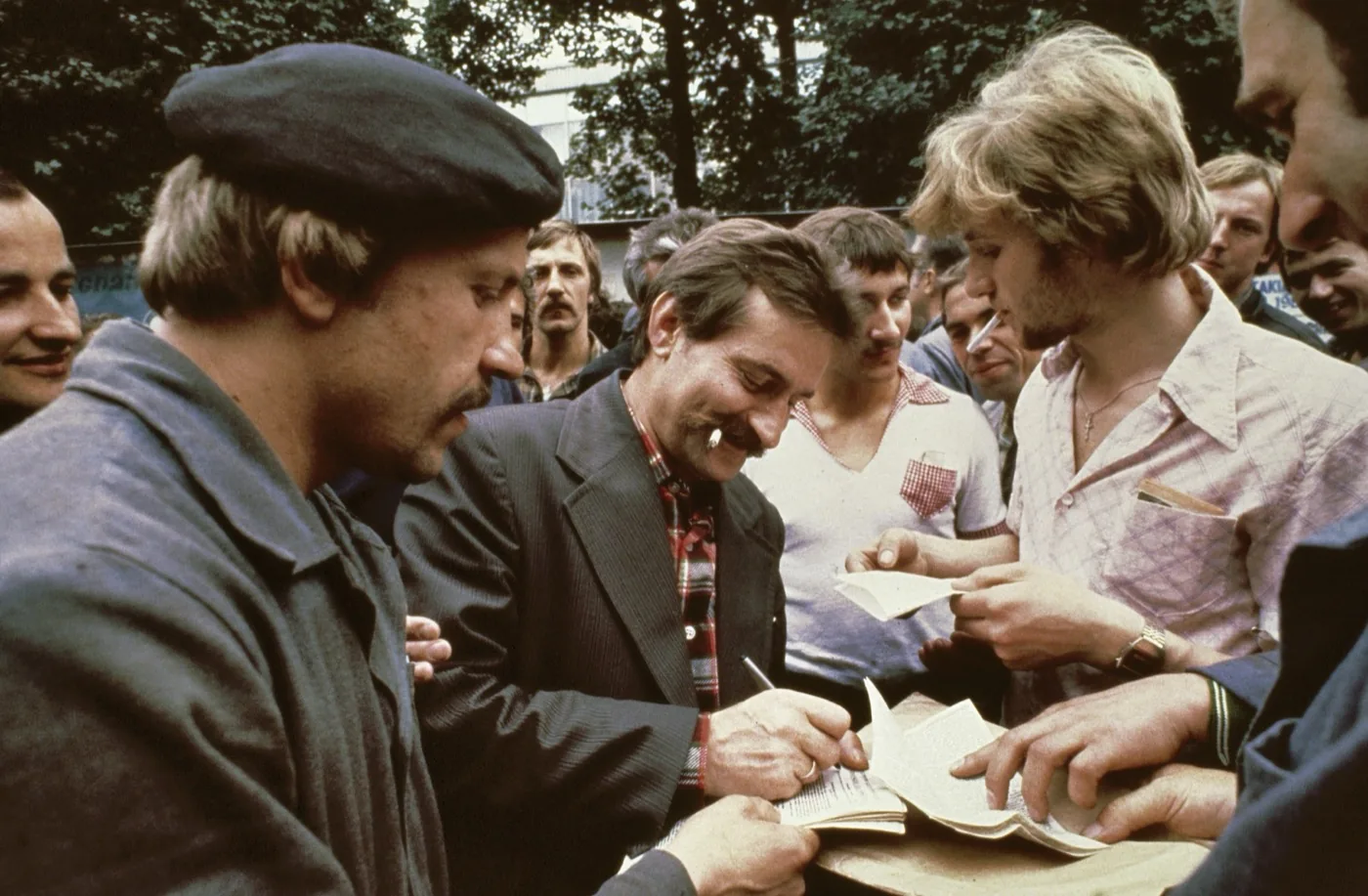
Solidarity (Solidarność in Polish) was a trade union founded in Poland in 1980. Within a year it had about ten million members, most of Poland's workforce, making it the first independent mass movement in the Soviet bloc. The government declared martial law in December 1981 and banned Solidarity, but the movement survived underground for seven years. In 1989, its candidates won a landslide in Poland's first partly free elections, and a Solidarity adviser was named prime minister, the first non-communist to hold the post in Eastern Europe since the 1940s. Within months, communist governments fell across the continent. The man who led Solidarity, an electrician named Lech Walesa, became president of Poland in 1990.
How a shipyard strike became a national movement
On August 14, 1980, workers at the Lenin Shipyard in Gdansk went on strike. The immediate cause was the firing of Anna Walentynowicz, a crane operator and underground newspaper editor, five months before her retirement. Rising food prices were already causing unrest across the country.
Lech Walesa, who had been fired from the same shipyard four years earlier for organizing workers, climbed over the perimeter wall to join the strikers. He was 36, the son of a farmer and carpenter from a village between Warsaw and Gdansk, with six children at home. He took charge quickly.
The strike spread along the Baltic coast. Within days, an inter-factory strike committee presented the government with 21 demands. The most important was the right to form trade unions independent of the Communist Party. No workers in the Soviet bloc had ever won that.
On August 31, the government gave in. Deputy Premier Mieczyslaw Jagielski and Walesa signed the Gdansk Agreement, granting the right to organize, the right to strike, and greater freedom of expression. Walesa signed with an oversized souvenir pen that had a picture of Pope John Paul II inside it. The Polish pope, elected in 1978, had visited Poland in June 1979, drawing millions to open-air masses across the country.
Solidarity was formally founded in September 1980. By September 1981, it had about ten million members, roughly four out of every five wage earners in the country. It brought together shipyard workers, farmers, opposition intellectuals, and Catholic clergy. No communist government had ever faced a challenge on this scale.
How Solidarity survived martial law
For sixteen months, Poland had a degree of freedom that no other Warsaw Pact country enjoyed. General Wojciech Jaruzelski imposed martial law on December 13, 1981. He said later that he acted to prevent a Soviet invasion.
Tanks rolled into cities across Poland. Solidarity was banned. Nearly 10,000 activists were interned, including Solidarity's leader, Walesa, who was held for almost a year. At the Wujek coal mine in Silesia, security forces shot and killed nine striking miners.
Solidarity did not disappear. It went underground, relying on smuggled printing presses, secret meetings in church basements, and support from the West. Radio Free Europe broadcast news back into Poland that state media would not report. In 1983, Walesa won the Nobel Peace Prize. He sent his wife, Danuta, to accept it in Oslo, worried that the government would not let him back into Poland if he left.
Poland's economy kept deteriorating through the 1980s. Shortages were constant, inflation climbed, and the government had no credible plan. By the late 1980s, a new wave of strikes was spreading. In Moscow, Mikhail Gorbachev had made clear that the Soviet Union would no longer send troops to prop up allied governments. The Brezhnev Doctrine, which had justified the Soviet invasion of Czechoslovakia in 1968, was over.
How Solidarity won the 1989 elections
The Polish government, nearly bankrupt and facing renewed strikes, agreed to negotiate. The Round Table talks ran from February to April 1989. Solidarity was legalized again, and the two sides agreed to partly free elections. The opposition could contest all 100 Senate seats and 161 of the 460 seats in the Sejm, the lower house.
In June 1989, Solidarity won 99 of 100 Senate seats and all 161 Sejm seats it was allowed to contest. The Communist Party failed to form a governing coalition. On August 24, Tadeusz Mazowiecki, a Catholic intellectual and longtime Solidarity adviser, became prime minister. No non-communist had led a government in the region since the late 1940s.
The effect was immediate. Within months, Hungary opened its border with Austria, the Berlin Wall fell on November 9, and Czechoslovakia's Velvet Revolution swept out its communist government. By the end of 1989, every Soviet-backed government in Eastern Europe was falling or had already fallen. Poland's elections helped set off the collapse of the entire Soviet bloc.
What happened to Solidarity after 1989?
As a political movement, Solidarity splintered quickly. The common enemy that had held shipyard workers, intellectuals, and priests together was gone, and the coalition broke into competing parties that disagreed on economic reform, the role of the Church, and nearly everything else. Solidarity's leader, Walesa, won the presidency in December 1990, but his time in office was marked by political infighting and he lost his reelection bid in 1995.
The trade union itself still exists. In 2026, Solidarity has several hundred thousand members and remains active in Polish labor politics, most recently organizing protests against EU environmental regulations. But it is an ordinary labor union now, not the mass movement that once enrolled most of Poland's workers.
Solidarity showed in 1980 that a workers' movement could force a communist government to give ground through strikes and negotiations rather than violence. Every other Soviet-backed government in Eastern Europe fell within a year of Poland's 1989 elections.