Holocaust
The Holocaust was Nazi Germany's systematic murder of six million Jews between 1941 and 1945, about two-thirds of Europe's Jewish population.
From 1941 to 1945, the German government murdered approximately six million Jews, roughly two-thirds of the 9.5 million Jews who lived in Europe before the war. The killing was organized through ministries and departments, paid for by the national budget, and run using the railroads, census records, and industrial capacity of a modern country. Nazi officials referred to it as the Final Solution. Jews call it the Shoah, meaning "the catastrophe." Germany also killed millions of other people during this period, including Roma, Soviet prisoners of war, people with disabilities, Polish civilians, and gay men. No state before had ever organized killing on this scale.
How Nazi Germany moved from persecution to murder
Adolf Hitler became chancellor of Germany in January 1933. Within months, his government stripped Jewish citizens of their jobs and organized boycotts of Jewish businesses. In 1935, the Nuremberg Laws classified people as Jewish based on their grandparents' religion and stripped them of German citizenship. On the night of November 9, 1938, Nazi paramilitaries burned more than 1,400 synagogues and smashed thousands of Jewish-owned shops across Germany in a pogrom called Kristallnacht. Police arrested about 26,000 Jewish men and sent them to concentration camps. Emigration surged after Kristallnacht, and by September 1939, more than half of Germany's 522,000 Jews had left the country. Those who remained, and the millions of Jews in countries Germany would soon conquer, were trapped.
Persecution turned to mass killing with the invasion of the Soviet Union in June 1941. Einsatzgruppen, mobile killing units, moved behind the advancing German army, shooting entire Jewish communities at the edges of pits and ravines. At Babi Yar near Kyiv, one unit killed 33,771 people over September 29 and 30, 1941. On January 20, 1942, fifteen senior officials gathered at a lakeside house in Wannsee, a suburb of Berlin, to plan the extermination of Jews across the continent. Reinhard Heydrich, head of the Reich Security Main Office, chaired the meeting. Adolf Eichmann, who ran Jewish affairs for the security service, took the minutes and organized the deportation system that followed.
The death camps in occupied Poland
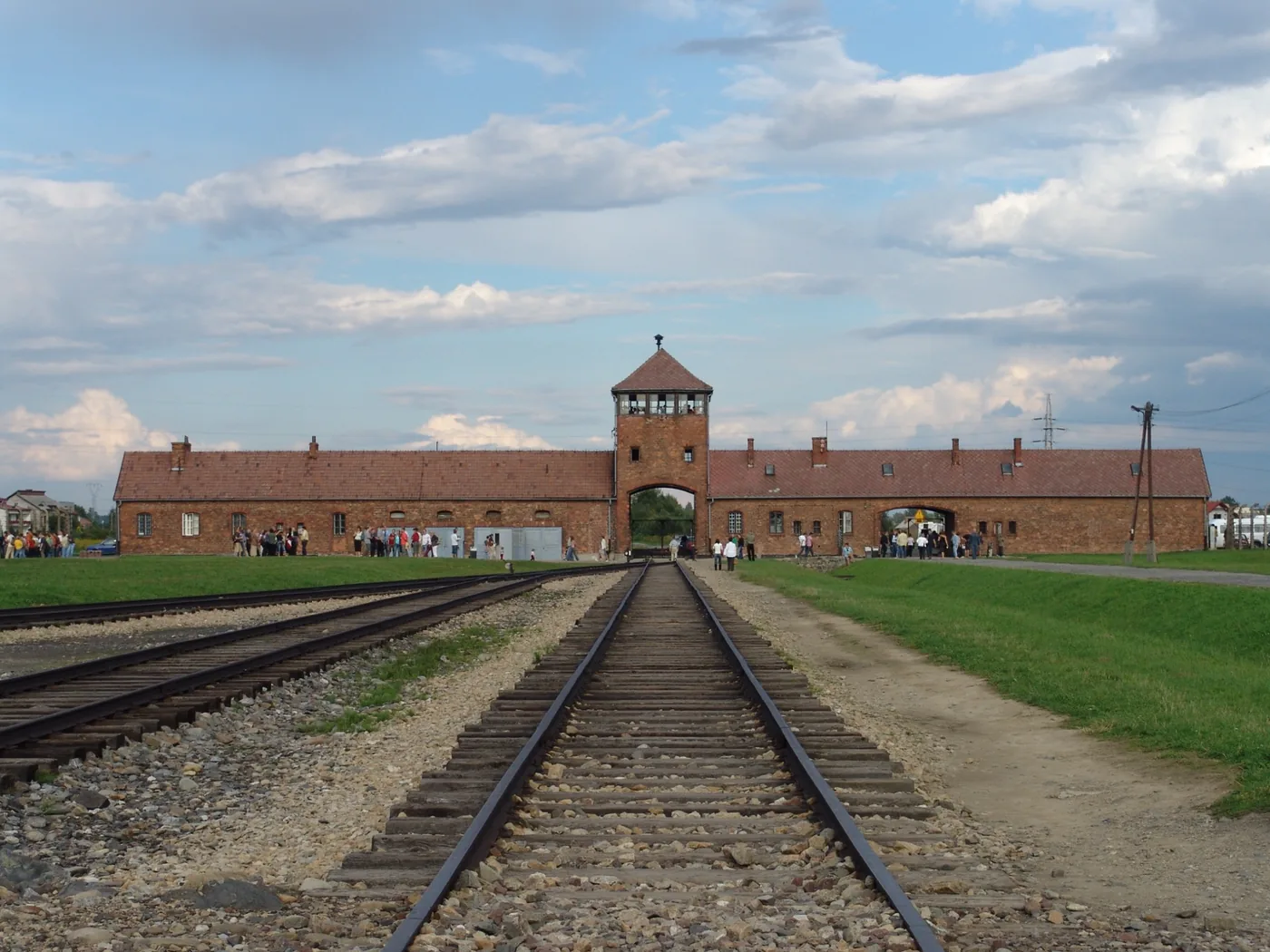
Jews across occupied Europe were first confined in sealed ghettos in cities like Warsaw, Lodz, and Krakow, where hundreds of thousands died of starvation and disease. Beginning in 1942, the ghettos were emptied. Their inhabitants were loaded into freight trains and sent to six killing centers that the German government built in occupied Poland: Chelmno, Belzec, Sobibor, Treblinka, Majdanek, and Auschwitz-Birkenau.
People arrived by the trainload and were selected on the platform. Those judged unfit for labor, the large majority, walked within hours into gas chambers disguised as showers. Guards collected the victims' hair, pulled gold from their teeth, and shipped everything of value back to Germany. Auschwitz-Birkenau was the largest killing center. It served as both a labor camp and a killing center, and roughly one million people died there, the great majority of them Jews. Soviet troops liberated Auschwitz on January 27, 1945. They found warehouses stacked with human hair, eyeglasses, and shoes. Most of the other camps had already been dismantled by the Germans, who tried to destroy the evidence.
How many people died in the Holocaust?
The most widely accepted figure is six million Jewish victims, a number drawn from prewar and postwar population counts and from the Nazis' own records. That was roughly two-thirds of Europe's prewar Jewish population of about 9.5 million.
The Nazis also killed between 250,000 and 500,000 Roma and Sinti, approximately three million Soviet prisoners of war, hundreds of thousands of disabled people, and many Polish civilians, political prisoners, and gay men. Including all victim groups, historians estimate that the Nazi regime systematically killed approximately 17 million people.
The Holocaust after 1945
After the war, the Allied powers put senior Nazi leaders on trial at Nuremberg. The trials set the principle that obeying superior orders was not a legal defense for mass murder. In 1960, Israeli agents captured Adolf Eichmann in Argentina, where he had been living under a false name since 1950. His trial in Jerusalem in 1961 was broadcast on television and brought survivor testimony to a worldwide audience for the first time. Eichmann was convicted in 1961 and executed in 1962.
The Holocaust reshaped international law. In 1944, Raphael Lemkin, a Polish-Jewish legal scholar, had coined the word "genocide" in his book Axis Rule in Occupied Europe, giving a name to a crime that until then had none. The word became the basis of the 1948 United Nations Genocide Convention. That same year, the United Nations adopted the Universal Declaration of Human Rights, a document shaped directly by what the war had revealed. The Holocaust also strengthened the push for a Jewish state, and Israel declared independence in 1948.
As of 2026, roughly 196,600 Holocaust survivors are still alive worldwide, with a median age of 87. January 27, the anniversary of Auschwitz's liberation, is observed around the world as Holocaust Remembrance Day.