
How did Israel become a country?
How Israel became a country: the fifty-year road from Herzl's pamphlet in Vienna to the UN partition vote and the 1948 war.
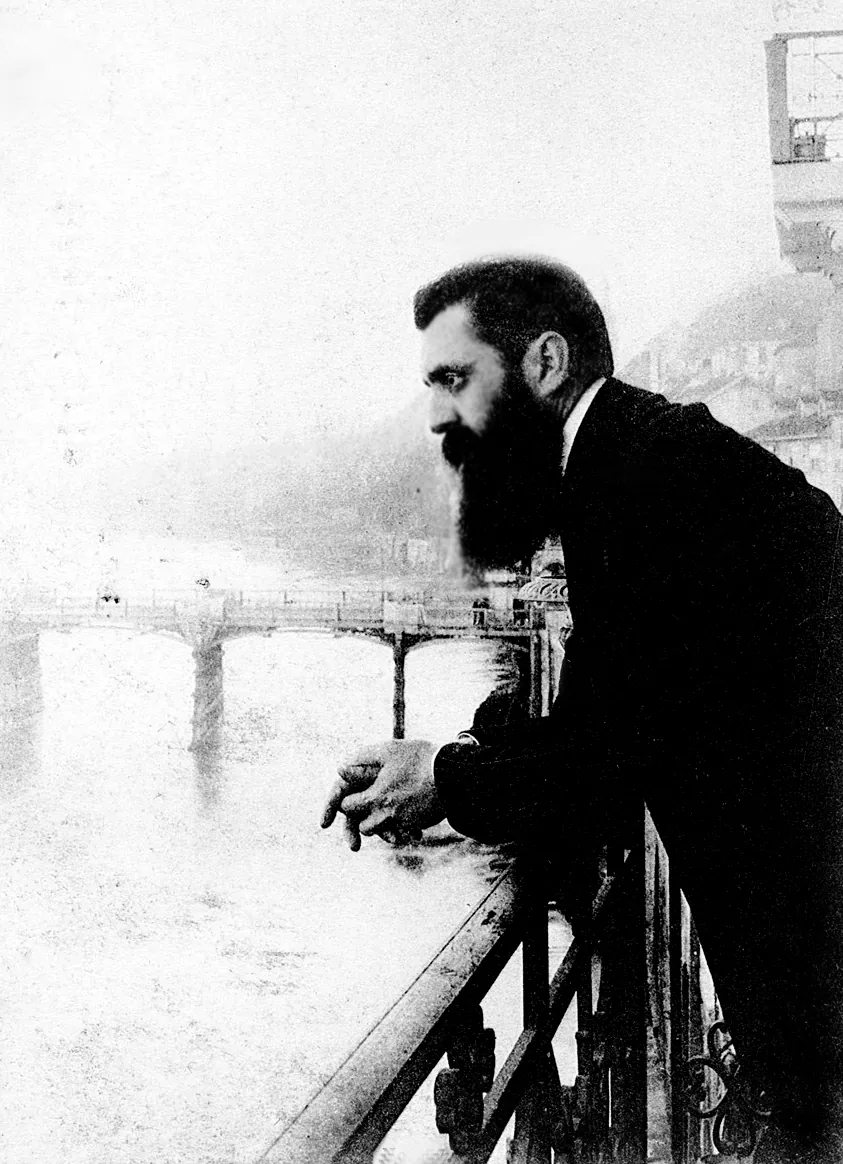
In August 1897, some two hundred delegates met in a concert hall in Basel, Switzerland. Their host was Theodor Herzl, a 37-year-old journalist from Vienna, and the program they adopted called for a legally secured home in Palestine for the Jewish people. Three days after the congress closed, Herzl wrote in his diary: "At Basle I founded the Jewish State. If I said this out loud today I would be greeted by universal laughter. In five years perhaps, and certainly in fifty years, everyone will perceive it."
Fifty years and three months later, on November 29, 1947, the United Nations voted to partition Palestine and create a Jewish state. What happened in between is the story of how Israel became a country: an idea born in Europe, a British promise that could not be kept, and a war that drew the map.
Where the idea of Israel came from
The idea did not come from Palestine. In 1897 the land between the Jordan River and the Mediterranean had been Ottoman territory for almost four centuries. Around 1880 it held roughly half a million people, nearly all of them Arabs, mostly Muslim with a large Christian minority. About 25,000 were Jews, mostly in the old religious communities of Jerusalem and a few other holy cities.
From 1882, Jewish families began arriving from the Russian empire, fleeing organized mob attacks called pogroms. Herzl supplied the political program. He was an unlikely founder: a Budapest-born playwright who spoke no Hebrew and had once fantasized about ending antisemitism by leading Vienna's Jews into mass baptism. As a correspondent in Paris, he covered the 1894 treason trial of Alfred Dreyfus, a Jewish officer convicted on fabricated evidence, and watched a modern European capital turn on its Jews. In 1896 he published a short book, The Jewish State, arguing that Jews would never be safe anywhere until they had a country of their own. He spent the rest of his life and most of his fortune on that argument. He died in 1904, at 44.
How Britain promised the same land twice
During the First World War, Britain fought the Ottoman Empire and made promises to anyone who could help. It promised Hussein, the ruler of Mecca, independence for the Arabs if they revolted, and it secretly agreed with France to divide the region. Then, on November 2, 1917, it issued the Balfour Declaration, a single sentence of 67 words. In it, the British government backed "the establishment in Palestine of a national home for the Jewish people," while promising that nothing would harm the rights of the "existing non-Jewish communities." Those communities were about nine tenths of Palestine's population, and the declaration did not name them.
In 1922 the League of Nations gave Britain a mandate to govern Palestine and wrote the Balfour Declaration into its charter. Britain then spent 26 years failing to build the one institution a government needs, a legislature. The Arab majority wanted an elected assembly, which would have voted immediately to stop Jewish immigration. The Zionist movement could not accept a parliament that would strangle the national home before it existed. So Britain ruled by decree, and each community built its own state in waiting. The Jews had the Jewish Agency and, from 1920, an underground army called the Haganah.
The revolt, the White Paper, and the Holocaust
The 1930s broke every possible compromise. As Hitler rose, roughly 250,000 Jews arrived in Palestine, and the Jewish share of the population climbed from about a tenth in 1922 to nearly a third by 1947. In 1936 Arab Palestine revolted against British rule and Jewish immigration. Britain crushed the revolt over three years, killing around 5,000 Arabs and exiling the Arab leadership. Its forces seized more than 13,000 weapons from Arabs, while arming Jewish auxiliary police to help put the revolt down. Arab Palestine came out of the revolt without its leaders and without its guns, and got neither back before the decisive war.
Then Britain reversed course. The 1939 White Paper capped Jewish immigration at 75,000 over five years, closing the main escape route from Europe just as the Holocaust began. By 1945 six million Jews had been murdered, and hundreds of thousands of survivors sat in displaced persons camps with nowhere to go. Britain kept the cap. In July 1947 the Royal Navy boarded the Exodus 1947, a refugee ship carrying 4,500 Holocaust survivors toward Palestine. It shipped the passengers back to camps in Germany, the country that had just murdered their families. The photographs went around the world. By then Britain had already given up. In February 1947 it handed Palestine to the new United Nations, the same year it quit India.
The UN partition vote and the war that started at once
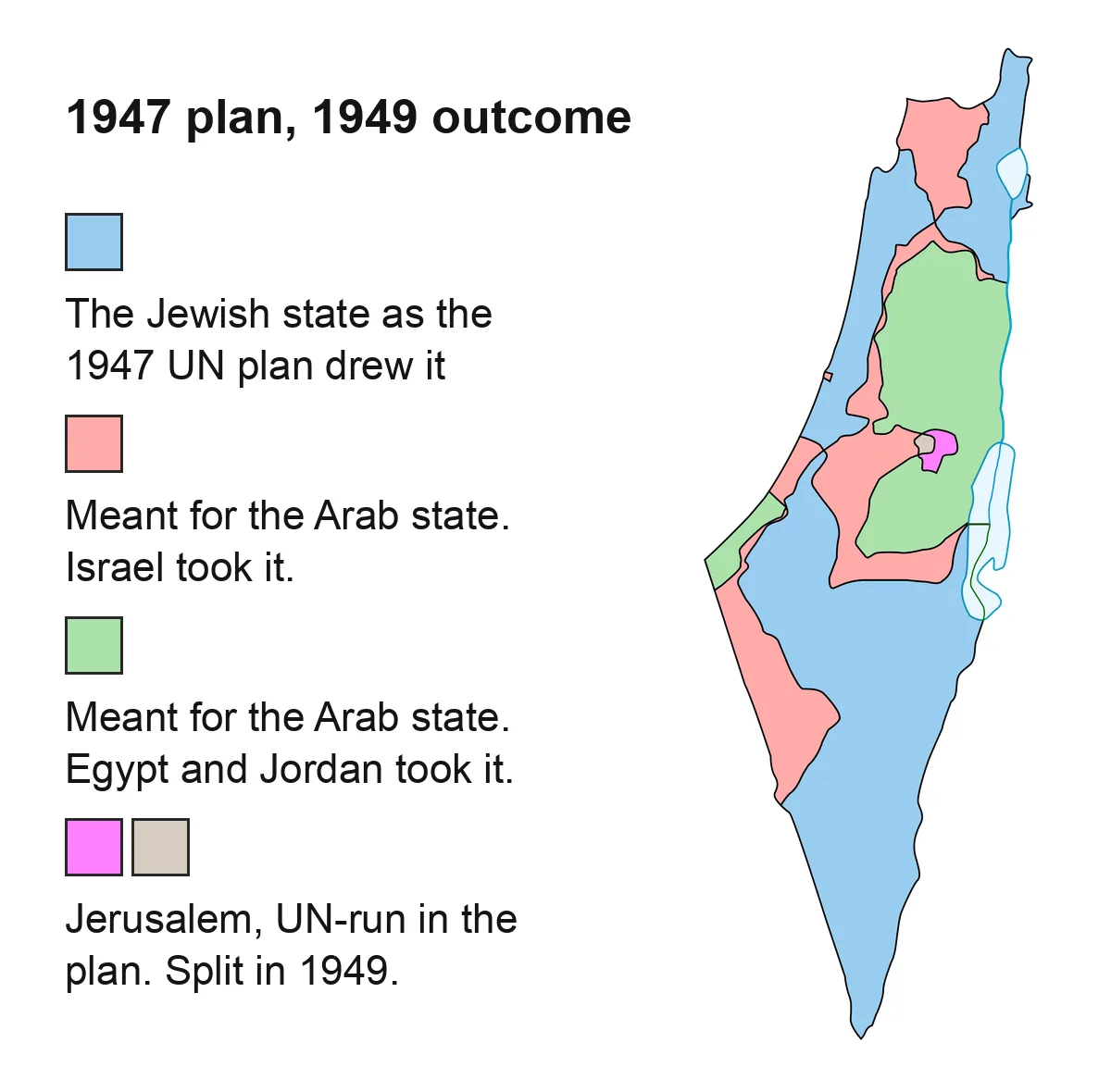
On November 29, 1947, the UN General Assembly voted 33 to 13, with 10 abstentions, to split Palestine into a Jewish state and an Arab state. The Jewish state got 56 percent of the land, though the Jews were a third of the population and much of that share was the Negev desert. Both superpowers voted yes: the United States, and Stalin's Soviet Union, which wanted Britain out of the Middle East and expected the new state to lean socialist. Britain abstained and refused to enforce the plan.
The Jewish Agency accepted the partition. The Arab states and the Palestinian leadership rejected it, on the grounds that no vote in New York could hand most of a country to a third of its people. Civil war began within days, months before any Arab army crossed a border. On April 9, 1948, fighters from two Jewish underground groups, the Irgun and Lehi, killed about 100 villagers at Deir Yassin. The panic that followed emptied whole towns. Haifa and Jaffa fell to Jewish forces before the British had finished packing. By mid-May, some 300,000 Arabs had already fled their homes.
May 14, 1948: a state declared in eight hours
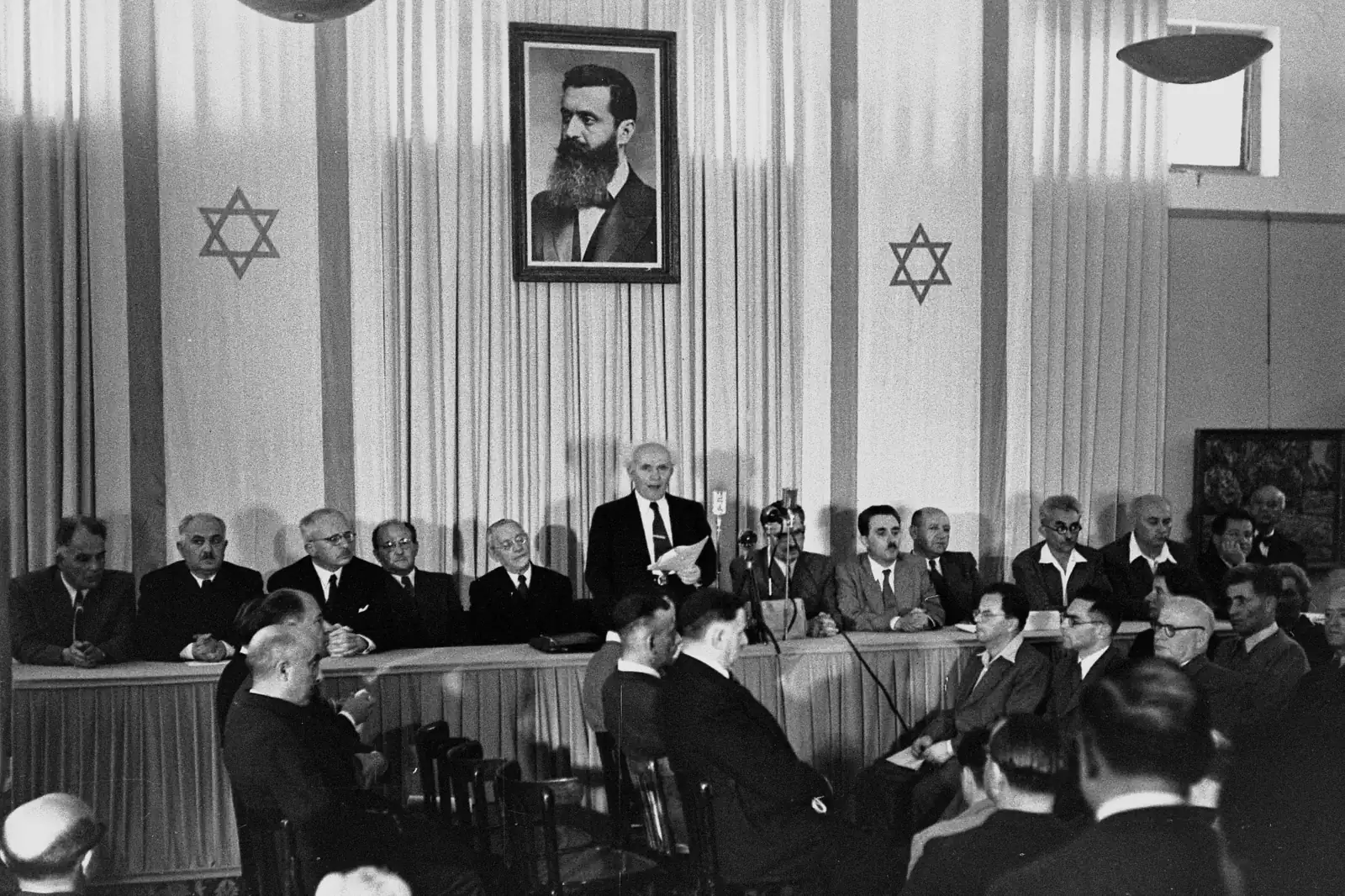
At four in the afternoon on May 14, 1948, David Ben-Gurion stood up in a small art museum on Rothschild Boulevard in Tel Aviv, beneath a portrait of Herzl, and read out the independence of the State of Israel. The text had been argued over until that morning, so the founders signed a blank parchment and the words were added later. At midnight the British Mandate expired and Israel legally existed. Eleven minutes after that, the White House recognized it. President Harry Truman had overruled his own Secretary of State, George Marshall, who had told him to his face that he would vote against him in the next election over it. The next day the armies of Egypt, Transjordan, Syria, Iraq, and Lebanon invaded.
Five armies against a one-day-old state sounds hopeless. In reality, the numbers favored Israel. The Arab states never put much more than 70,000 soldiers into Palestine. Israel had about 30,000 soldiers in May and more than 100,000 by December. Out of a Jewish population of 650,000, that was nearly everyone who could carry a rifle. During a four-week UN truce in June, Israel bought 24,500 rifles, 52 million rounds of ammunition, and 25 fighter planes from Czechoslovakia, with Stalin's approval. By the time the fighting resumed, the Israeli army had doubled in size. In October it broke the Egyptian army in the Negev. Among the Egyptian officers trapped in the encirclement at Faluja was a young major named Gamal Abdel Nasser. Four years later he overthrew Egypt's king.
Independence for one people, catastrophe for the other
The fighting wound down at the end of 1948, and between February and July 1949 Israel signed armistice agreements with Egypt, Lebanon, Jordan, and Syria. They were ceasefires, not borders. The lines, drawn on the map in green pencil, are still called the Green Line. Israel finished the war holding 78 percent of the old Mandate, against the 56 percent the UN had offered it. Around 6,000 Israelis were dead, roughly one percent of the Jewish population. Israelis call 1948 the War of Independence.
Palestinians call it the Nakba, the catastrophe. Roughly 700,000 Palestinians fled or were driven from their homes, more than half the Arab population, and Israel barred them from returning. Researchers have counted 418 villages emptied, most later destroyed. Families locked their doors and kept the keys, sure they would be back within weeks. About 5.9 million of their descendants are still registered as refugees today. And the Arab state the UN had voted for never appeared. The land meant for it was split three ways instead: Israel held part of it, Jordan annexed the West Bank and East Jerusalem, and Egypt took the Gaza Strip. Jordan and Egypt kept their parts until the next big war, in 1967. A second movement of people ran the other way. In the following decades, some 850,000 Jews left or were pushed out of Arab and Muslim countries, and most of them went to Israel. The new state's population doubled within three and a half years.
Why 1948 never ended
Israel became a country in 1948, but the war that made it settled almost nothing else. The borders were never agreed. The refugees were never allowed back and never compensated, and their right of return has helped sink every round of talks, from Oslo to Camp David. And the second state promised in the 1947 partition plan has still never existed for a single day.
The map kept changing the way it was first drawn, by war. Israel fought Egypt over the Suez Canal in 1956. In the Six-Day War of 1967, it captured the West Bank and East Jerusalem from Jordan, Gaza and the Sinai Peninsula from Egypt, and the Golan Heights from Syria. Egypt attacked again in 1973, made peace in 1979, and got the Sinai back. Jordan made peace in 1994. The West Bank and Gaza, the two territories where a Palestinian state could exist, have been the center of the conflict ever since, and every two-state proposal has been an attempt to turn the 1949 Green Line into a real border.
That unfinished business is still running the region. The Gaza war that began in 2023 killed more than 73,000 people by the count of Gaza's health ministry before a ceasefire took hold in October 2025. Saudi Arabia still ties normalization with Israel to progress on Palestinian statehood. Herzl's prediction came true: the state he founded on paper in Basel exists, and it is the strongest military power in the Middle East.
Test what you learned
5 questions on this article. About two minutes, no signup.