
Nuremberg Trials
The Nuremberg trials of 1945-1946 prosecuted senior Nazi leaders for war crimes and crimes against humanity.
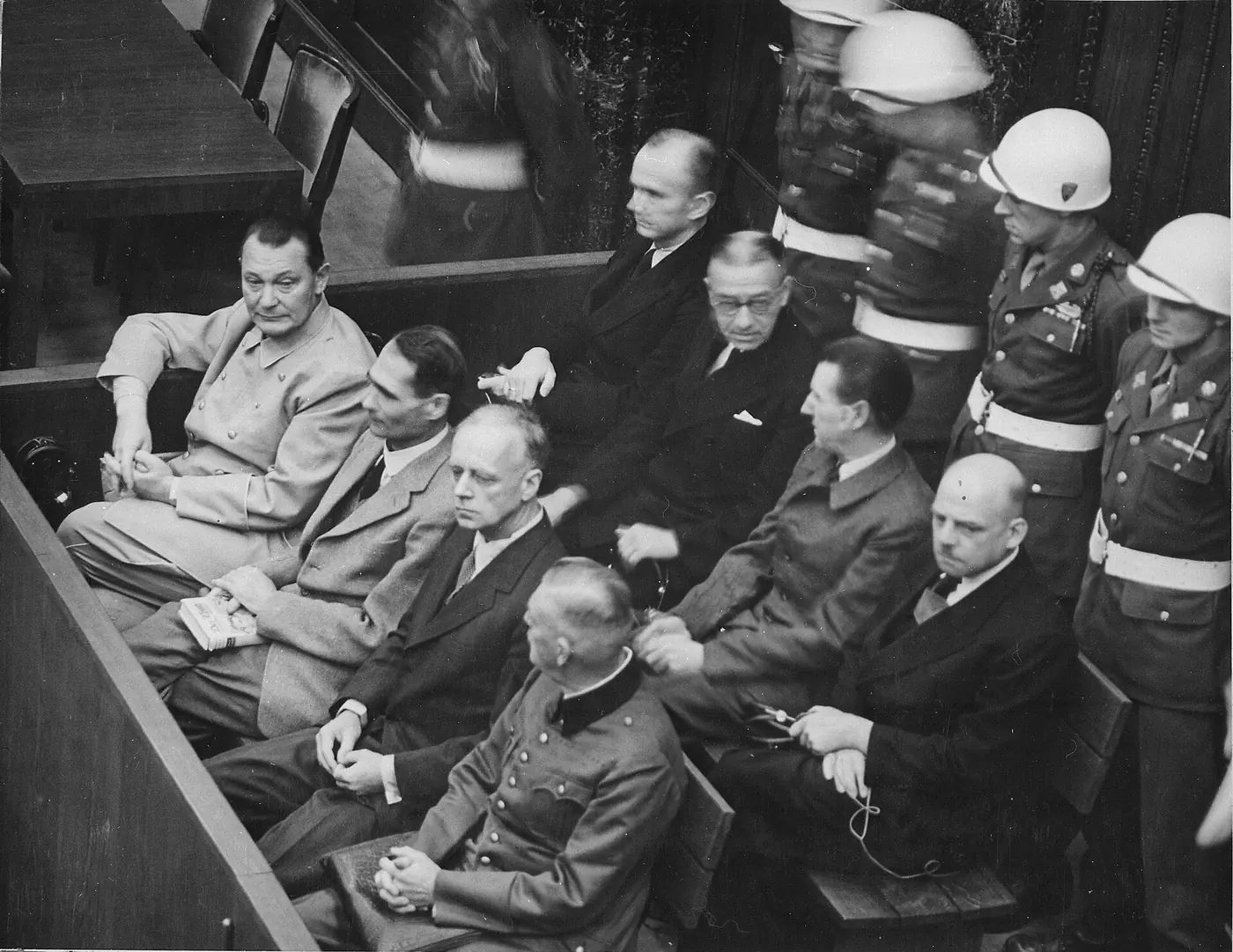
The Nuremberg trials were the first international war crimes tribunal, held in Nuremberg, Germany, from November 1945 to October 1946. The United States, Britain, France, and the Soviet Union prosecuted senior leaders of Nazi Germany for planning aggressive war and carrying out the Holocaust. Twenty-two defendants stood trial on four charges, including the new legal category of crimes against humanity. Twelve were sentenced to death, three were acquitted, and seven received prison terms ranging from ten years to life. The trials established that individual leaders can be held criminally responsible for acts of state, a principle with no clear precedent in international law.
How the Nuremberg tribunal came about
Winston Churchill initially wanted to shoot senior Nazis on identification, without a trial. Stalin suggested that fifty thousand German officers should be shot, a remark that may have been a joke. The push for a courtroom came from the Americans. Secretary of War Henry Stimson, a lawyer by training, argued that shooting prisoners without a trial would look like revenge and would produce no record to hold up against future denial. Supreme Court Justice Robert Jackson agreed and took the lead role as chief prosecutor.
Jackson was an unusual figure for the biggest trial of the century. He never went to college. He learned law as an apprentice in a Jamestown, New York, law office, spent a year at Albany Law School, and passed the bar at 21. He worked his way through the Roosevelt administration, serving as solicitor general and then attorney general before joining the Supreme Court in 1941. President Truman appointed him chief prosecutor at Nuremberg in 1945, and Jackson took a leave from the Court to do it.
Nuremberg was chosen because its courthouse had survived the Allied bombing and had a prison attached. The tribunal opened on November 20, 1945, with judges and prosecutors from all four powers. Jackson built the prosecution around the Germans' own documents rather than survivor testimony. Testimony could be challenged by the defense, but the Nazis' own paperwork could not. The German bureaucracy had kept detailed records of its own crimes, and those records made the case nearly impossible to deny.
The Nuremberg verdicts
Twenty-four men were originally indicted. Robert Ley, the head of the German Labor Front, hanged himself in his cell before the trial began. The industrialist Gustav Krupp was ruled too ill to stand trial. That left twenty-two defendants.
On October 1, 1946, the tribunal delivered its verdicts. Twelve defendants were sentenced to death by hanging. Three were acquitted: the banker Hjalmar Schacht, the diplomat Franz von Papen, and the radio official Hans Fritzsche. The acquittals showed that the tribunal was weighing evidence, not delivering a predetermined result. Seven defendants received prison sentences. Rudolf Hess, Hitler's former deputy, got life. Albert Speer, the armaments minister, got twenty years. Grand Admiral Karl Doenitz got ten.
Hermann Goering, the highest-ranking Nazi captured alive, had been defiant throughout the trial. He was sentenced to death but took a hidden cyanide capsule the night before his scheduled hanging. How he obtained it inside a guarded prison was never fully explained. Martin Bormann, Hitler's private secretary, was sentenced to death in absentia and was later confirmed to have already been dead. The remaining ten condemned men were hanged on October 16, 1946.
What did the Nuremberg trials establish?
The trials created three principles that had no clear precedent in international law. First, a person who commits crimes on behalf of a government can be prosecuted as an individual. Second, obeying an order from a superior does not excuse a war crime, though it can lessen the sentence. Third, certain crimes violate the rights of all people and can be prosecuted even if the government that committed them had authorized them under its own laws.
These principles sat largely unused during the Cold War. For nearly fifty years, no new international criminal tribunal was created. The Nuremberg precedent returned in the 1990s, when the United Nations set up courts for the Yugoslav Wars and the Rwandan genocide. In 2002, the International Criminal Court opened in The Hague as a permanent body to try genocide, war crimes, and crimes against humanity. As of 2026, 125 countries have joined the court. The United States, Russia, China, and India have not.
Were the Nuremberg trials fair?
The strongest criticism of the Nuremberg trials is that they were victors' justice. The judges all came from the four winning powers. Three of the four charges were essentially new law. The defendants were convicted under rules that were not clearly established law at the time of their crimes. The Allies' own actions fell outside the tribunal's jurisdiction, including the firebombing of German cities and the atomic bombings of Hiroshima and Nagasaki.
The Soviet role raised the sharpest contradiction. Soviet judges sat on the tribunal even though the original indictment charged the Germans with the Katyn massacre, the murder of about 22,000 Polish military officers, police, and intellectuals. The Soviets themselves had carried out the Katyn massacre. The tribunal quietly dropped that charge, but the Soviet judges stayed on the bench.
Jackson addressed this criticism in his opening statement. He argued that the willingness of four victorious nations to put their prisoners before a court, rather than execute them, was itself the strongest answer to the charge of revenge. His point was that even an imperfect trial served justice better than a firing squad. The legal framework the Nuremberg trials created is still in use, but it reaches the leaders of defeated countries far more easily than anyone else.