
Gunpowder
Gunpowder is an explosive mixture invented in ninth-century China that transformed warfare and shifted political power to centralized states.
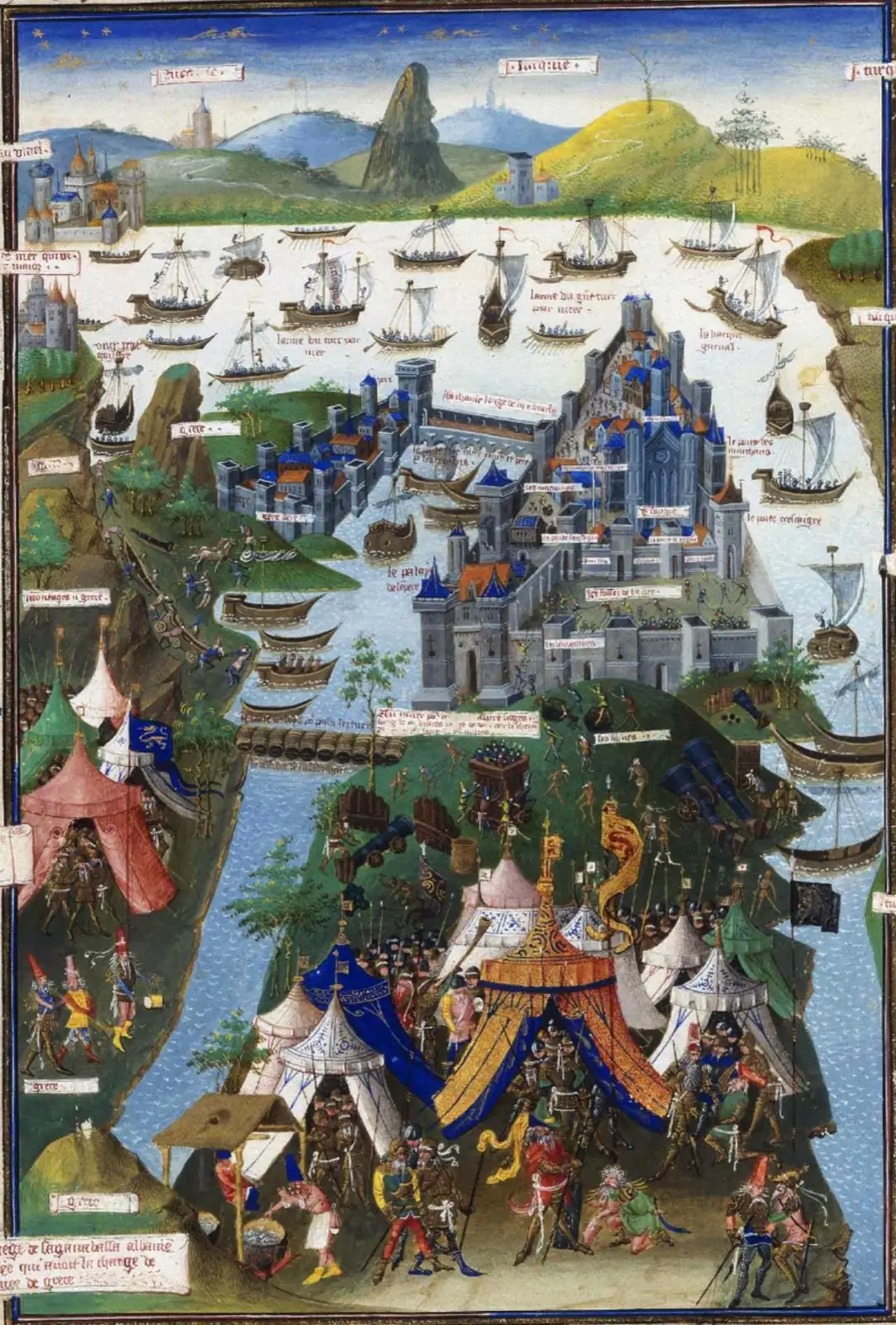
Gunpowder is a mixture of saltpeter (potassium nitrate), sulfur, and charcoal. Chinese alchemists discovered it by accident in the ninth century while searching for an elixir of immortality. It was the first chemical explosive. Before gunpowder, a lord behind a high stone wall could hold off an army for months. Cannon changed that. They could shatter walls that no besieging force had ever breached, and they were so expensive that only central governments could afford them. Gunpowder shifted power away from feudal lords and toward kings and sultans across Europe, the Middle East, and Asia.
How Chinese alchemists discovered gunpowder
Around the ninth century, during the Tang dynasty, Taoist alchemists were trying to create an elixir of immortality. They mixed saltpeter, sulfur, and charcoal, and found that the mixture burned violently. When confined in a container, it exploded. They did not find eternal life. They had discovered the first chemical explosive.
The oldest written formula for gunpowder appears in the Wujing Zongyao, a Song dynasty military manual compiled in 1044. By then, Chinese armies were already using gunpowder in fire arrows and bombs. Over the next two centuries, Chinese engineers developed increasingly powerful weapons, including early guns called fire lances, but none yet had the force to bring down a major stone fortification.
How did gunpowder reach Europe?
The Mongol conquests of the 1200s carried gunpowder knowledge westward. Genghis Khan's empire connected China to Persia and Europe by road and relay station, and merchants, diplomats, and soldiers moved the formula along those routes. The English friar Roger Bacon described a gunpowder formula in his 1267 work Opus Majus, possibly drawing on information that reached Europe through diplomatic contacts with the Mongols. By the 1320s, European metalworkers were casting the first cannon. The earliest documented order for one appears in a 1326 ordinance from Florence, directing the manufacture of brass guns and iron cannonballs.
The early European cannon were small and unreliable. It took another century before they became powerful enough to decide the fate of a city. That test came at Constantinople in 1453.
Gunpowder and the fall of Constantinople
The Theodosian walls of Constantinople had stopped every army that attacked them for a thousand years. The inner wall stood 12 meters high and was reinforced by 96 towers. No besieging force had ever broken through.
In 1453, the Ottoman sultan Mehmed II decided to try what no one else had managed. He was 21 years old. He hired a Hungarian cannon founder named Orban to build the largest gun in the world. Orban had first offered his services to the Byzantine emperor, Constantine XI, but Constantinople's treasury was nearly empty and could not pay him. Orban left for the Ottoman court at Edirne, where Mehmed gave him all the money and materials he asked for. Orban claimed his gun could blast through "the very walls of Babylon itself."
Orban cast a bronze bombard about eight meters long. It fired stone balls weighing around 540 kilograms. Sixty oxen dragged it 230 kilometers to Constantinople. Starting on April 6, the bombard and roughly 70 other Ottoman guns hammered the walls for 53 days. On May 29, 1453, Ottoman soldiers poured through the breaches. Constantinople, capital of the Byzantine Empire since 330 AD, fell in a single day.
How did gunpowder change the world?
The fall of Constantinople showed what a government with enough cannon could do to any fortification. But cannon were ruinously expensive. A full siege train cost more than almost any feudal lord could raise on his own. Usually only a king or sultan with a national tax base could afford one. Cannon, and the professional soldiers trained to use them, ended up in the hands of central governments. A feudal lord who had once been able to close his gates and negotiate from behind stone walls could no longer do so. The period of upheaval that followed, roughly from the 1400s to the 1600s, is what historians call the military revolution.
Three Islamic states rose on the strength of the new weapons: the Ottoman Empire, the Safavid dynasty in Persia, and the Mughal dynasty in India. Historians group them as the gunpowder empires. All three used cannon and muskets to conquer large territories.
When European ships sailed to Africa, India, and the Americas starting in the 1400s, they carried small crews. What made those crews dangerous was the iron cannon mounted on their decks and hauled onto shore. Gunpowder did not cause European overseas expansion on its own, but it gave small expeditionary forces the ability to overpower larger armies that lacked it.
Defense eventually caught up. In the late 1400s, Italian engineers developed a new kind of fortification: low, thick, earth-backed walls with angled bastions that could absorb cannon fire and let defenders cover the approaches from multiple angles. These star forts, called the trace italienne, spread across Europe and its colonies over the next two centuries. Fortifications returned, but in a different form. Only states that could afford both cannon and the new defenses held real military power.