
Hyperinflation
Hyperinflation is the point at which a currency stops working as money, defined as prices rising more than 50 percent in a single month.
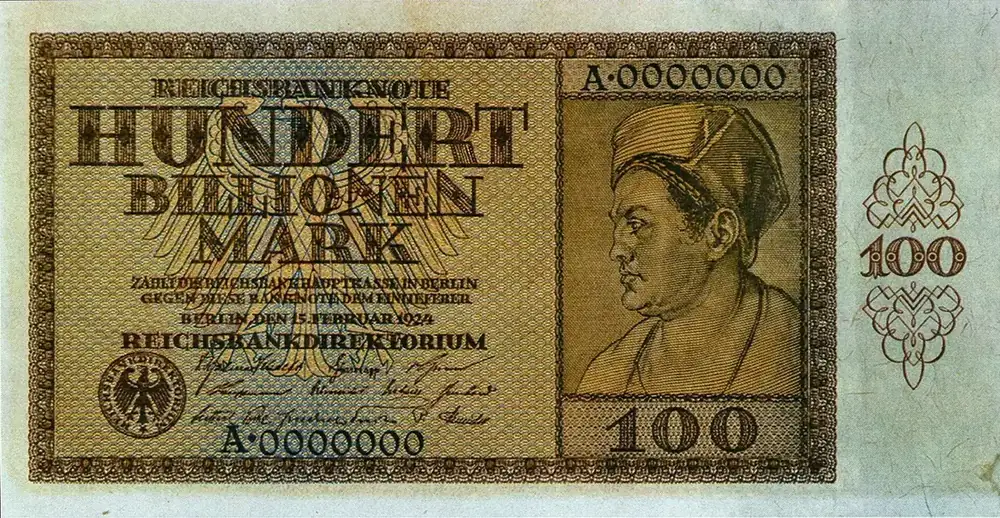
Hyperinflation is the point at which a currency stops working as money. The economist Phillip Cagan set the standard definition in 1956: prices rising more than 50 percent in a single month, which compounds to about 13,000 percent a year. Below that line, a country has a severe inflation. Above it, wages lose their value within hours of being paid, sellers refuse paper currency, and the savings of everyone who held cash are destroyed. Germany in 1923, Hungary in 1946, and Zimbabwe in 2008 are the best-known cases. Every one of them started the same way: a government that could not cover its spending decided to print money instead.
What causes hyperinflation
Every hyperinflation begins with a gap between what a government spends and what it collects in taxes. The gap usually opens after a war, a revolution, or a collapse in a country's main source of income. A government facing that gap has three choices: cut spending, default on its debts, or print money. Printing looks painless at first, because people still accept the newly printed currency at close to its face value.
The crisis begins once people expect prices to keep rising. Holding cash becomes irrational, so people spend it faster. That pushes prices higher, which makes people spend even faster. This feedback loop, driven by the speed at which money changes hands rather than the amount printed, is the difference between a bad inflation and a runaway one.
As inflation accelerates, a government's real tax revenue collapses. Taxes are based on economic activity from the previous quarter, but by the time the government collects them, the currency has lost much of its value. This dynamic is known as the Olivera-Tanzi effect, and it forces the government to print still more money, which drives inflation higher, which shrinks tax revenue again. Because of this cycle, hyperinflations almost never wind down gradually. They end abruptly, when a government introduces a new currency and makes a credible commitment to stop printing.
Hyperinflation destroys the savings of people who hold their wealth as cash, particularly pensioners and salaried workers. People who own land, businesses, or foreign assets are not wiped out. People who owe debts see those debts effectively erased.
Germany's hyperinflation, 1922-1923
Germany's hyperinflation is the most famous case. Germany had financed most of World War I through borrowing rather than taxes. After losing the war, it owed heavy war reparations to the Allied powers. Then, in January 1923, France occupied the Ruhr, Germany's main industrial region, after Germany fell behind on reparations payments. The German government told workers in the Ruhr to go on strike in protest and paid their wages with printed money.
By November 1923, one US dollar was worth 4.2 trillion German marks. Workers were paid twice a day and rushed to spend their wages before the next price increase. Shopkeepers raised their prices several times a day.
The hyperinflation ended within weeks. On November 15, 1923, the government introduced a new currency, the Rentenmark, backed by a claim on German land and industrial assets. The central bank stopped printing money for the government, and the Rentenmark was fixed at 4.2 per dollar, the same rate the mark had held before the war. The speed of the recovery showed that the crisis had been one of confidence. But the savings of millions of ordinary Germans were already gone.
The worst hyperinflations in history
Hungary's hyperinflation in 1945 and 1946 was far worse than Germany's and remains the most extreme ever recorded. At its peak in July 1946, prices roughly doubled every 15 hours. Hungary's currency, the pengő, became worthless and was replaced by the forint.
Zimbabwe's hyperinflation in 2007 and 2008 ranks second. The government's official inflation figure reached 231 million percent in July 2008, after which Zimbabwe's statistics office stopped publishing numbers. Independent estimates put the actual peak far higher. Zimbabwe abandoned its own currency in 2009 and adopted the US dollar.
Yugoslavia experienced hyperinflation in 1993 during the wars that followed its breakup. Venezuela entered hyperinflation after 2016 as oil revenue collapsed under Nicolás Maduro. Venezuela's acute hyperinflation lasted about four years, though the country's annual inflation rate was still around 580 percent in mid-2026.
Did Germany's hyperinflation bring Hitler to power?
It is widely believed that Germany's 1923 hyperinflation put Adolf Hitler in power, but the timeline does not support that. Hitler attempted a coup, the Beer Hall Putsch, in November 1923, at the peak of the crisis. The coup failed, and Hitler was arrested. By 1928, with the hyperinflation five years in the past and the economy recovered, the Nazi party's vote share had fallen below 3 percent.
What brought Hitler to power was the Great Depression, not the hyperinflation. The deflationary crisis that began after 1929 pushed unemployment to nearly a third of the German workforce. That mass unemployment drove voters to the Nazi party, which won 37 percent of the vote in July 1932. Hitler became chancellor in January 1933, nearly a decade after the hyperinflation had ended.
Hyperinflation and modern central banking
The 1923 hyperinflation left a lasting effect on Germany. The experience created a national consensus that economic catastrophe could arrive through the currency, and that preventing inflation was worth significant economic pain. The German central bank, the Bundesbank, made price stability its primary mission for decades. When the European Central Bank was created in 1998, its mandate reflected the same priority, largely because Germany insisted on it.
A crisis that lasted about two years in one country still influences how central banks across Europe set policy more than a century later.