
War Reparations
War reparations are payments a defeated country must make to the winners of a war, most famously after World War I.
War reparations are payments that a defeated country is required to make to the winners of a war, meant to compensate for the damage the war caused. The practice is ancient, but the modern history of reparations starts in 1871, when Germany, freshly unified after its victory in the Franco-Prussian War, imposed an indemnity of five billion gold francs on France. Germany kept soldiers in France until every franc arrived. France finished paying by September 1873, less than three years later, driven in part by a refusal to let German soldiers remain on its territory any longer than necessary. Germany took away one lesson: large indemnities can be collected. France took away another: it was owed something in return. Both shaped what came after World War I, when the Allies imposed reparations on Germany that destabilized Europe for a generation.
How the Allies set Germany's reparations bill
The 1919 Treaty of Versailles held Germany and its allies responsible for all the loss and damage caused by the war. This was Article 231. It was intended as a legal foundation for reparations, but most Germans read it as a statement of sole guilt. They called it the war guilt clause, and it poisoned the politics of reparations before any sum was named.
An Allied commission was given the job of setting the amount. It reported in May 1921 with the London Schedule of Payments: 132 billion gold marks, roughly $33 billion at the time, or about $600 billion today. The figure was split into three categories of bonds, labeled A, B, and C. The A and B bonds, totaling about 50 billion gold marks, were the real obligation. The C bonds made up the rest and were never seriously expected to be collected. They existed largely to satisfy French and British voters who wanted Germany punished. Few Germans grasped the difference. The headline number did the political damage regardless of what the Allies actually intended to collect.
John Maynard Keynes, a 36-year-old British economist, had been part of the British delegation at Versailles. He resigned in protest before the treaty was signed. In 1919 he published The Economic Consequences of the Peace, arguing that the sums demanded were beyond Germany's capacity to pay, and that draining the wealth of Europe's biggest economy would hurt every country connected to it. Later economists have shown that Keynes overstated his economic case. But his read of the political consequences proved accurate: demanding money that a defeated population sees as unjust creates a political crisis whether or not the economics work.
How Germany's reparations collapsed in the 1920s
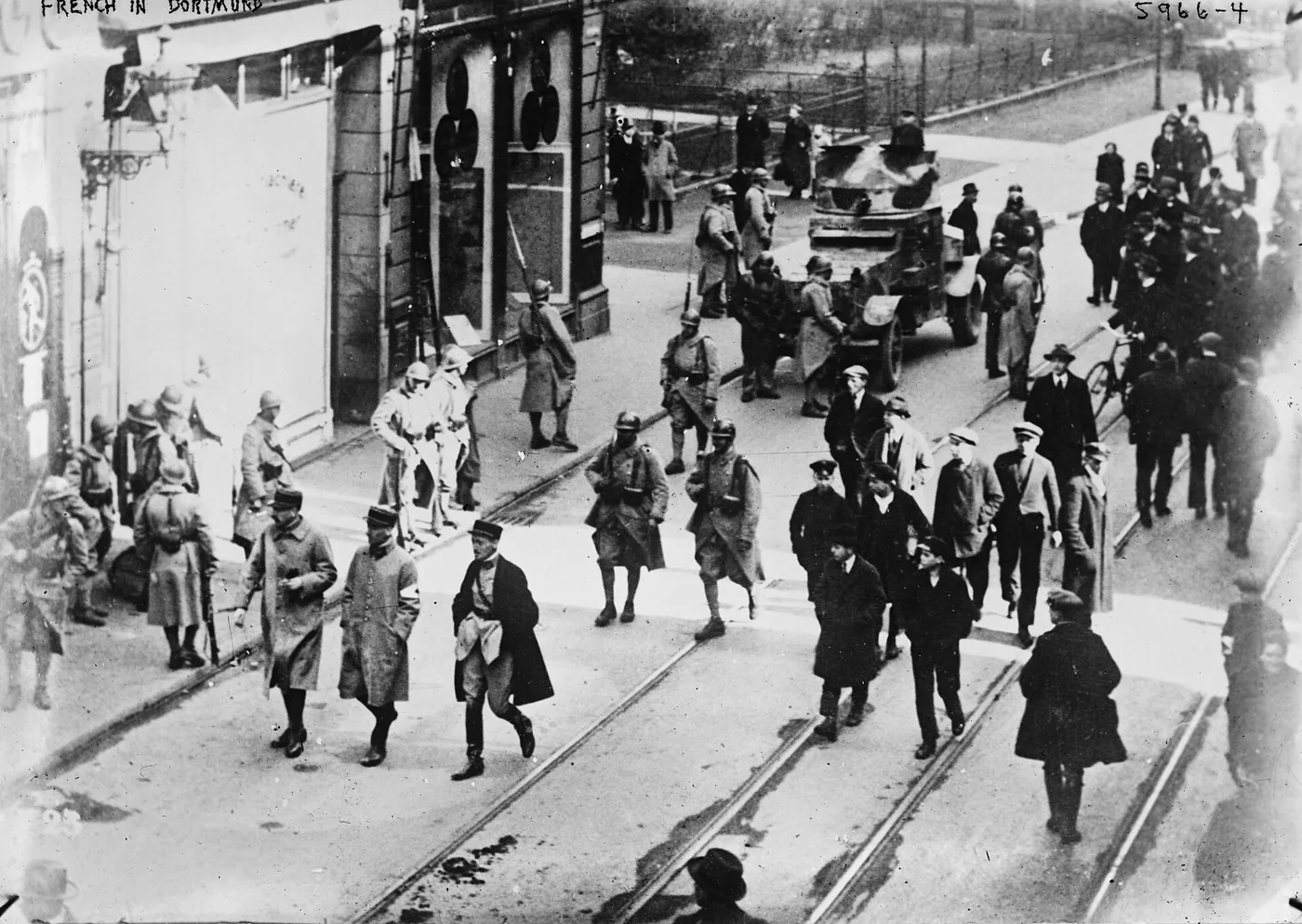
By January 1923, Germany had fallen behind on its scheduled shipments of coal and timber. France and Belgium sent troops into the Ruhr, Germany's industrial heartland, to seize output directly. Ruhr workers refused to cooperate with the occupiers, and the German government covered their lost wages by running the printing presses. The currency collapsed. By November 1923, one US dollar bought 4.2 trillion German marks. The hyperinflation erased the savings of Germany's middle class by the end of the year.
A 1924 agreement called the Dawes Plan restructured Germany's payments and brought in American loans to stabilize the economy. A second agreement in 1929, the Young Plan, cut the amount owed and stretched repayment out to 1988. But both plans depended on a circular flow of money that worked only as long as American banks kept lending. The United States lent money to Germany. Germany sent reparations to Britain and France, who in turn used that money to service their own war debts to the United States. When American lending dried up after the crash of 1929, at the start of the Great Depression, the cycle collapsed. Reparations were suspended in 1932. Adolf Hitler canceled them when he took power the following year.
How much did Germany pay in WWI reparations?
Germany never paid anything close to the 132 billion gold mark headline figure. Before payments stopped in 1932, Germany had covered only a fraction of even the realistic 50 billion mark obligation, and much of what it did pay came from American loans.
The story did not end in 1932. Under agreements reached after World War II, interest on Germany's old reparation bonds was set to resume once the country reunified. When reunification came in 1990, Germany began making those payments. The last installment, roughly $94 million, arrived on October 3, 2010, the twentieth anniversary of reunification and almost 92 years after the World War I armistice.
Why the Allies handled reparations differently after World War II
After World War I, the Allies sent Germany a bill and spent a decade trying to collect it. The effort helped cause hyperinflation, political extremism, and eventually a second world war. After World War II, the victors changed course, at least in the west.
In the east, the Soviet Union stripped German factories and shipped them home. In the west, the United States briefly considered the Morgenthau Plan, which would have deindustrialized Germany. It dropped the idea. Instead, the Marshall Plan sent American money to Germany and the rest of Western Europe. The reasoning was straightforward: a stable, recovered Germany integrated into a Western alliance was more useful to Western Europe than a ruined country making payments it resented.
Reparations have not disappeared. Iraq paid $52.4 billion through a United Nations compensation fund for its 1990 invasion of Kuwait, with the last payment made in January 2022. Claims for reparations for slavery and colonial rule remain active political questions in a number of countries. The failure of World War I reparations remains the most studied case of what goes wrong when victors impose terms a defeated country cannot accept. It is the main reason modern peace settlements rarely demand large payments from defeated states.