
INF Treaty
The INF Treaty, signed in 1987, banned all US and Soviet ground-launched missiles with ranges between 500 and 5,500 km.
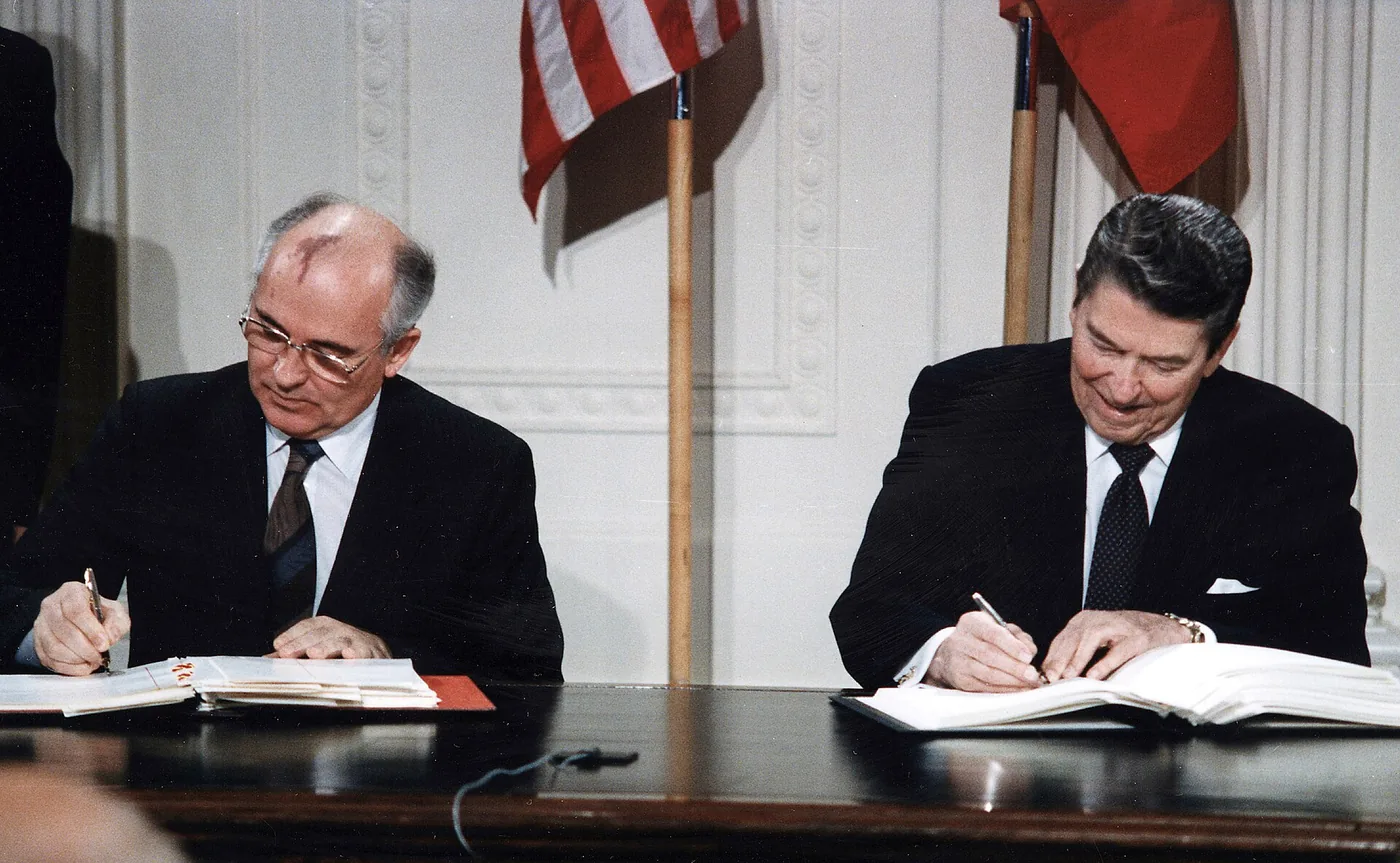
The Intermediate-Range Nuclear Forces Treaty was an arms control agreement signed on December 8, 1987, by US President Ronald Reagan and Soviet leader Mikhail Gorbachev. It required both countries to destroy all ground-launched ballistic missiles and cruise missiles whose range fell between 500 and 5,500 kilometers, as well as their launchers and ground equipment. By the June 1991 deadline, 2,692 missiles had been destroyed: 1,846 Soviet and 846 American. It was the first arms control treaty to eliminate an entire class of nuclear weapons rather than cap their numbers. The treaty also created an unprecedented verification system, with inspectors stationed at each other's missile factories. The United States withdrew on August 2, 2019.
How the SS-20 started a missile crisis in Europe
The crisis that led to the treaty began with a Soviet missile called the SS-20, first deployed in 1976. The SS-20 traveled on a road vehicle, carried three independently targeted warheads, and could strike most cities in Western Europe within minutes. But it could not reach the United States.
That gap created a strategic problem for the alliance. NATO's strategy depended on the idea that a Soviet attack on a European city would be treated as an attack on an American one. A missile that could destroy a city like Hamburg without threatening a city like Chicago put European leaders in doubt about whether Washington would risk American cities to defend European ones.
In December 1979, NATO adopted the "double-track decision": negotiate with the Soviet Union for the removal of these missiles, and if negotiations failed, deploy American missiles of the same class in Europe. Negotiations went nowhere. In 1983, the United States began placing Pershing II ballistic missiles and Gryphon cruise missiles across Western Europe. Soviet leaders feared the Pershing II could strike Moscow in about ten minutes, which gave Soviet planners the same anxiety the SS-20 gave NATO.
The deployments triggered massive peace protests across Western Europe, some of the largest the continent had seen. They also coincided with some of the most dangerous moments of the Cold War. In November 1983, NATO ran a command exercise called Able Archer that some senior Soviet officials apparently interpreted as possible cover for an actual nuclear first strike.
How Reagan and Gorbachev reached a deal
In November 1981, Reagan proposed what he called the "zero option": both sides would eliminate all intermediate-range missiles. Most observers considered the proposal a negotiating position that the Soviet Union would never accept.
Gorbachev accepted it. In October 1986, Reagan and Gorbachev met at a summit in Reykjavik, Iceland, and came close to agreeing to eliminate a far larger set of nuclear weapons. The summit collapsed over disagreements about missile defense, but it opened the path to a narrower deal on intermediate-range missiles alone. The INF Treaty was signed fourteen months later.
The treaty's verification rules went further than any previous arms control agreement. Each side could conduct short-notice inspections of the other's missile sites. Both countries also stationed full-time inspection teams at each other's missile-production plants: American inspectors at Votkinsk in Russia and Soviet inspectors at Magna in Utah. The American team at Votkinsk monitored railcars leaving the factory for thirteen years. Later arms control agreements were built on this verification model.
Why did the United States withdraw from the INF Treaty?
Starting in 2014, Washington charged that Russia had tested a ground-launched cruise missile called the 9M729 at ranges the treaty prohibited. Russia denied the accusation. Russia also argued that US missile defense sites in Romania and Poland were capable of launching offensive cruise missiles, which would itself be a violation. Neither side changed its position. In February 2019, the United States announced its withdrawal, and the treaty ended on August 2 of that year.
China was also a factor. China was never a party to the INF Treaty, and over roughly two decades it built the world's largest force of intermediate-range missiles, including hundreds of DF-21 and DF-26 launchers. A treaty that bound only the United States and Russia while leaving China free to build these weapons looked, to American strategists, like a self-imposed disadvantage in the Pacific.
Intermediate-range missiles after the treaty
Since the treaty ended, the weapons it banned have returned. Russia fired its Oreshnik intermediate-range ballistic missile at the Ukrainian city of Dnipro in November 2024 and has used it again since. The United States deployed Typhon mid-range missile launchers to the Philippines in April 2024 and tested them in Australia in 2025. In July 2024, the United States and Germany agreed to station American long-range missiles in Germany, but the Pentagon canceled the planned deployment in May 2026.
The INF Treaty remains the clearest example that nuclear arms control can work: a class of weapons was built, deployed, feared, and then verified out of existence. It also shows what such agreements require. Both governments had to see the weapons as a problem worth solving, and that condition is harder to meet when three major nuclear powers are involved instead of two.