
Cruise Missile
A cruise missile is a small unmanned aircraft that carries a warhead and flies at low altitude to strike targets hundreds of kilometers away.
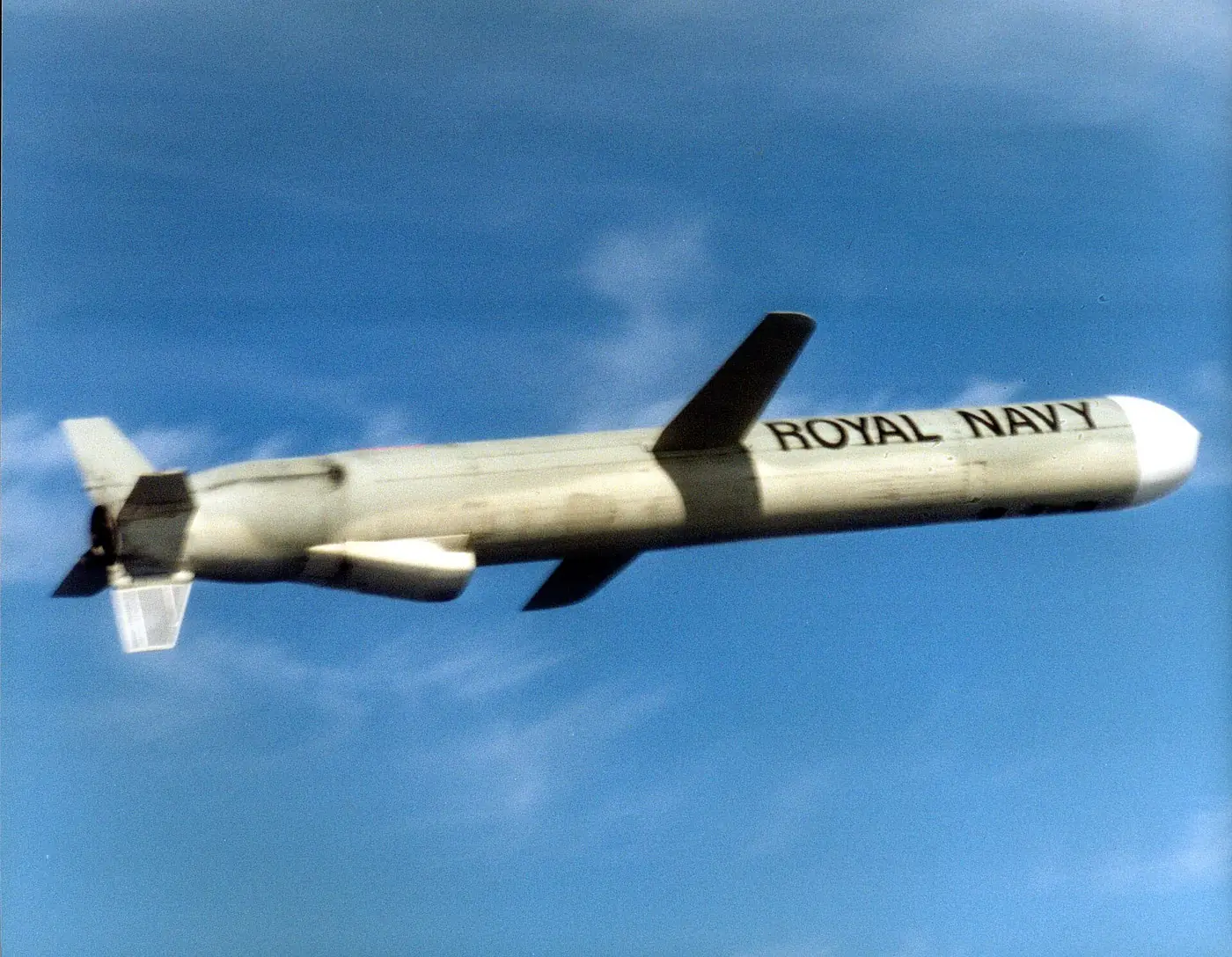
A cruise missile is a small unmanned airplane that carries a warhead instead of a pilot. Unlike a ballistic missile like an ICBM, which flies up out of the atmosphere and falls back down, a cruise missile stays inside the atmosphere for its entire flight. It has wings, a jet engine, and a guidance computer. Most cruise missiles fly below the speed of sound and stay close to the ground, often lower than 100 meters, tracing the landscape to avoid radar. The first cruise missile used in war was the German V-1 of 1944. The most widely known is the American Tomahawk, which entered service in 1983, was first fired in combat during the 1991 Gulf War, and is still in use today.
How the Tomahawk solved the guidance problem
Germany's V-1 flying bomb, first launched in 1944, was the earliest weapon used in war that worked like a cruise missile. The V-1 used a pulse-jet engine and navigated with a gyroscope and a mechanical counter that measured how far it had flown. When the counter reached a preset distance, the engine cut out and the bomb dove into the ground. It could hit a city but not a specific target within it. Germany launched thousands of V-1s at London and Antwerp between June 1944 and March 1945.
It took about thirty years after the V-1 for guidance technology to catch up with the idea. The American Tomahawk cruise missile entered service in 1983 with a navigation system called TERCOM, for terrain contour matching. The missile carried a digital map of ground elevations along its planned route. A radar altimeter measured the terrain below, and the guidance computer matched those readings against the stored map to correct the missile's course. In the final seconds of flight, a camera system compared an image of the target area against stored photographs. Later versions added GPS. The result was a weapon that could hit a single building from over 1,600 kilometers away.
Cruise missiles in the Gulf War
On the night of January 17, 1991, the United States opened the Gulf War by firing Tomahawk missiles at targets in Iraq. Television networks broadcast footage of cruise missiles flying through the streets of Baghdad, and the images became some of the best-known footage of the war. About 288 Tomahawks were fired during the campaign.
The Gulf War showed governments something that mattered as much politically as it did militarily. A cruise missile can be fired from a warship or submarine far offshore, without military bases or overflight permission from other countries. It does not put a pilot at risk of being killed or captured. A strike can be as small as a single missile. During the 1990s, the United States fired Tomahawks at targets in Sudan, Afghanistan, and Iraq in operations that lasted hours, not weeks, and the phrase "limited strike" entered common use. The appeal was as much political as military: cruise missiles removed the two risks that end public support for a military action fastest, dead or captured pilots.
How do cruise missiles work?
A cruise missile launches from a ship, submarine, aircraft, or ground vehicle. Unless it is dropped from an aircraft, a rocket booster accelerates it to flying speed, then a small jet engine takes over and the missile extends its wings. From that point it flies like an unmanned airplane on a pre-planned route.
Most cruise missiles fly below 100 meters, following the shape of the terrain to stay below radar. Modern versions use GPS for navigation but usually carry backup systems in case GPS signals are jammed. The Tomahawk's TERCOM system, for example, can match radar altimeter readings against a stored terrain map without relying on GPS.
A Tomahawk is about 6 meters long with its booster, weighs about 1,500 kilograms, and has a wingspan of about 2.6 meters. Current versions have a range of about 1,600 kilometers and fly at roughly 890 kilometers per hour, just below the speed of sound. They can be retargeted while in flight and can loiter over an area while a commander decides on a target.
Cruise missiles in the 2020s
In 1987 the United States and the Soviet Union signed the INF Treaty, which eliminated all ground-launched missiles, ballistic and cruise, covering ranges from 500 to 5,500 kilometers. The American Gryphon, a ground-launched cruise missile, was destroyed under the treaty. Sea-launched and air-launched weapons were not covered, so the Tomahawk survived. The United States withdrew from the treaty in 2019, and it is no longer in force.
Since Russia's full-scale invasion of Ukraine in 2022, cruise missiles have become a regular weapon of the war. Russia has launched thousands of Kalibr and Kh-101 missiles against targets across Ukraine, including cities and energy infrastructure. Ukraine has used British-supplied Storm Shadow missiles to strike Russian military targets, including ships of the Black Sea Fleet, and has built cruise missiles of its own. In 2024 and 2025, the Houthis in Yemen used cruise missiles and drones against commercial shipping in the Red Sea.
The spread of cruise missiles has created a growing problem for defenders. A modern interceptor missile can cost several times more than the cruise missile it is built to destroy. Attackers can produce cruise missiles faster than defenders can stockpile the interceptors needed to shoot them down. Inexpensive single-use attack drones now serve a similar purpose at lower cost. Long-range cruise missiles were once used almost exclusively by the United States. They are now a standard weapon for dozens of countries and several non-state armed groups.