
Mikhail Gorbachev
Mikhail Gorbachev was the last Soviet leader, whose glasnost and perestroika reforms ended the Cold War and led to the Soviet collapse in 1991.
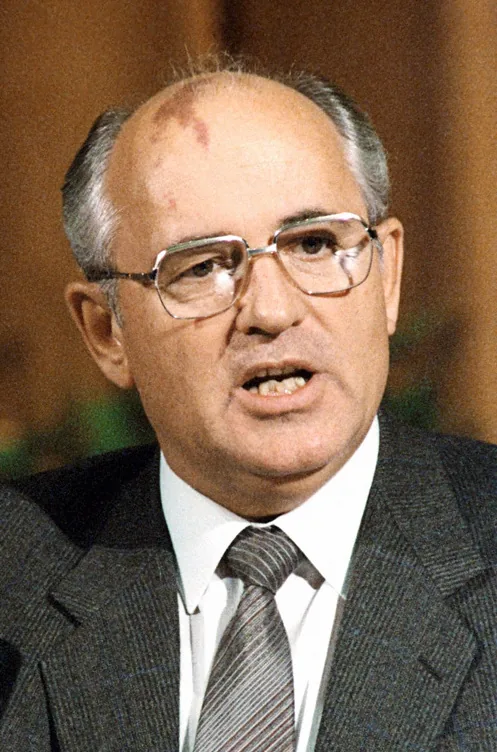
Mikhail Gorbachev was the last leader of the Soviet Union. He came to power in March 1985 at the age of 54, the youngest person to lead the country in decades, and introduced two reforms that became known worldwide: glasnost (openness) and perestroika (restructuring). Glasnost lifted censorship and let Soviet citizens speak freely for the first time in generations. Perestroika tried to loosen central economic planning without abandoning socialism. Gorbachev believed these reforms would save the Soviet system, but they weakened it faster than they could fix it. By December 1991 the Soviet Union had dissolved and Gorbachev had resigned. In 1990 he won the Nobel Peace Prize for his part in ending the Cold War peacefully. He died on August 30, 2022, at 91.
How Gorbachev tried to reform the Soviet Union
Gorbachev was born on March 2, 1931, to a peasant family in the village of Privolnoye in southern Russia. His childhood was shaped by the worst of the Soviet system. Both of his grandfathers were arrested during Stalin's purges, and several relatives died in the famine of 1933. As a teenager he worked driving farm machinery on a collective farm.
He earned a silver medal in high school, good enough to get him into Moscow State University without an entrance exam. There he studied law and met Raisa Titarenko at a student dance. They married in 1953 and remained devoted to each other for nearly 46 years, until Raisa died of leukemia in 1999. Their visible closeness was unusual in Soviet politics, where leaders' wives were rarely seen in public.
After university, Gorbachev returned to the Stavropol region and spent two decades climbing the Communist Party ranks. In 1978 he moved back to Moscow to oversee Soviet agriculture. The Politburo chose him as General Secretary in March 1985. The Soviet Union he took charge of was armed with thousands of nuclear weapons but weighed down by a stagnant economy and a war in Afghanistan it could not win.
Glasnost let newspapers report the truth about Stalin's crimes, the 1986 Chernobyl nuclear accident, and the chronic shortages that left store shelves bare. Perestroika tried to introduce limited market elements into the planned economy. But once people could speak freely, they questioned not just individual policies but the Soviet system itself. And once central planning was loosened, nothing workable replaced it. The reforms Gorbachev designed to save the system made its failures visible and its controls unenforceable.
How Gorbachev ended the Cold War
Gorbachev's foreign policy broke sharply from his predecessors. In December 1987, he and U.S. President Ronald Reagan signed the INF Treaty, the first agreement to eliminate an entire class of nuclear weapons. Under the treaty, the two countries destroyed a combined 2,692 missiles by 1991. In February 1989, Gorbachev withdrew the last Soviet troops from Afghanistan, ending a nine-year war that had killed about 15,000 Soviet soldiers.
The biggest test came later that year. For two decades, Moscow had enforced the Brezhnev Doctrine: any Eastern European country that tried to leave the Soviet bloc would face military intervention. In 1989, Poland held partly free elections, Hungary opened its border with Austria, and East Germans began fleeing west by the thousands. Gorbachev chose not to intervene. His foreign ministry spokesman, Gennadi Gerasimov, told reporters that Moscow now followed a "Sinatra Doctrine," after the Frank Sinatra song "My Way," meaning every country could choose its own path.
On November 9, 1989, the Berlin Wall fell. No order came for Soviet forces to stop it. In 1990 the Nobel Committee awarded Gorbachev the Peace Prize for his leading role in changing relations between East and West.
The forces Gorbachev had set loose were moving faster than he could manage. In August 1991, Communist hardliners launched a coup. They held Gorbachev at his vacation home in Crimea and sent armored vehicles into the streets of Moscow. Within three days the attempt fell apart, undone by public resistance and by Boris Yeltsin, who rallied crowds outside the Russian parliament. Gorbachev returned to Moscow, but real power had shifted to Yeltsin and the leaders of the individual Soviet republics. On December 25, 1991, Gorbachev announced his resignation on television. Shortly afterward, the Soviet flag was lowered over the Kremlin for the last time. The Soviet Union ceased to exist the next day.
Why is Gorbachev praised abroad but blamed in Russia?
In most of the world, Gorbachev is remembered as the leader who ended the Cold War without bloodshed. Western governments and the Nobel Committee honored him for choosing not to use force when he could have.
Inside Russia, many people blame him for the chaos that followed. The 1990s brought hyperinflation, mass unemployment, a drop in life expectancy, and the loss of superpower status. Russians who lived through those years often hold Gorbachev responsible for starting a process he could not control. When he ran for president in 1996, he received about half a percent of the vote.
Gorbachev lived for three decades after leaving office. He ran a foundation, gave lectures around the world, and watched much of what he had worked to build be reversed. He was recognizable everywhere, partly for his fame and partly for the port-wine stain birthmark on his head that Soviet official portraits had edited out. He died on August 30, 2022, in a Moscow hospital, honored across most of the world but not in the country he had once led.