
Niccolo Machiavelli
Niccolo Machiavelli was a Florentine diplomat who wrote The Prince, a guide to how rulers actually gain and keep power.
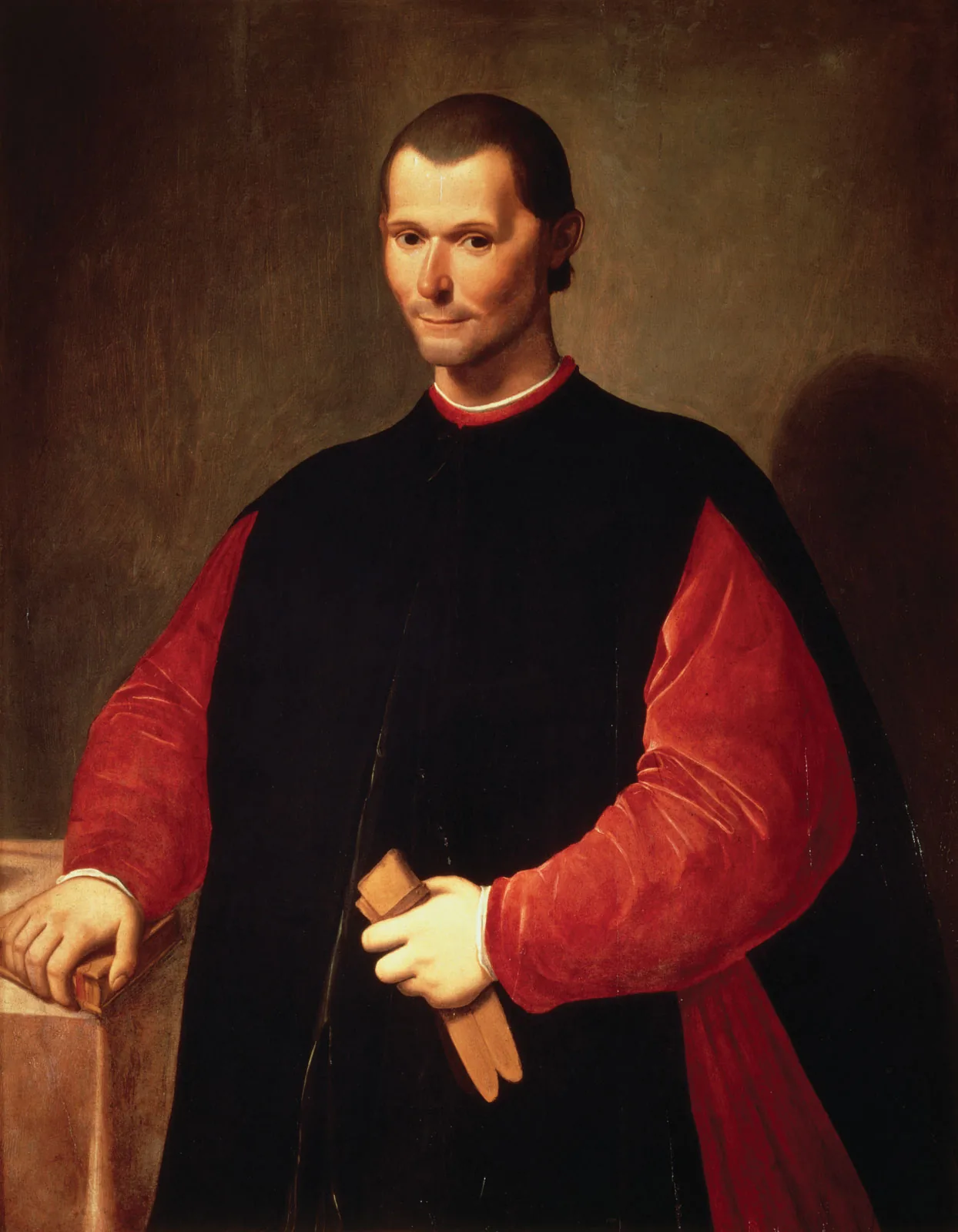
Niccolo Machiavelli (1469–1527) was a Florentine diplomat and political writer best known for The Prince, his short book on how rulers take and keep power. He spent fourteen years as a senior official of the Florentine republic, traveling to the courts of kings and popes and watching how they held their thrones. After the republic fell in 1512, the new government arrested him on suspicion of conspiracy and tortured him six times. He wrote The Prince the following year from a farm outside Florence, drawing on everything he had seen. The Catholic Church banned all of his writings in 1559, and the word "Machiavellian" became an insult meaning cunning and ruthless. He is now considered the founder of modern political science.
Machiavelli's career in Florence
Machiavelli was born in Florence on May 3, 1469, into a family that was respectable but not wealthy. In 1498, at the age of 29, he was appointed secretary of the Florentine republic's second chancery and of the committee that handled war and foreign affairs. The job put him at the center of Florentine diplomacy for the next fourteen years.
He went on missions to the king of France, the Holy Roman Emperor, and the papal court. He watched Cesare Borgia, the son of Pope Alexander VI, seize territory across central Italy through speed, betrayal, and violence. Borgia impressed him deeply and later became a central example in The Prince. Machiavelli also pushed Florence to create a citizen militia to replace the mercenary soldiers the city relied on. He believed mercenaries would never risk their lives for a government that merely paid them. The militia helped capture the rival city of Pisa in 1509.
In 1512, a Spanish army backed by the pope marched on Florence. Machiavelli's militia broke at the town of Prato, and the republic collapsed. The Medici took back control of Florence. Machiavelli was fired in November. Months later, his name appeared on a list of people suspected of plotting against the Medici. He was arrested and subjected to the strappado, a form of torture in which the prisoner's arms are tied behind the back and the body is hoisted into the air, dislocating the shoulders. He endured six drops and maintained his innocence throughout. In March 1513, he was released when Giovanni de' Medici became Pope Leo X and issued a general amnesty.
Machiavelli was sent to a small farm outside Florence. He was 43, out of work, and desperate to get back into politics. He wrote The Prince later that year and dedicated it to Lorenzo di Piero de' Medici, the young ruler of Florence, hoping it would earn him a position. It did not.
What The Prince argues
The Prince is short, roughly 26,000 words. Machiavelli states his purpose plainly: he will deal with how things actually are, not with how they ought to be. Most political writing before him described ideal states and ideal rulers. Machiavelli described real ones.
He built his arguments from examples, mostly from recent Italian history and from ancient Rome. A ruler who is generous will eventually run out of money and have to raise taxes, making his people hate him. A ruler who is merciful at the wrong moment may let a problem grow until it destroys him. A ruler who always keeps his word will be outmaneuvered by rulers who do not.
Several of the book's conclusions became famous. A ruler who cannot be both is better off feared than loved, Machiavelli wrote, because love depends on other people's loyalty, which can shift, while fear depends on the ruler's own actions. A single harsh act, done and finished, causes less suffering than violence spread out over years. Rulers who are armed succeed, and rulers who depend on others for protection fail. Fortune governs about half of events, and preparation and boldness decide the rest.
The Prince circulated in handwritten copies during Machiavelli's lifetime but was not printed until 1532. Machiavelli had died five years earlier, on June 21, 1527. In 1559 the Catholic Church placed all of Machiavelli's works on its Index of Prohibited Books.
Machiavelli's other major works
The Prince is Machiavelli's most famous book, but not his longest. He wrote the Discourses on Livy around the same time, and it runs several times longer. The Prince addresses how one ruler can take and hold power. The Discourses argues that free republics are stronger and more durable than states ruled by a single person. Citizen armies fight harder than mercenaries. The conflict between nobles and common people in ancient Rome was not a flaw but the source of Roman liberty, because it forced both sides to compromise. Republics must be renewed from time to time, pulled back to their founding principles, or they decay.
Machiavelli also wrote The Art of War, a dialogue on military organization, and the Florentine Histories, a history of his city commissioned by Giulio de' Medici, a cardinal who later became Pope Clement VII. His comedy La Mandragola (The Mandrake) is considered one of the best plays of the Italian Renaissance and is still performed today.
What does "Machiavellian" mean?
The word "Machiavellian" means cunning, manipulative, and willing to use deception to gain power. It has been used as an insult since the sixteenth century, and it comes directly from The Prince's argument that rulers sometimes have to lie, break promises, and use force to hold their states together.
The label is not entirely fair. Machiavelli did not celebrate cruelty or deception. He described them as tools that rulers use, and he judged those tools by their results. He spent much of The Prince warning about the dangers of being hated, and he argued in the Discourses that republics produce better outcomes than tyrannies.
But the label is not baseless either. Machiavelli did insist that the moral rules of private life do not work unchanged in government. A leader who refuses to act harshly when the situation demands it may put the state at risk. That idea has served both cautious leaders trying to avoid catastrophe and ambitious ones searching for justification.
Machiavelli was the first major modern writer to study politics as it is practiced rather than as it should be practiced. Every realist thinker who came after him, from Clausewitz to Morgenthau, built on that approach: analyzing states and leaders by what keeps them in power rather than by what they claim to believe.