
Renaissance
The Renaissance was a movement from about 1330 to 1600 that began in Italy, recovered ancient ideas, and reshaped European art, scholarship, and politics.
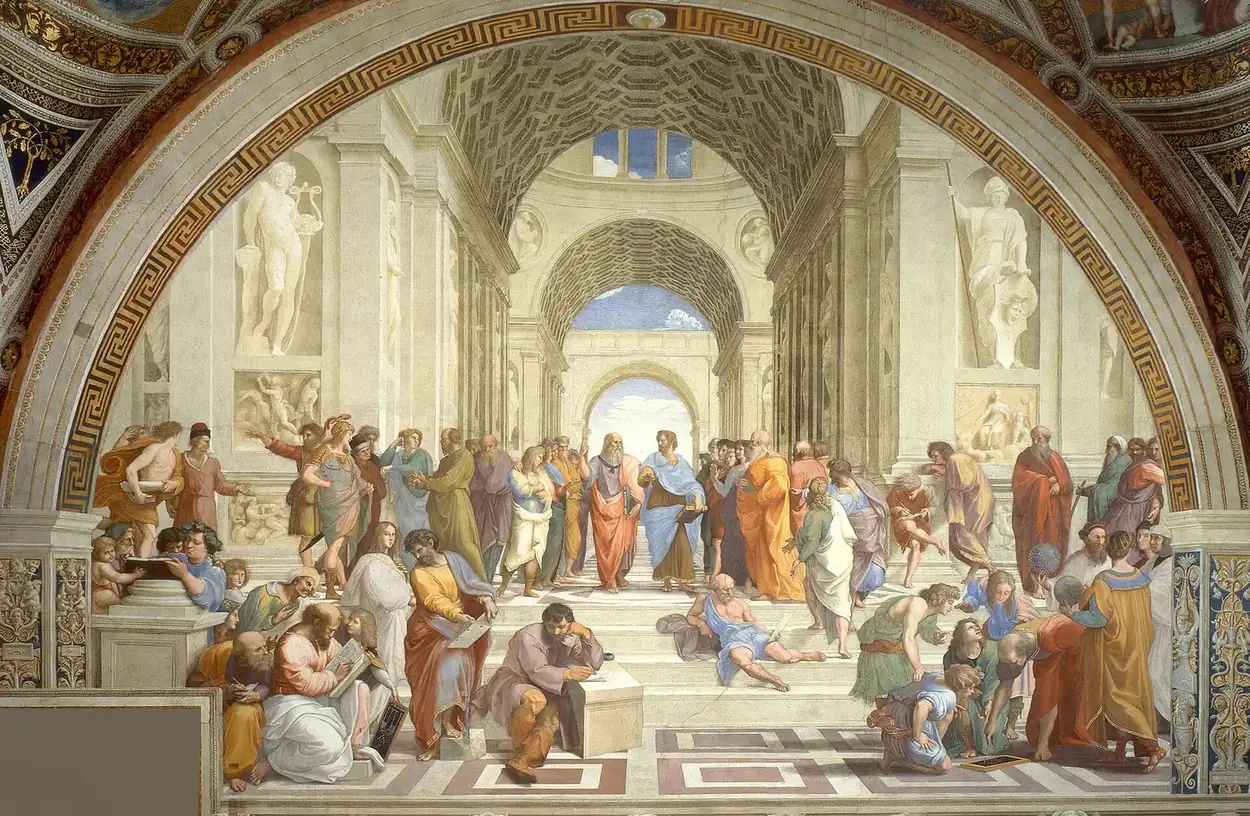
The Renaissance was a cultural movement that began in northern Italy around 1330 and spread across Europe over roughly three centuries. The word means "rebirth," and the people who used it believed they were recovering the knowledge of ancient Greece and Rome after a thousand years of neglect. The movement reshaped European art, from Botticelli's paintings to Michelangelo's ceiling in the Sistine Chapel. But its most lasting product was a way of thinking: find the original text, read it yourself, and decide whether the standard account of it is accurate. Over the following centuries, that approach helped bring about the Reformation, the rise of modern science, and the Enlightenment.
How the Renaissance took shape in Florence
The Italian poet Francesco Petrarch, who lived from 1304 to 1374, is often called the father of the Renaissance. He traveled across Europe collecting crumbling Latin manuscripts, including lost letters by Cicero, and argued that the ancient world had understood things the Middle Ages had forgotten. In 1341 Petrarch was crowned Poet Laureate in Rome, a revival of an ancient Roman honor that had not been awarded in Rome in centuries. The generation of scholars he inspired built a new course of study they called the studia humanitatis. Its five subjects were history, poetry, moral philosophy, rhetoric, and grammar, each taught from ancient texts in the original Latin or Greek.
Florence became the center of this new learning. The city's wealth came from wool and banking, and no family spent more of it on art and scholarship than the Medici. Cosimo de' Medici, who took control of Florence in 1434, supported artists like the sculptor Donatello and the architect Filippo Brunelleschi. Cosimo's grandson Lorenzo, known as "the Magnificent," later supported Botticelli, Leonardo da Vinci, and Michelangelo. Competition between Italian cities helped the movement spread. An artist who fell out of favor in one city could find work in another, so talent and ideas moved freely across the peninsula.
How Renaissance scholars challenged inherited claims
The humanists' most powerful idea was a principle called ad fontes, meaning "to the sources." The idea was straightforward: find the original document, read it in the language it was written in, and decide whether the accepted interpretation matches what the author actually said.
In 1440, the Italian scholar Lorenzo Valla used this method on the Donation of Constantine, a document the papacy cited to claim authority over the western Roman Empire. Valla proved the Donation was a forgery. The Latin in the document used words and grammatical forms from the eighth century, not the fourth century when Emperor Constantine lived. The Church could not answer the argument. Within a century, the same method of checking original sources was being used to question the Church's own teachings.
Two developments made the recovery of ancient knowledge permanent. First, Greek scholars and manuscripts moved west as the Byzantine Empire shrank and finally fell to the Ottoman Turks in 1453. They brought works by Plato that western Europe had not had access to for centuries. Second, the printing press, which spread through Europe after about 1450, meant that a recovered text could be copied by the thousands instead of being lost to a single fire.
Why did the Renaissance start in Italy?
Italy had three advantages that no other part of Europe could match at the time. First, Italian cities sat on the major trade routes between Europe and Asia. Venice, Genoa, and Florence had grown rich from that trade, and their wealth created a class of merchants and bankers who could afford to pay for art and scholarship.
Second, Italy was politically fragmented. Unlike France or England, which had strong central monarchies, Italy was divided among a dozen competing city-states. That competition drove patronage. Rulers who could not claim royal bloodlines tried to prove their worth by building libraries, commissioning paintings, and attracting the best scholars in Europe.
Third, Italy was where the Roman Empire had been. Ancient ruins and inscriptions were closer at hand than anywhere else in Europe. The combination of trade wealth, political competition, and closeness to the ancient past made Italy the place where the Renaissance could begin.
What the Renaissance changed
The Italian city-states gave Europe more than art. In 1450, the Duke of Milan had one of the first permanent resident ambassadors in Florence, a diplomat who lived in a foreign capital, sent regular reports home, and managed negotiations continuously instead of visiting once for a single purpose. Every modern embassy descends from this Italian practice.
Machiavelli, writing in Florence in the early 1500s, applied the humanist method to politics. Instead of asking what a ruler ought to do, he studied what rulers actually did and what worked. His approach treated power as something to be understood and used, not as a gift from God.
None of this made Europe more peaceful or free. The movement's greatest sponsors were wealthy bankers and popes. The fifteenth century, its most productive era, ended with French and Spanish armies fighting across Italy, and the same period saw the Inquisition and the beginnings of the Atlantic slave trade. What the Renaissance left behind was a single powerful assumption: that the world operates by discoverable rules, and that inherited claims deserve to be tested against original evidence. When later thinkers turned that assumption toward ancient texts, they built modern scholarship. When they turned it toward nature, they built modern science. When they turned it toward government, they built the modern state.