
Holy Roman Empire
The elected empire that governed central Europe for a thousand years, from Charlemagne's coronation to Napoleon's conquest.
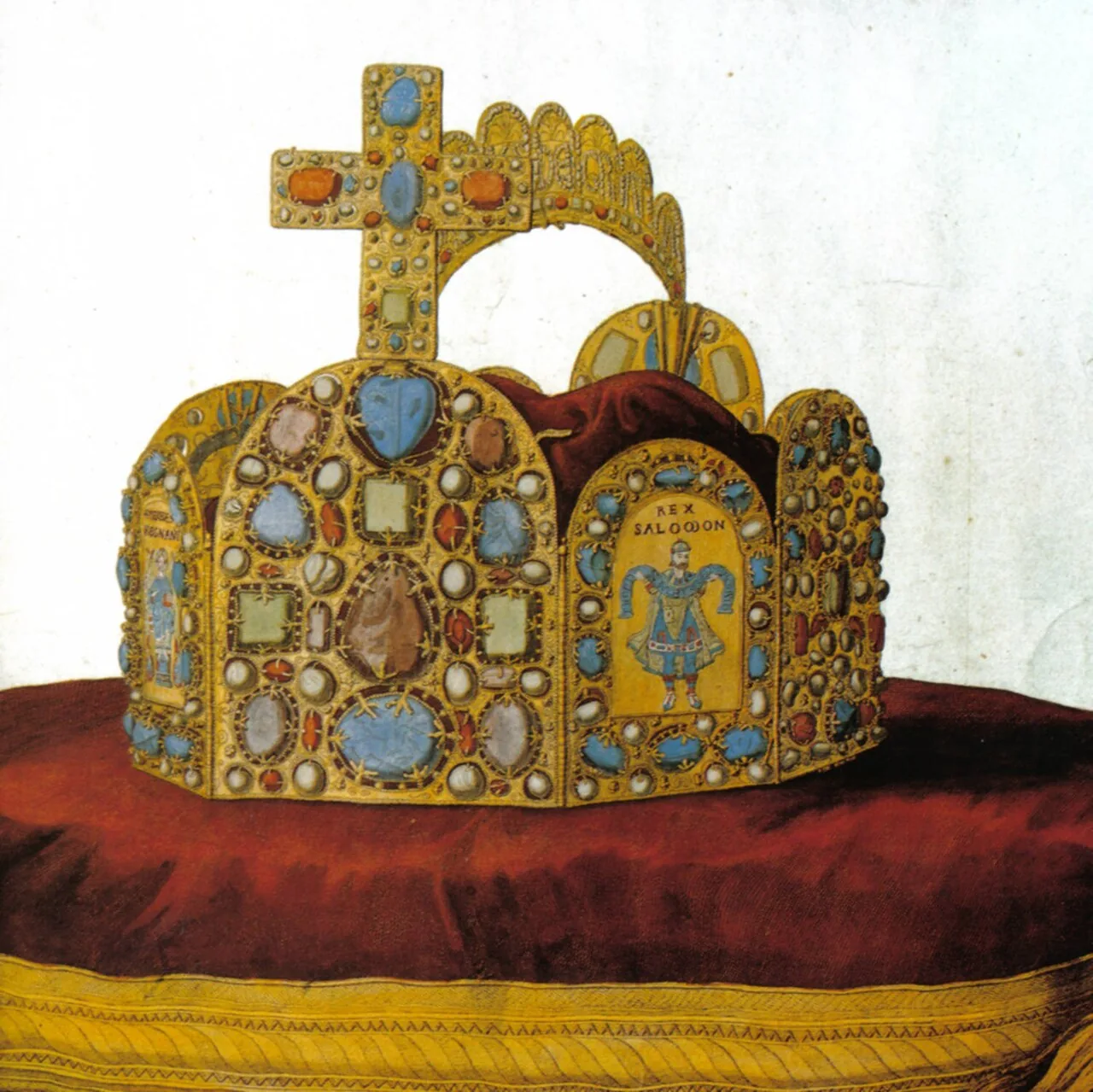
The Holy Roman Empire was the political structure that governed most of central Europe for roughly a thousand years, from 800 to 1806. It had an elected emperor and, beneath him, hundreds of territories: principalities, duchies, bishoprics, and self-governing cities, each running its own affairs. The empire was not a country. It had no capital and no standing army. Its people spoke German, Czech, Italian, Dutch, French, and Slovene. In 1756, Voltaire wrote that it was "neither holy, nor Roman, nor an empire." By his century he had a point. But for most of its life the empire provided something rare: a shared legal order that let small states survive alongside powerful ones.
How the Holy Roman Empire worked
Most histories begin the empire on December 25, 800, when Pope Leo III crowned Charlemagne emperor in Rome. The coronation brought back a title that no one in western Europe had held since the fall of Rome in 476. But the empire as a continuous institution began in 962, when Otto I received the imperial crown in Rome. From that point on, the claim to the title belonged to whoever held the German crown. The emperor's claim was to be the highest secular authority in Christian Europe, the worldly partner of the pope.
The crown was elected. The Golden Bull of 1356 fixed the rules: seven prince-electors chose each new emperor. Three were archbishops (Mainz, Trier, and Cologne) and four were secular rulers (Saxony, the Palatinate, Brandenburg, and Bohemia). Because the emperor needed their votes, he could never simply give orders. Emperors gained power by bargaining, bribing, and marrying into the right families.
From 1438, the Habsburg dynasty held the imperial title almost without interruption, though they still had to negotiate with the princes like every emperor before them. Below the emperor sat an imperial diet where princes and cities debated policy, and imperial courts where a small bishopric could bring a case against a powerful duchy.
Why was it called the Holy Roman Empire?
The name came together in stages. "Roman" was the oldest part. When the pope crowned Charlemagne in 800, he was reviving the title of the Roman emperors, linking the new empire to the authority of ancient Rome. "Holy" came later. Emperor Frederick Barbarossa's court first used the Latin phrase "sacrum imperium" (holy empire) in 1157, tying the emperor's authority to God and the Church. The full title "Holy Roman Empire" appeared in official documents from the 1200s.
"Empire" was always the loosest fit. The emperor's real power depended on how much his princes were willing to give him, and after the 1600s that was very little. Voltaire's famous line captured the state of things in his own century. But when the name was first used, each word in it had a genuine claim.
How the Reformation and the Thirty Years War weakened the empire
The Reformation broke what religious unity the empire had. Once princes could choose between Catholicism and Protestantism, religion became inseparable from territorial politics. The Peace of Augsburg in 1555 tried to settle the problem: each prince could set the official religion of his own territory. The compromise kept the peace for about sixty years.
Then it collapsed. The Thirty Years War lasted from 1618 to 1648 and killed roughly 20 to 40 percent of the population in German lands. Some regions lost more than half their people to fighting, famine, and disease. Spain, Sweden, France, and Denmark all sent armies into the empire.
The Peace of Westphalia ended the war in 1648 and is often called the birth of the modern state system. Under its terms, princes gained the right to sign treaties and form alliances on their own. The imperial title and the imperial courts survived, but real power moved to roughly three hundred separate territories.
How did the Holy Roman Empire end?
Napoleon ended it. In December 1805, he defeated the Austrian and Russian armies at the Battle of Austerlitz. The following July, he pulled sixteen of the empire's member states into a new alliance called the Confederation of the Rhine, under French protection. Those states formally withdrew.
On August 6, 1806, Emperor Francis II gave up the imperial title and released all remaining states from their obligations, partly to prevent Napoleon from claiming the crown for himself. Francis kept his separate title as Emperor of Austria, which he had created two years earlier. A political structure that had lasted a thousand years ended with a written declaration.
Why the Holy Roman Empire still matters
Because central Europe spent centuries as hundreds of small states rather than one centralized kingdom, it developed a lasting culture of federalism and local authority. Germany did not unify as a single country until 1871, under Bismarck. Today Germany is a federal republic with real power in its sixteen states, the Länder, and a deliberately weak central government. Dozens of cities that were once independent capitals still have their own universities, orchestras, and museums.
Some scholars have noticed a resemblance between the European Union and the Holy Roman Empire: a structure of overlapping authority, shared law, and negotiated sovereignty among states that keep their own identities. The comparison is imperfect, but the pattern is real. The empire showed, across a thousand years, that a large and diverse region can hold together through negotiation and shared law rather than centralized force.