
Manifest Destiny
Manifest Destiny was the 1840s belief that the United States was meant by God to expand from the Atlantic to the Pacific Ocean.
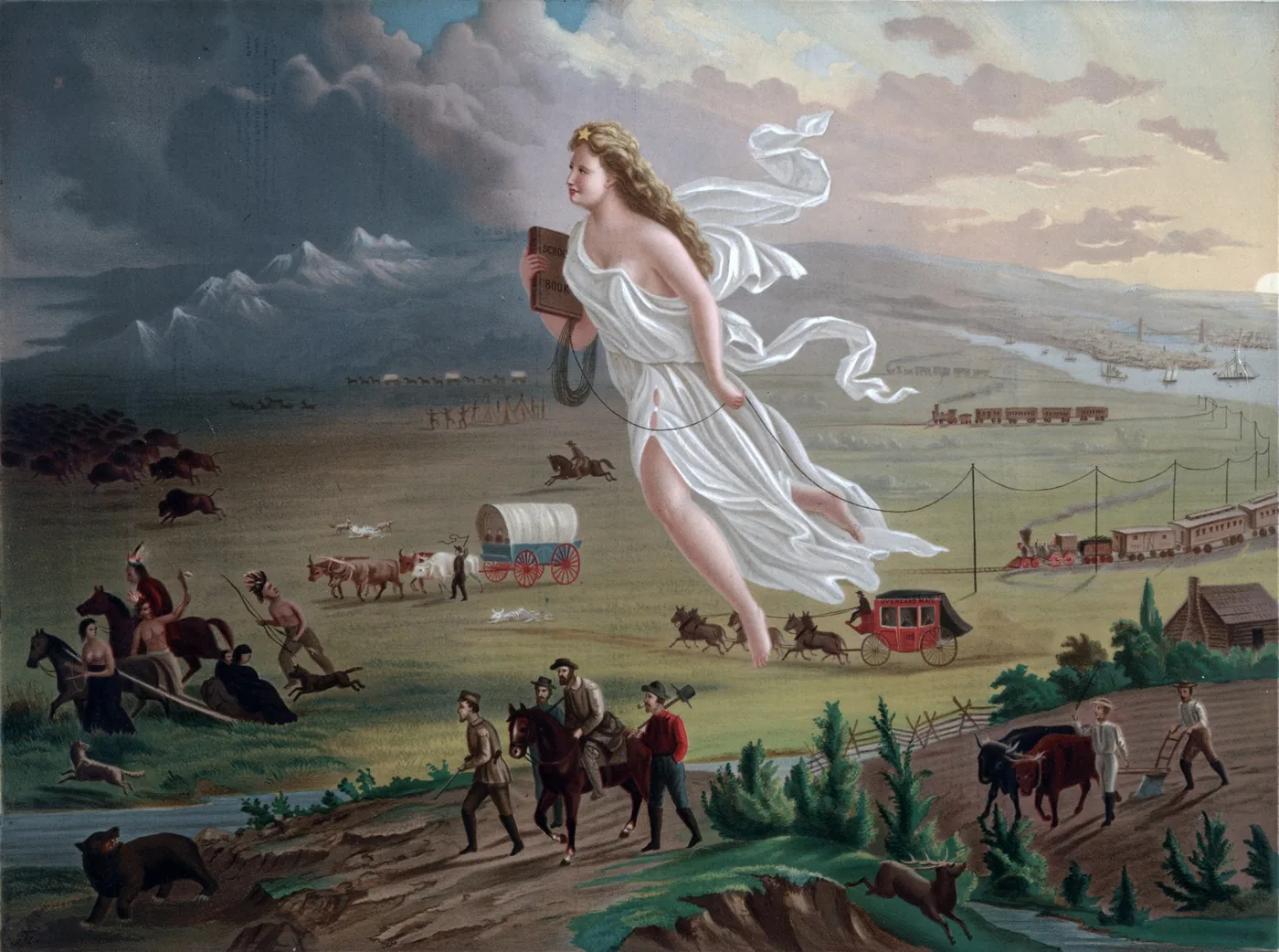
In 1845, a New York journalist named John L. O'Sullivan wrote that it was America's "manifest destiny to overspread the continent." The phrase named a belief already taking hold: that God intended the United States to stretch from the Atlantic Ocean to the Pacific. The idea drew on three sources: national pride, a Protestant faith that God was on America's side, and a racial claim that white Anglo-Saxon settlers had a right to the continent. Within three years of O'Sullivan's article, the United States had annexed Texas, settled the Oregon boundary with Britain, and won a war against Mexico that added more than 525,000 square miles of new territory. The expansion cost Native nations their lands and their lives, and it opened the fight over slavery that helped cause the Civil War.
Who coined the term "Manifest Destiny"?
John L. O'Sullivan coined the phrase in an article titled "Annexation" in the July-August 1845 issue of the United States Magazine and Democratic Review. O'Sullivan was arguing for the annexation of Texas. America, he wrote, had a "manifest destiny to overspread the continent." Providence had given the land to the nation's "yearly multiplying millions," and no foreign government had the right to stand in the way.
O'Sullivan was born at sea off the coast of Gibraltar in 1813, studied at Columbia College, and founded the Democratic Review while still in his twenties. He later served as a U.S. diplomat in Portugal.
The idea that the country had a special claim to the continent was older than the phrase. The Monroe Doctrine of 1823 had warned European powers to stay out of the Western Hemisphere, and President Andrew Jackson had forced Native peoples from the Southeast in the 1830s. O'Sullivan's contribution was a two-word label that made expansion sound not just desirable but inevitable.
How the United States reached the Pacific
The president who acted on Manifest Destiny most directly was James K. Polk. A former Speaker of the House and governor of Tennessee, Polk won the 1844 election as the first "dark horse" presidential candidate in American history. He was 49 years old and promised to serve only one term. He set four goals for his presidency. Two of them were about acquiring new territory: Oregon from Britain and California from Mexico.
In 1845, Congress voted to annex Texas, which had been an independent republic since breaking from Mexico in 1836. Mexico considered the annexation theft and refused to recognize it. In 1846, after a border dispute along the Rio Grande, the two countries went to war. The Mexican-American War lasted two years. The Treaty of Guadalupe Hidalgo, signed on February 2, 1848, ended it. Mexico gave up more than 525,000 square miles, including present-day California, Nevada, Utah, most of Arizona, and parts of New Mexico, Colorado, and Wyoming. The United States paid Mexico $15 million, about $630 million in today's money. Nine days before the treaty was signed, a carpenter named James Marshall had discovered gold at Sutter's Mill in California, though neither government knew it yet.
In 1846, Polk also settled the Oregon boundary with Britain at the 49th parallel, despite his supporters' slogan "Fifty-Four Forty or Fight," which demanded territory much farther north. By 1848, the borders of the United States stretched to the Pacific.
The expansion depended on taking land from Native peoples. Treaties with Native nations were broken as soon as settlers wanted the land they covered. Entire communities were confined to reservations or wiped out.
How Manifest Destiny helped cause the Civil War
Every new territory the United States gained raised the same question: would slavery be allowed there? In August 1846, while the Mexican-American War was still being fought, a Pennsylvania congressman named David Wilmot proposed banning slavery in any territory taken from Mexico. The Wilmot Proviso passed the House but failed in the Senate, and the debate split Congress along North-South lines.
The Compromise of 1850 tried to settle the question by admitting California as a free state and leaving the status of the remaining territories to their settlers. It held for four years. Then the Kansas-Nebraska Act of 1854 opened Kansas to a popular vote on slavery, and armed settlers from both sides rushed in. Seven years later, in 1861, the country went to war over the same question.
Manifest Destiny was supposed to unite the country through expansion. Instead, the territory it added forced Americans to decide whether slavery would spread, and the failure to agree led to the Civil War.
Manifest Destiny after the frontier closed
In 1890, the Census Bureau declared that the American frontier no longer existed as a continuous line. The continent was settled. But Americans did not stop expanding when they reached the coast.
In 1898, the Spanish-American War gave the United States the Philippines, Puerto Rico, and Guam. The United States also gained effective control over Cuba and annexed Hawaii. Politicians no longer spoke of overspreading the continent. Instead they talked about a "civilizing mission" and "the white man's burden." The argument echoed what O'Sullivan had written in 1845: that American expansion was not just permitted but required by God.
American exceptionalism, the idea that the country has a unique mission in the world, carries on ideas from Manifest Destiny. O'Sullivan's phrase allowed Americans to describe conquest as something that was meant to happen. That framing shaped how the country understood its growth and its place in the world long after the frontier closed.