
Marcus Aurelius
Marcus Aurelius was a Roman emperor, Stoic philosopher, and author of the Meditations, a private journal on how to live well.
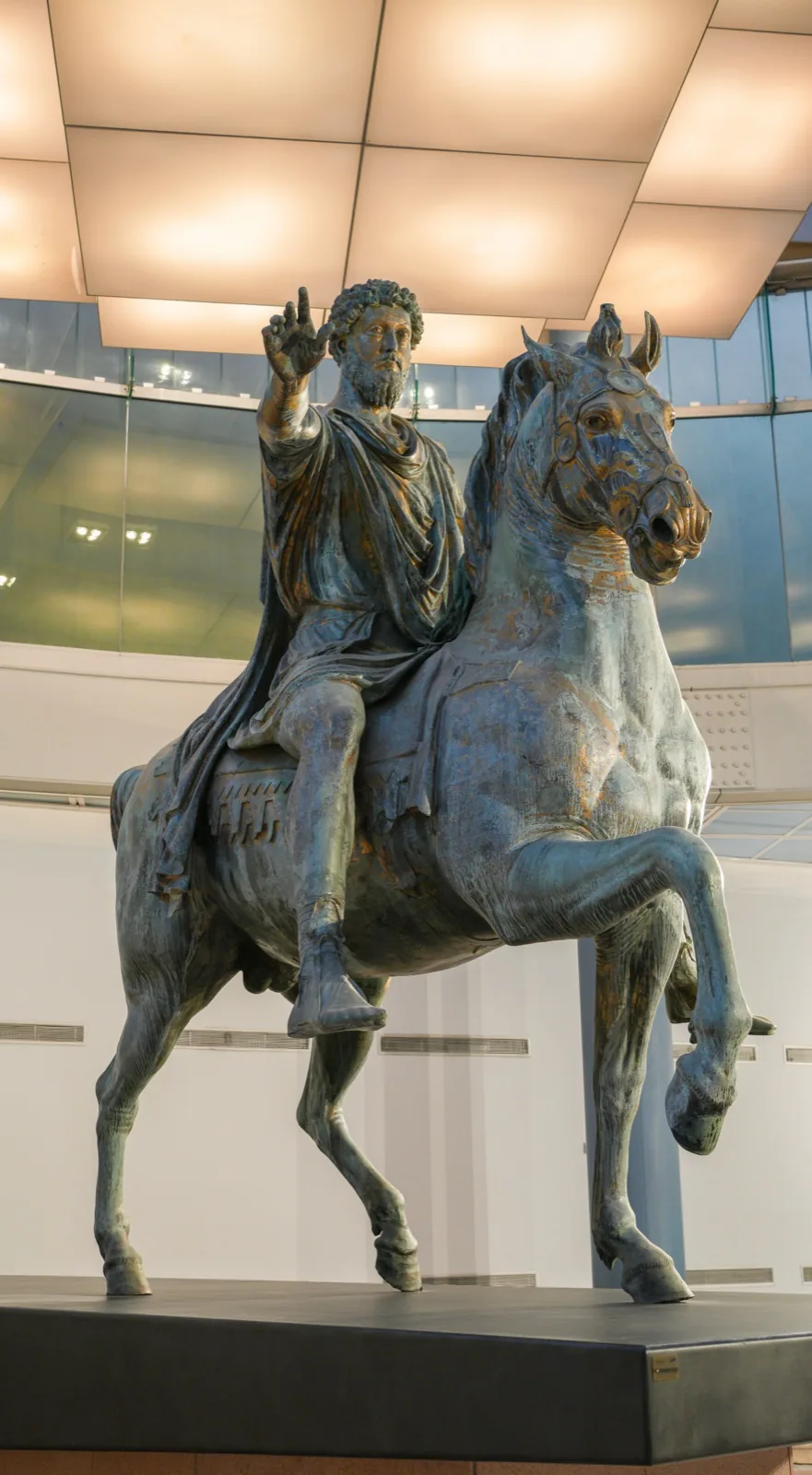
Marcus Aurelius was emperor of the Roman Empire from 161 to 180 CE. He was born in Rome on April 26, 121, into a wealthy family with roots in Roman Spain. He was the last of the Five Good Emperors, a line of rulers who each chose a capable successor by adoption rather than passing power to a son. Marcus spent much of his reign fighting wars along the Danube frontier and governing through a devastating plague. While on campaign, he kept a private journal in Greek about how to think and act well. That journal, published centuries later as the Meditations, became one of the most widely read works of philosophy ever written.
How Marcus Aurelius became emperor
Marcus owed his position to a chain of adoptions that began with the emperor Hadrian. In 138, Hadrian adopted a senator named Antoninus Pius and required Antoninus to adopt two boys: the sixteen-year-old Marcus and the seven-year-old Lucius Verus. Marcus grew up in the imperial household, studying rhetoric and law, but what interested him most was philosophy. At twelve, he began wearing a philosopher's rough Greek cloak and sleeping on the ground, until his mother told him to use a bed. He studied Stoicism, a Greek school of thought that taught self-discipline, acceptance of what you cannot control, and duty to others.
Antoninus ruled for twenty-three years, and Marcus spent that time learning to govern at his side. When Antoninus died in 161, Marcus took power and did something no emperor had done before: he made Lucius Verus his equal co-emperor rather than ruling alone. The two governed together until Verus died in 169.
Marcus Aurelius and the frontier wars
Marcus's reign coincided with the height of the Pax Romana, Rome's long period of internal peace, but the peace did not reach the frontiers. Early in his reign, the Parthian Empire attacked Roman territory in the east, and Roman forces spent years pushing it back. Then a worse threat came from the north.
Starting around 166, Germanic and Sarmatian tribes began crossing the Danube River in force. The Marcomanni and their allies pushed deep into Roman territory and at one point raided into northern Italy itself. Marcus spent most of the years from 168 to 180 commanding armies along the Danube, living in camp and directing campaigns across hundreds of miles of frontier.
At the same time, soldiers returning from the eastern war carried a disease, probably smallpox, that spread across the empire. The Antonine Plague may have killed millions of people. The wars and the plague overlapped for more than a decade, and Marcus managed the empire through all of it. Rather than raise taxes to fund the army, he held a public auction of palace furnishings in the Forum of Trajan, selling gold cups, silk robes, and paintings from the imperial collection.
What Marcus Aurelius wrote in the Meditations
During those years of war, Marcus kept a journal. He wrote in Greek, not Latin, and addressed the entries to himself. The notes were not a diary of events. They were reminders about how to think and act: be patient, control your temper, do your duty, accept that death is natural, stop worrying about fame. He returned to the same ideas again and again, as if arguing with himself.
Marcus never gave the journal a title and never meant for anyone else to read it. How it survived is unclear. It appeared centuries later under the title Meditations, and for most of its history only scholars read it. In modern times it found a much wider audience. Today it is one of the bestselling philosophy books in the world, translated into more than sixty languages.
Why did Marcus Aurelius choose Commodus?
The Five Good Emperors earned that name because each chose his successor by ability, not blood. Marcus broke the pattern. He raised his biological son, Commodus, to co-emperor in 177, when Commodus was fifteen.
The decision was not as simple as it looks. The earlier adoptive successions happened partly because those emperors had no surviving sons. Marcus did. Passing over a living son would have been unusual by Roman standards, and it would have left Commodus as a rival to any adopted heir, making civil war likely. Marcus and his wife Faustina had about fourteen children, but most died young. By the 170s, Commodus was his only surviving son.
Marcus Aurelius died on March 17, 180, at Vindobona (modern Vienna) or Sirmium (in modern Serbia), after nearly two decades of war. He was fifty-eight. Commodus, now sole emperor at eighteen, abandoned the Danube campaigns and returned to Rome. He ruled for twelve years. Ancient sources describe him as vain and cruel, obsessed with performing as a gladiator in the arena. He was assassinated in 192. Historians often mark his reign as the beginning of Rome's long decline.
Marcus's gilded bronze equestrian statue survived the Middle Ages because Christians believed it depicted Constantine, the first Christian emperor. The original now stands inside Rome's Capitoline Museums, with a copy in the piazza outside. The Meditations are still widely read nearly two thousand years after Marcus wrote them.