
Molotov-Ribbentrop Pact
The Molotov-Ribbentrop Pact was a 1939 non-aggression treaty between Nazi Germany and the Soviet Union with a secret protocol dividing Eastern Europe.
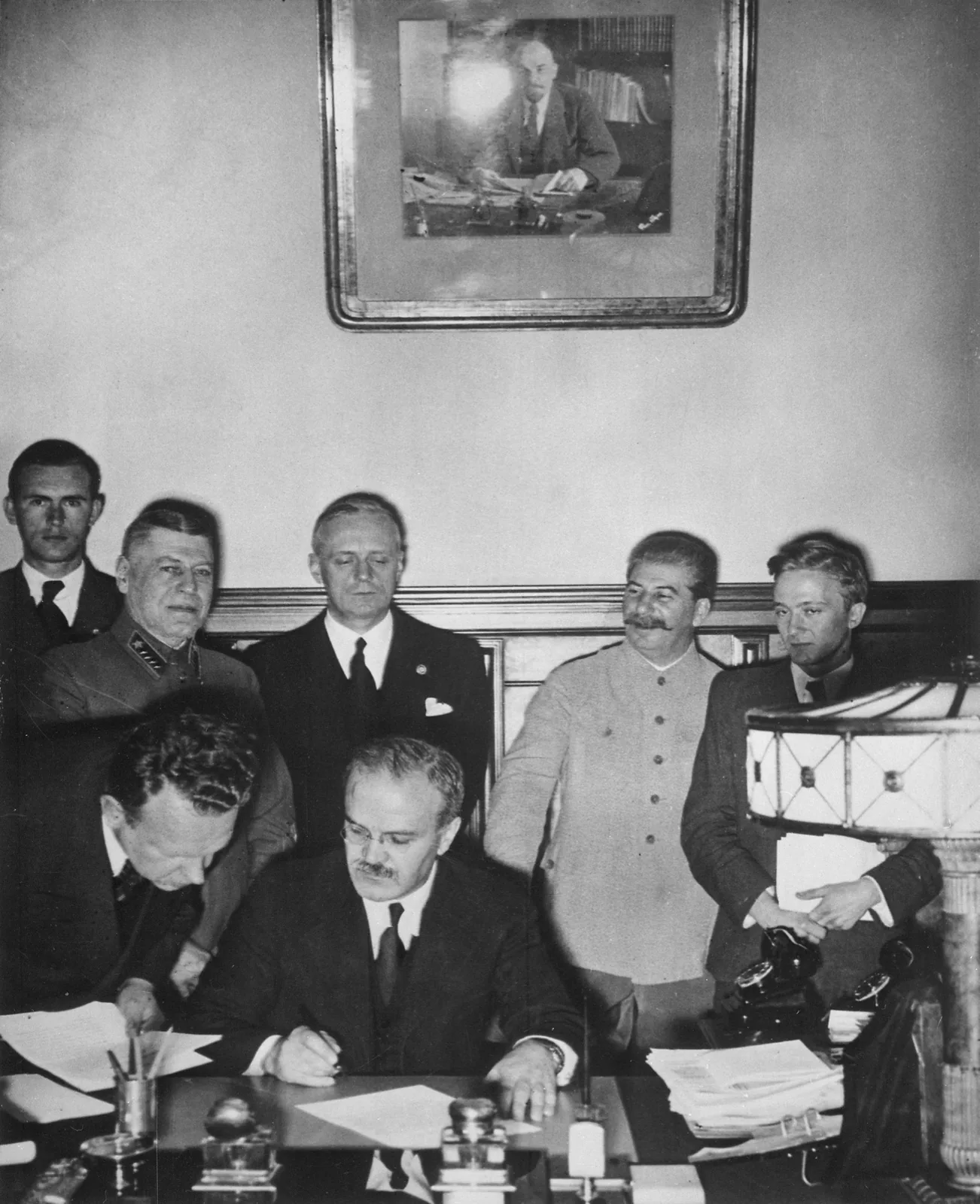
The Molotov-Ribbentrop Pact was a non-aggression treaty between Nazi Germany and the Soviet Union, signed on August 23, 1939. It is named after the two foreign ministers who signed it: Vyacheslav Molotov for the Soviet Union and Joachim von Ribbentrop for Germany. The two countries had spent years denouncing each other as ideological enemies, fascism against communism. But attached to the public treaty was a secret protocol that divided Eastern Europe into German and Soviet spheres of influence. Nine days later, Germany invaded Poland. The Second World War had begun. The pact gave Adolf Hitler a free eastern border and gave Joseph Stalin time and territory. Both leaders believed they were the one outsmarting the other.
Why Hitler and Stalin signed the Molotov-Ribbentrop Pact
Hitler's immediate goal was Poland. He planned to invade within days of signing the pact, but he wanted to avoid what had destroyed Germany in the First World War: fighting France, Britain, and Russia all at the same time. A deal with Stalin would keep the Soviet Union out of the way.
Stalin had his own reasons. Between 1936 and 1938, he had purged the Soviet military's officer corps, executing or imprisoning thousands of experienced commanders. The Red Army needed time to rebuild. Stalin also distrusted Britain and France. At the Munich Agreement in 1938, the two Western powers had handed Hitler the Sudetenland, a region of Czechoslovakia, without consulting the Czechs or firing a shot. To Stalin, the Western powers seemed willing to let German expansion point eastward. He calculated that a deal with Hitler would buy time to rearm, gain a buffer zone of new territory in Eastern Europe, and let the Western powers exhaust themselves in war with Germany.
Britain and France were also negotiating with Stalin that summer, trying to bring the Soviet Union into an alliance against Germany. Those talks dragged on for months without result. When Hitler offered a deal that came with territory, Stalin took it.
The negotiations with Germany moved fast. Ribbentrop flew to Moscow on August 23. He had been a champagne salesman before entering politics and had acquired his aristocratic "von" by arranging for a distant relative to adopt him. His counterpart, Molotov, was born Vyacheslav Skryabin and had taken the name Molotov, from the Russian word for hammer, as a revolutionary alias. The two signed the treaty at the Kremlin that night. Stalin attended the ceremony and smiled for the cameras.
The secret protocol and the invasion of Poland
The published treaty was a simple pledge: Germany and the Soviet Union would not attack each other. The part that mattered was the secret protocol attached to it. The protocol drew a line through Eastern Europe. Poland would be split between Germany and the Soviet Union. Estonia, Latvia, and later Lithuania fell into the Soviet sphere. So did Finland and Bessarabia, a region of Romania. Moscow denied the protocol existed for the next fifty years.
On September 1, 1939, nine days after the pact was signed, Germany invaded Poland. On September 17, the Red Army invaded Poland from the east. Within weeks Poland was divided between the two powers, roughly as the protocol described.
Over the following two years, Stalin took most of what the protocol had promised. The Soviet Union annexed Estonia, Latvia, and Lithuania in 1940. It fought the Winter War with Finland in 1939-1940 to seize Finnish territory. Throughout this period, the Soviet Union shipped oil and grain to Germany, fueling the army that was being built to attack it.
Why did Hitler break the Molotov-Ribbentrop Pact?
Hitler never intended the pact to last. He had written in Mein Kampf that Germany's future lay in conquering territory to the east, and the Soviet Union was the territory he meant. On June 22, 1941, he launched Operation Barbarossa, the largest military invasion in history. More than three million German soldiers crossed the Soviet border.
Stalin was caught off guard. Despite warnings from his own intelligence services and from the British government, he had refused to believe Hitler would attack so soon. According to multiple accounts, Stalin withdrew from public view for several days after the invasion began, apparently in shock. The pact had lasted less than two years. The war that followed killed an estimated 27 million Soviet citizens, more than any other country lost in the Second World War.
The Molotov-Ribbentrop Pact today
For Poland and the Baltic states, the pact is the document that led to their occupation: first by both dictatorships, then, for the Baltic states, by the Soviet Union for nearly fifty years. Moscow denied the secret protocol's existence until 1989, when the Soviet government finally admitted the document was real. By then the Soviet Union was beginning to collapse, and the Baltic states were using the pact's anniversary to demand independence. On August 23, 1989, the fiftieth anniversary of the signing, an estimated two million people in Estonia, Latvia, and Lithuania formed a human chain across all three countries in protest.
August 23 is now the European Day of Remembrance for Victims of Stalinism and Nazism. The pact lasted twenty-two months, but the borders it drew and the occupations it set in motion shaped Eastern Europe for the rest of the century.