
Mossad
The Mossad is Israel's foreign intelligence service, responsible for espionage and covert operations abroad since 1949.
The Mossad is Israel's foreign intelligence service, responsible for espionage and covert operations outside the country. Its full Hebrew name, HaMossad leModiʿin uleTafkidim Meyuḥadim, means "the Institute for Intelligence and Special Operations," but most people just call it "the Institute." Prime Minister David Ben-Gurion created it on December 13, 1949, the year after Israel's founding. The Mossad works under the prime minister's office, not under any defense or interior ministry, giving its director unusual access to the country's leadership. In more than seventy years, the Mossad has become one of the most recognized intelligence services in the world, unusually aggressive for a country of about ten million people. Its agents have kidnapped a Nazi war criminal from Argentina, hunted down those it held responsible for the Munich massacre across Europe, and stolen half a ton of nuclear documents from a warehouse in Tehran.
How the Mossad was built
Ben-Gurion appointed Reuven Shiloah, a Jerusalem-born intelligence operative, as the Mossad's first director. Shiloah had spent years building contacts with British and American intelligence services during the British Mandate in Palestine, and he proposed a central body to coordinate Israel's scattered spy agencies. The early Mossad was small and disorganized. In 1952, Isser Harel replaced Shiloah and transformed it. Harel was secretive, demanding, and personally involved in operations.
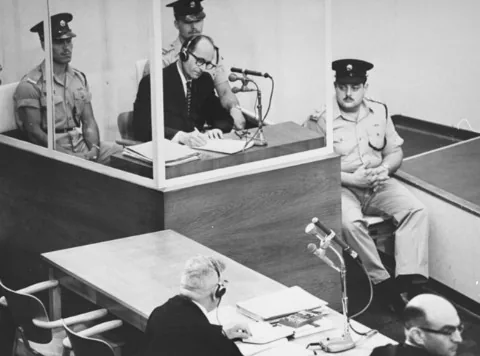
In 1960, Harel flew to Buenos Aires to lead the Mossad's most famous mission: the capture of Adolf Eichmann. Eichmann, one of the chief organizers of the Holocaust, had been living in Argentina under the name Ricardo Klement. A German Jewish emigrant named Lothar Hermann tipped off the Israelis after suspecting that a man near his daughter was Eichmann's son. Harel's team rented safe houses, watched Eichmann for weeks, and on May 11 grabbed him on the street as he walked home from a bus stop. They held him in a rented villa for nine days, then smuggled him out of Argentina on an El Al flight. Eichmann stood trial in a glass booth in Jerusalem in 1961. He was convicted and hanged in 1962.
Under Harel's successor, Meir Amit, who took over in 1963, the Mossad professionalized and built close ties with the CIA. Metsada, the Mossad's special-operations branch, houses a small unit called Kidon that carries out targeted killings abroad.
The Mossad from Munich to Tehran
On September 5, 1972, Palestinian gunmen from the group Black September broke into the Israeli team's quarters at the Munich Olympics and killed eleven Israeli athletes. Prime Minister Golda Meir authorized Operation Wrath of God, a campaign that lasted years to hunt down and kill those the Mossad held responsible. Mossad teams tracked targets across Europe and the Middle East. The campaign suffered a serious failure in Lillehammer, Norway, in July 1973, when agents shot and killed Ahmed Bouchiki, a Moroccan waiter they mistook for a Black September operative. Six agents were arrested and five were convicted by Norwegian courts.
The Mossad's record includes both celebrated successes and costly mistakes. In October 1973, Israeli intelligence missed the coordinated Arab assault that began the Yom Kippur War. The lack of warning left Israel dangerously exposed in the first days of the fighting. Aman, the military intelligence agency, bore most of the blame, but the Mossad shared in it. Three years later, Mossad intelligence on Entebbe airport in Uganda helped make possible the Israeli commando raid that rescued more than a hundred hostages from a hijacked airliner. In 1997, Mossad agents attempted to assassinate Khaled Mashal, the head of Hamas, on a street in Amman, Jordan, by spraying a fentanyl-based toxin into his ear. The agents were caught. To recover them, Israel had to hand over the antidote that saved Mashal's life and release Sheikh Ahmed Yassin, who founded Hamas, from an Israeli prison.
Since at least 2010, the Mossad has waged a sustained campaign against Iran's nuclear program. The Stuxnet computer worm, widely attributed to Israel and the United States, damaged Iranian uranium centrifuges. Israeli agents assassinated several Iranian nuclear scientists, including Mohsen Fakhrizadeh, the program's chief architect, who was killed near Tehran in November 2020 by a remote-controlled gun. In January 2018, the Mossad stole more than 100,000 documents on Iran's nuclear weapons work from a warehouse in Tehran, loaded them onto trucks, and smuggled them out of the country. The Mossad has also targeted Hezbollah in Lebanon. In September 2024, thousands of pagers that the Mossad had rigged with explosives detonated across Lebanon at the same time, killing at least twelve people and wounding thousands.
What is the difference between the Mossad, Shin Bet, and Aman?
Israel runs three main intelligence and security services, and people often confuse them. The Mossad gathers intelligence and runs operations outside the country. Shin Bet (the Shabak) covers domestic security and counterterrorism within Israel and the Palestinian territories. Aman, the military intelligence branch, is the largest of the three and focuses on battlefield intelligence and strategic warning. The Mossad and Shin Bet both report directly to the prime minister, and Aman reports to the defense minister through the military chief of staff. The Mossad's direct access to the prime minister, without a ministry in between, is one reason it has taken on operations that intelligence services in larger countries would consider too risky.