Fascism
Fascism was a political movement that Benito Mussolini founded in Italy in 1919, promising national rebirth through a single party and violence.
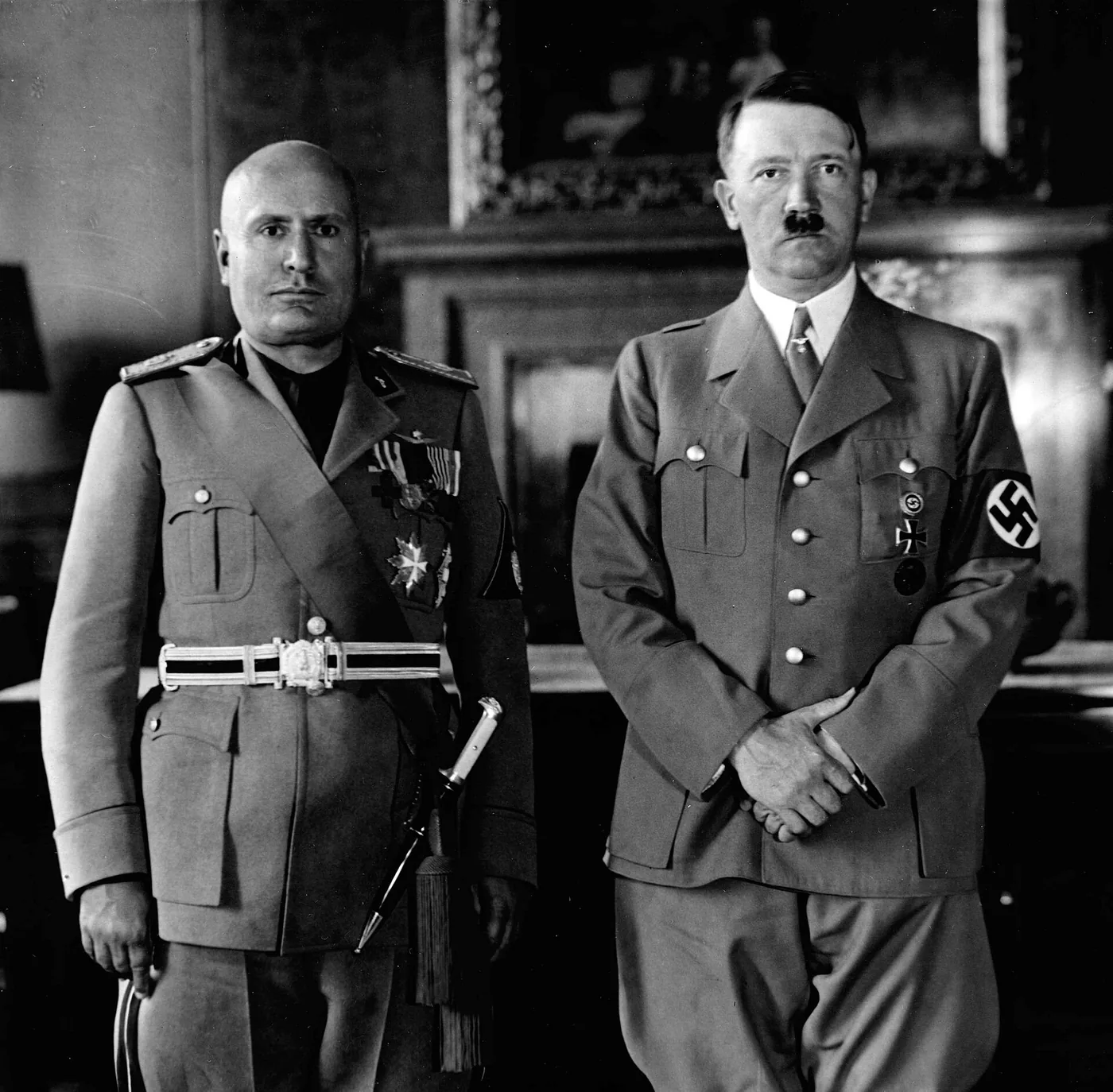
Fascism was a political movement that Benito Mussolini founded in Milan, Italy, on March 23, 1919. It promised a reborn nation through discipline and collective struggle. A fascist leader claimed to represent the national will directly, without parliaments or elections. For nearly twenty years, fascism was the most powerful new political force in Europe, and many respectable people admired it, believing it had solved problems that liberal democracy could not. The movement spread to Germany, where Adolf Hitler's National Socialism made racial theory central to everything. Both regimes were destroyed in World War II, and the defeat was so complete that almost no political movement has claimed the label since.
How Mussolini built fascism in Italy
Mussolini started his political life on the left. His father was a blacksmith and a committed socialist who named him after the Mexican revolutionary Benito Juarez. His mother was a schoolteacher. He was expelled from multiple schools for fighting, worked briefly as a schoolteacher himself, and then turned to journalism and socialist politics. By 1912 he was editing Avanti!, the Italian Socialist Party's newspaper, and soon doubled its circulation. During World War I he broke with the party and turned to fervent nationalism. In March 1919 he gathered a small group of veterans and radicals in Milan and started the Fasci Italiani di Combattimento.
The fascist movements that followed, in Italy and elsewhere, shared a diagnosis: the nation had grown soft, was split by class struggle and political infighting, was humiliated abroad, and was threatened from within. They shared a promise: national rebirth through a leader who embodies the people's will. They shared a set of tools: one ruling party, a paramilitary force in matching shirts, worship of the leader, dominance over the press, and hostility to both liberalism and Marxism. Fascist leaders presented violence as proof of seriousness and as a force for renewal. Fascism was harder to define than most ideologies. Communism had Karl Marx and a body of written theory. Fascism had no equivalent, and fascist leaders saw no need for ideological consistency.
In October 1922, Mussolini mobilized tens of thousands of Blackshirt paramilitaries in what became known as the March on Rome. The march looked like a seizure of power, but the decisive act was the decision by King Victor Emmanuel III to invite Mussolini to form a government instead of declaring martial law. Conservative politicians, worried about the left, gave him the government, convinced they could keep him in check.
The dismantling of democracy was fast. In May 1924, the socialist deputy Giacomo Matteotti gave a speech in parliament denouncing fascist violence. Fascist agents kidnapped and murdered him within two weeks. The affair nearly brought Mussolini down, but he used the crisis to abandon parliamentary rule entirely and build a one-party state.
How Hitler took power in Germany
The Great Depression of the early 1930s helped fascism spread. Mass unemployment radicalized voters across Europe, and the Nazi Party grew from a fringe group in the 1920s to Germany's largest party by 1932.
Adolf Hitler followed the same path to power as Mussolini. On January 30, 1933, President Paul von Hindenburg appointed Hitler as chancellor at the urging of former chancellor Franz von Papen and a group of conservative politicians and industrialists. They believed they could use him and keep him under control. Within two months, on March 23, the Reichstag passed the Enabling Act, which gave Hitler the power to make laws without parliament. The Weimar Republic was finished.
German National Socialism was related to Italian fascism but was not the same thing. Hitler made racial theory central to everything his government did, and his regime carried out the Holocaust. Italian fascism adopted antisemitic legislation only in 1938, under German influence. But the pattern of how both men reached power was identical: conservative elites, afraid of the left, appointed leaders who then destroyed the system that had given them the opening.
Where does the word fascism come from?
The name comes from the Italian word fascio, meaning a bundle or group. Mussolini took it from the fasces, a bundle of rods bound around an axe that attendants carried in front of Roman magistrates as a symbol of authority. The symbol made a political point: a single rod breaks easily, but a bundle bound together does not. Mussolini used the image to argue that a divided nation needed to be bound together under one leader and one party.
Fascism after 1945
Fascism as a system of government did not survive the war it started. In July 1943, Mussolini's own Grand Council voted him out of power. Italian partisans shot him in April 1945, and Hitler killed himself two days later.
Today the word fascism is mostly used as an insult for any authoritarian or nationalist politics. One structural test for recognizing the real thing has four parts: one party merged with the government, organized street violence, a leader who claims to be the nation's voice, and a campaign to remake the country by removing internal enemies. Those four features together were common in Europe in 1935. They are rare today. The gap between how the word is used now and what it originally described makes it harder to identify the specific pattern if it does appear again.