
League of Nations
The League of Nations was the first international organization created to prevent war, active from 1920 to 1946.
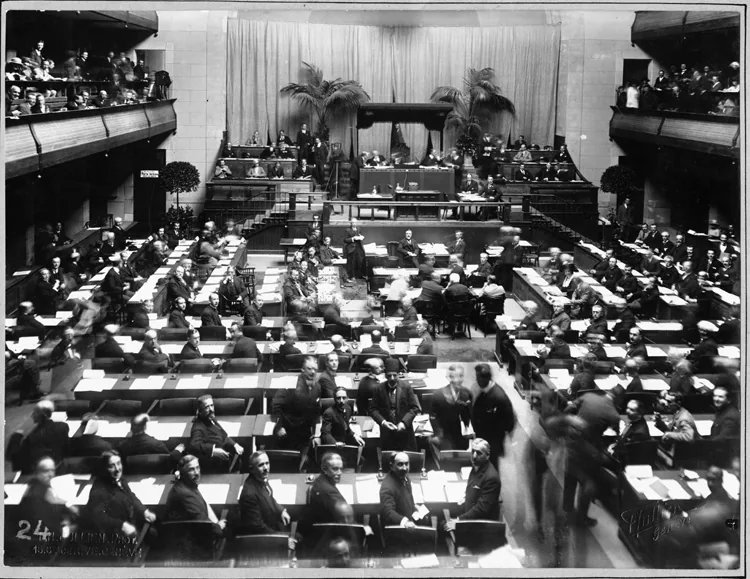
The League of Nations was the first permanent international organization built to prevent war, founded in 1920 and headquartered in Geneva. Its founding idea was collective security. When any member was attacked, the others were supposed to act together through diplomacy or economic sanctions. The American president Woodrow Wilson designed it, fought for it until a stroke left him paralyzed, and never persuaded the United States Senate to let America join. The League settled minor disputes in the 1920s, but it could not stop Japan from seizing Manchuria in 1931 or Italy from invading Ethiopia in 1935. By the time World War II started, the organization built to prevent it was already irrelevant. It was formally dissolved in April 1946, and the United Nations took its place.
How Woodrow Wilson created the League of Nations
Wilson proposed the League as the last of his Fourteen Points, a plan for peace after World War I that he presented to Congress in January 1918. He was a former political science professor who had been president of Princeton University before entering politics. He believed that a permanent body of nations could make war obsolete. When the war ended in November 1918, Wilson became the first sitting American president to travel to Europe, sailing to Paris to negotiate the peace settlement in person.
At the Paris Peace Conference, Wilson insisted that the League's charter, called the Covenant, be written into the Treaty of Versailles. Britain's David Lloyd George and France's Georges Clemenceau agreed, partly because they wanted Wilson's support on other terms. The Covenant created an Assembly of all member states and a smaller Council led by the great powers. Both bodies could propose responses to a crisis, but passing anything important required every member to agree. A single dissenting vote could stop the League from acting. The League had no army. Its main enforcement tool was economic sanctions, and enforcing them depended on each government choosing to comply.
Back in Washington, the Senate had turned Republican in the 1918 midterm elections. The Foreign Relations Committee was now chaired by Henry Cabot Lodge, a senator who had known Wilson for years and disliked him personally. Both men held advanced degrees, and each considered himself the country's leading authority on government. Lodge offered to accept the treaty with reservations that would limit American obligations under the Covenant. Wilson refused to compromise.
In September 1919, Wilson left Washington by train to take his case directly to the American people. Over 22 days he traveled 8,000 miles and gave 40 speeches. On September 25, he collapsed after speaking in Pueblo, Colorado. A week later, on October 2, he suffered a stroke that paralyzed his left side. He spent the rest of his presidency largely secluded. The Senate voted the treaty down in November 1919 and again in March 1920. The United States never joined the League of Nations.
Why did the League of Nations fail?
The League failed because it had no way to force its members to act. It had no army, every important decision required unanimity, and its most powerful intended member, the United States, never joined. When aggressors tested the system in the 1930s, the two leading great powers in the League, Britain and France, chose to avoid confrontation.
Through the 1920s the League had done useful work. It resettled refugees, settled a territorial dispute between Sweden and Finland over the Åland Islands, and organized campaigns against epidemics and human trafficking. But these were problems that no great power had a reason to block.
The first real test came in September 1931, when Japan invaded the Chinese region of Manchuria. The League sent a commission led by the British politician Lord Lytton to investigate. The commission published its report in October 1932 and concluded that the invasion violated international agreements and that the Japanese puppet state of Manchukuo was not a real country. The League's Assembly adopted the report in February 1933. Japan voted against it, walked out, and formally withdrew from the League. Japan kept Manchuria, and the League had no means to do anything about it.
The second test came in October 1935, when Mussolini's Italy invaded Ethiopia. The League imposed sanctions, but the sanctions did not include oil. Britain and France undermined them further by secretly negotiating the Hoare-Laval Pact in December 1935, an arrangement that would have given Italy much of what it wanted. When the pact leaked to the press, the British foreign secretary, Samuel Hoare, and the French foreign minister, Pierre Laval, were both forced to resign. Ethiopia's emperor, Haile Selassie, traveled to Geneva and addressed the League in person on June 30, 1936. "It is us today," he reportedly said as he left the podium. "It will be you tomorrow." The League voted to lift its sanctions on Italy four days later.
Germany had not been admitted to the League until 1926 and withdrew under Hitler in 1933. It rearmed in open violation of the Treaty of Versailles and annexed Austria and parts of Czechoslovakia while the League took no meaningful action. The Soviet Union, which had joined in 1934, was expelled in 1939 for invading Finland. Britain and France pursued appeasement rather than collective action. By September 1939, when Germany invaded Poland and World War II began, the League of Nations had been irrelevant for years.
How the League of Nations shaped the United Nations
The League ended its final session in Geneva on April 18, 1946. By then, World War II was over, and the United Nations was already operating. The UN's founders had studied the League's failures closely. The UN Charter, signed in 1945, gave five great powers permanent seats on a Security Council with veto power. The design was meant to keep the strongest countries inside the organization. The League had shown what happened when they stayed outside.
The League of Nations existed for 26 years and failed at its central purpose. But its failure shaped every major international institution that came after it. The principle the League was built to test, that an attack on one nation is a problem for all, remains the foundation of the United Nations and of NATO today.