
Napoleonic Code
The Napoleonic Code is the French civil code Napoleon enacted in 1804 to unify the country's laws, now the basis for legal systems in over 100 countries.
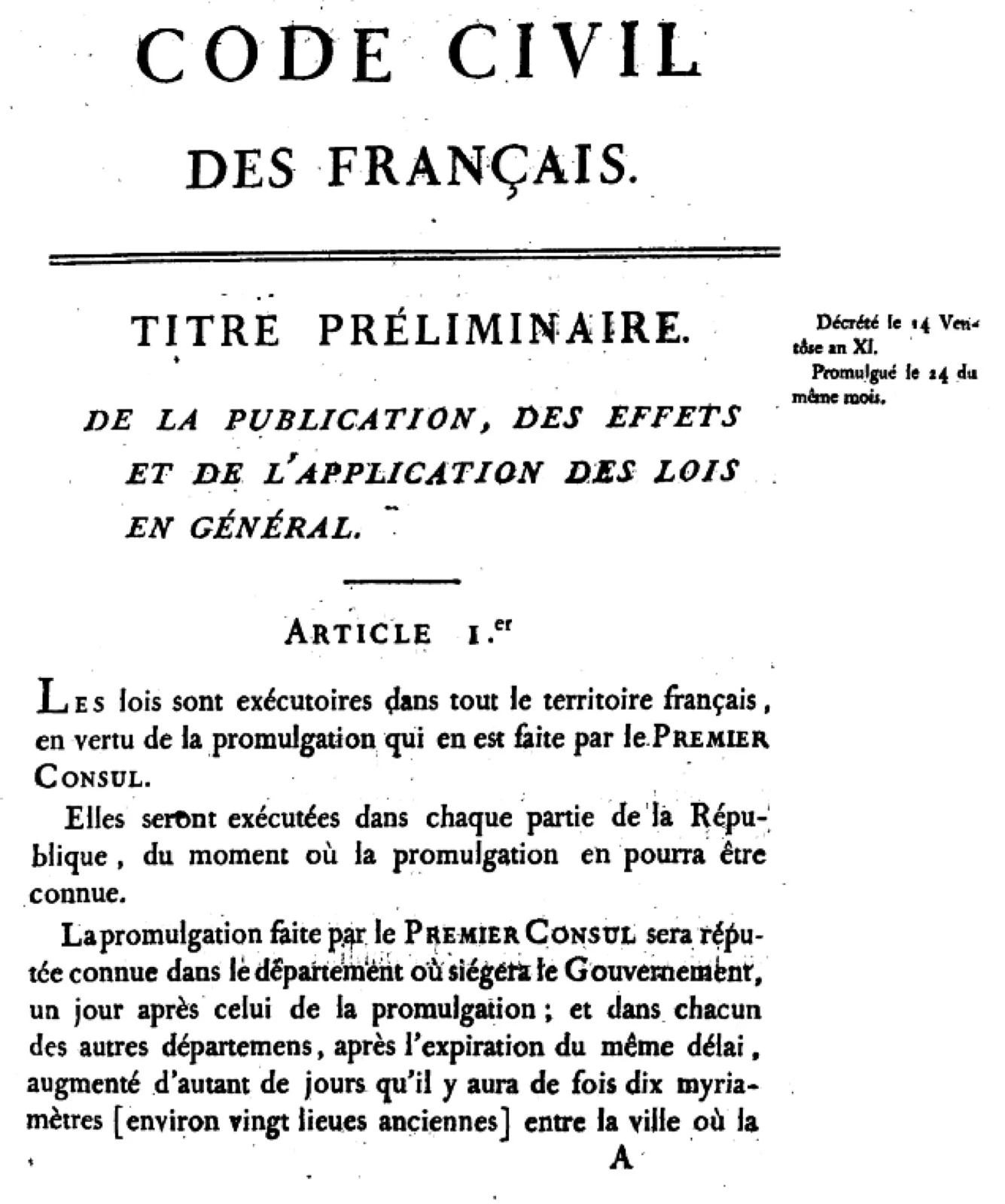
The Napoleonic Code is the French civil code that Napoleon Bonaparte enacted on March 21, 1804. It replaced hundreds of conflicting local laws with a single set of rules covering property, contracts, marriage, and inheritance. The code established legal equality for all male citizens, ended hereditary privilege, and put civil matters like marriage under state authority instead of the church. It was one of the first modern national legal codes, written plainly enough that ordinary citizens could read it rather than needing a lawyer to interpret it. More than a hundred countries today base their private law on principles the code introduced.
How Napoleon replaced hundreds of legal systems with one
Before 1804, France had roughly three hundred local legal systems. Roman law governed the south. The north ran on feudal customs that varied from one district to the next. Royal edicts, church rules, and revolutionary decrees were layered on top. A contract valid in one province might mean nothing in the next. The French Revolution had ended the feudal system, but it had not replaced the legal patchwork with anything unified. Someone buying property in Lyon followed different rules than someone doing the same in Bordeaux.
In 1800, Napoleon, then serving as First Consul, appointed four jurists to draft a single code: Francois Tronchet, Jean-Etienne-Marie Portalis, Felix Bigot de Preameneu, and Jacques de Maleville. Two specialized in the customary law of the north, two in the Roman-influenced written law of the south. The commission produced a draft in four months. Napoleon personally chaired about half of the more than one hundred sessions where the Council of State debated it. He had no legal training, but he argued points of law with the jurists on their own terms.
The final code was promulgated on March 21, 1804, as the Code civil des Francais. It became known as the Code Napoleon. It condensed French private law into 2,281 numbered articles. Its principles came from the Enlightenment and the Revolution, written into permanent law. All male citizens were equal before the law. Class privilege was abolished. Property was protected, contracts were freely entered, and the state took control of civil records and marriage from the church. Careers depended on ability, not family name. Inheritance was divided equally among all children, ending the old rule of primogeniture that favored the eldest son.
In exile on Saint Helena, Napoleon said he would be remembered for his laws, not his conquests. "What nothing will destroy, what will live on forever, is my Civil Code," he said.
How the Napoleonic Code treated women
The code declared all men equal before the law, but it did not extend the same equality to women. It placed married women under their husbands' legal authority. A wife needed her husband's permission to enter a contract, buy or sell property, or bring a case to court. The law also gave fathers broad authority over their children.
The drafters made this choice on purpose, securing men's legal equality partly at the expense of women's independence. It took nearly two centuries of reforms to undo it. France abolished the husband's formal legal authority over his wife in 1938. In 1965, married women gained the right to open bank accounts and take jobs without their husband's permission. Paternal authority gave way to shared parental authority in 1970, and full legal equality between spouses came only in 1985.
Where the Napoleonic Code applies today
The code spread alongside Napoleon's armies into Belgium, the Netherlands, the German territories west of the Rhine, the Italian peninsula, Poland, and Spain. In many of these places it remained in force long after French soldiers left. Its clear structure and plain language made it attractive to countries that had never been under French rule.
Over the nineteenth and twentieth centuries, the code became the model for civil-law systems across Latin America, large parts of the Middle East and North Africa, and parts of East Asia. Chile's civil code of 1855 was built on it and was widely copied across South America. Egypt adopted a civil code that blended Napoleonic and Islamic law. Japan drew on the French and German models during the Meiji reforms of the 1890s. Today more than a hundred countries base their private law on the Napoleonic Code or on codes descended from it.
In the United States, Louisiana is the only state whose private law comes from the French and Spanish civil-law tradition rather than English common law. Quebec, in Canada, follows a similar tradition.
In France itself, the code is still in force, though it has been heavily amended over two centuries. Fewer than half of the original articles remain active. The rest have been revised or replaced, but the structure Napoleon's jurists built in 1804 remains the foundation of private law in France and in the more than a hundred countries that followed its model.