
Bolsheviks
The Bolsheviks were the faction of Russian Marxists led by Lenin who seized power in the October Revolution of 1917.
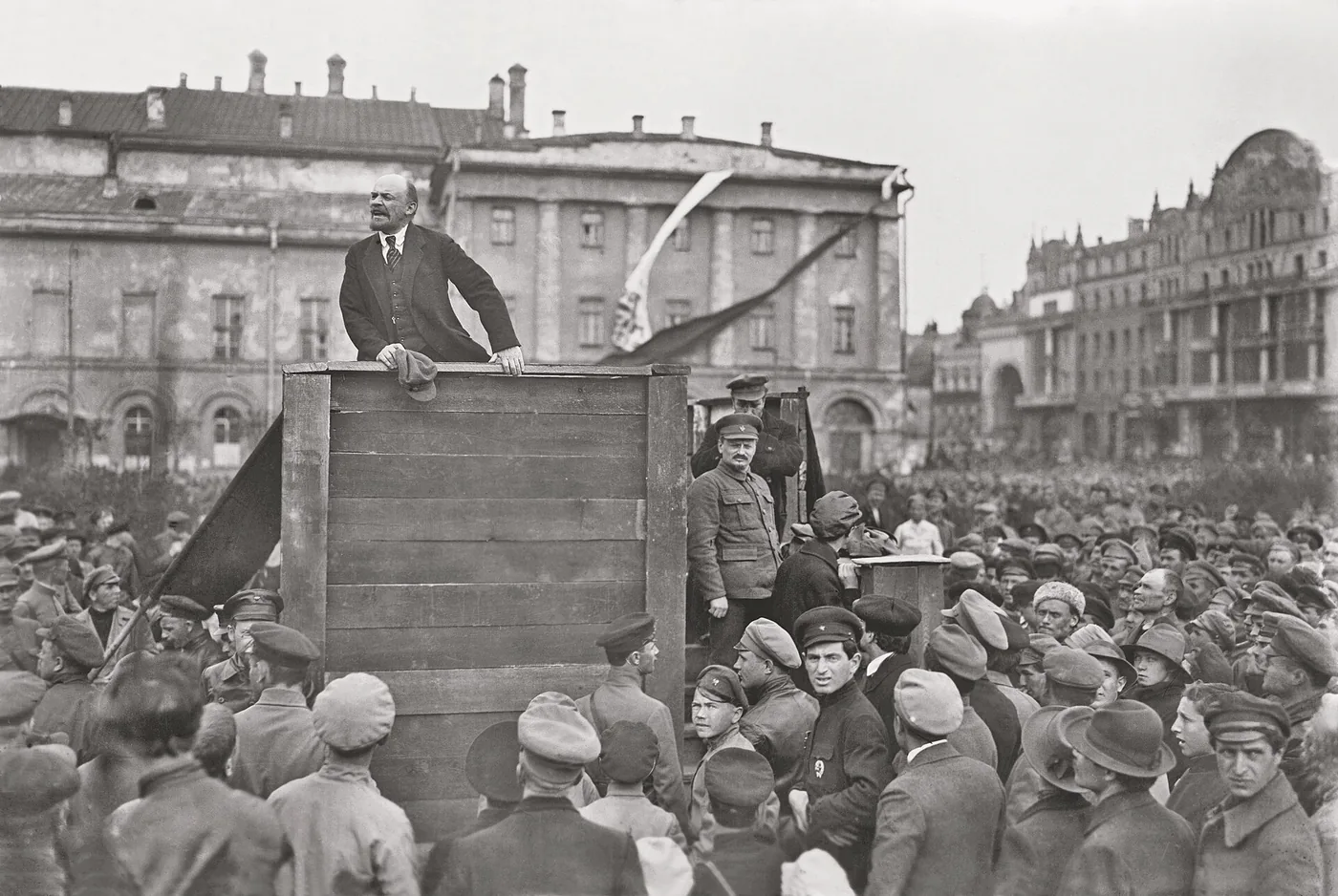
The Bolsheviks were the faction of Russian Marxists led by Vladimir Lenin. They seized power in the October Revolution of 1917 and founded the Soviet state. The name means "majority men" in Russian, taken from a single vote at a party congress in 1903, though Lenin's faction was often the smaller one in the years that followed. The Bolsheviks began as a small group of professional revolutionaries who believed that a disciplined party, not the working class itself, should lead the revolution. In October 1917, with Russia exhausted by World War I and the Provisional Government unable to hold the country together, the Bolsheviks took Petrograd and formed a new government. The civil war that followed killed more than seven million people.
How the Bolshevik party began
The Bolsheviks emerged from a fight at the Russian Social Democratic Labour Party's second congress, held in 1903. The sessions were split between Brussels and London since police surveillance made gathering inside Russia too dangerous. The central dispute was what it meant to be a party member. Julius Martov argued for broad membership, open to anyone willing to work under the party's direction, the way the large socialist parties of western Europe operated. Lenin took the opposite position, insisting that membership be limited to people who personally took part in one of the party's organizations. In a country where political opposition was illegal, that amounted to a tight core of professional revolutionaries.
Lenin, born Vladimir Ulyanov, had been a revolutionary since his late teens. His older brother Alexander was hanged in 1887 for plotting to assassinate Tsar Alexander III. In 1902 Lenin published a pamphlet called What Is To Be Done? He argued that workers on their own develop only what he called "trade union consciousness": they push for higher pay but stop there. Revolutionary consciousness, Lenin wrote, had to be brought to them from the outside, by an organized revolutionary party acting on their behalf. The idea had a consequence that shaped the twentieth century. If the party represents the working class's true interests, the party can override ordinary workers whenever the two reach different conclusions.
Lenin's supporters won a narrow vote at the congress on the makeup of the editorial board for the party's newspaper, Iskra. Lenin called his group the bolsheviki ("majority men") and Martov's group the mensheviki ("minority men").
How the Bolsheviks seized power in 1917
When Tsar Nicholas II abdicated in March 1917, the Bolsheviks were still a small organization on the margins of Russian politics. Most of their leaders were in exile or in Siberia. Lenin was in Switzerland. The German government, which was fighting Russia in World War I, arranged for Lenin to cross Germany in a sealed train, expecting him to cause disruption at home. Lenin arrived in Petrograd in April and surprised his own comrades by declaring that the Bolsheviks would not work with the Provisional Government under any terms.
Lenin's program was three slogans: peace, land, and bread, plus all power to the soviets, the councils of workers and soldiers that had formed across Russia. These addressed the three things most Russians wanted, and none of the competing parties promised all three together.
On October 25 by the old Russian calendar, November 7 by the modern one, Red Guards and soldiers loyal to the Bolsheviks seized Petrograd's bridges, telegraph stations, and railway terminals. Leon Trotsky, chairman of the Petrograd Soviet, organized the operation through the Military Revolutionary Committee. The Bolsheviks then occupied the Winter Palace with almost no resistance and announced a new government on the evening of October 26.
A civil war followed and lasted until 1920. In December 1917 the Bolsheviks established a secret police force called the Cheka, the first of several Soviet security agencies that eventually became the KGB. The party changed its name to the Russian Communist Party (Bolsheviks) in March 1918.
What was the difference between the Bolsheviks and the Mensheviks?
The dispute at the 1903 congress looked procedural, but it was about what kind of revolution Russia would have. The Mensheviks, led by Martov, followed Karl Marx's own sequence: Russia needed to develop a capitalist economy and a large industrial working class before a socialist revolution could happen. The party's job was to organize that working class as it grew.
Lenin reversed the sequence. He argued that a small, disciplined party could seize power during a crisis and build socialism from the top down, without waiting for capitalism to run its course. In October 1917, the Bolsheviks did exactly that, taking the Russian state with a committed minority in a country where most people were peasants, not industrial workers.
The Mensheviks were suppressed after the revolution. Martov left Russia in 1920 and died of tuberculosis in Germany in 1923.
How the Bolshevik model spread
In 1921 the Tenth Party Congress banned organized factions within the party. The rule meant that the method Lenin had used to win power, organizing a faction inside a larger party, could never be used against his successors.
Joseph Stalin used that structure to destroy every rival. By 1940, every member of Lenin's original inner circle apart from Stalin had been killed. Most were shot on orders from the party they had founded.
The party dropped "(Bolsheviks)" from its name in 1952, becoming the Communist Party of the Soviet Union. But Lenin's vanguard party model outlasted both the name and the country. The Comintern exported it worldwide in the 1920s and 1930s, and it was adopted in China, Vietnam, Cuba, and more than a dozen other countries. The Chinese Communist Party's organizational structure today descends directly from the model Lenin designed in 1902 and tested in 1917.