
Oprichnina
The oprichnina was Ivan the Terrible's campaign of state terror against Russia's aristocracy from 1565 to 1572.
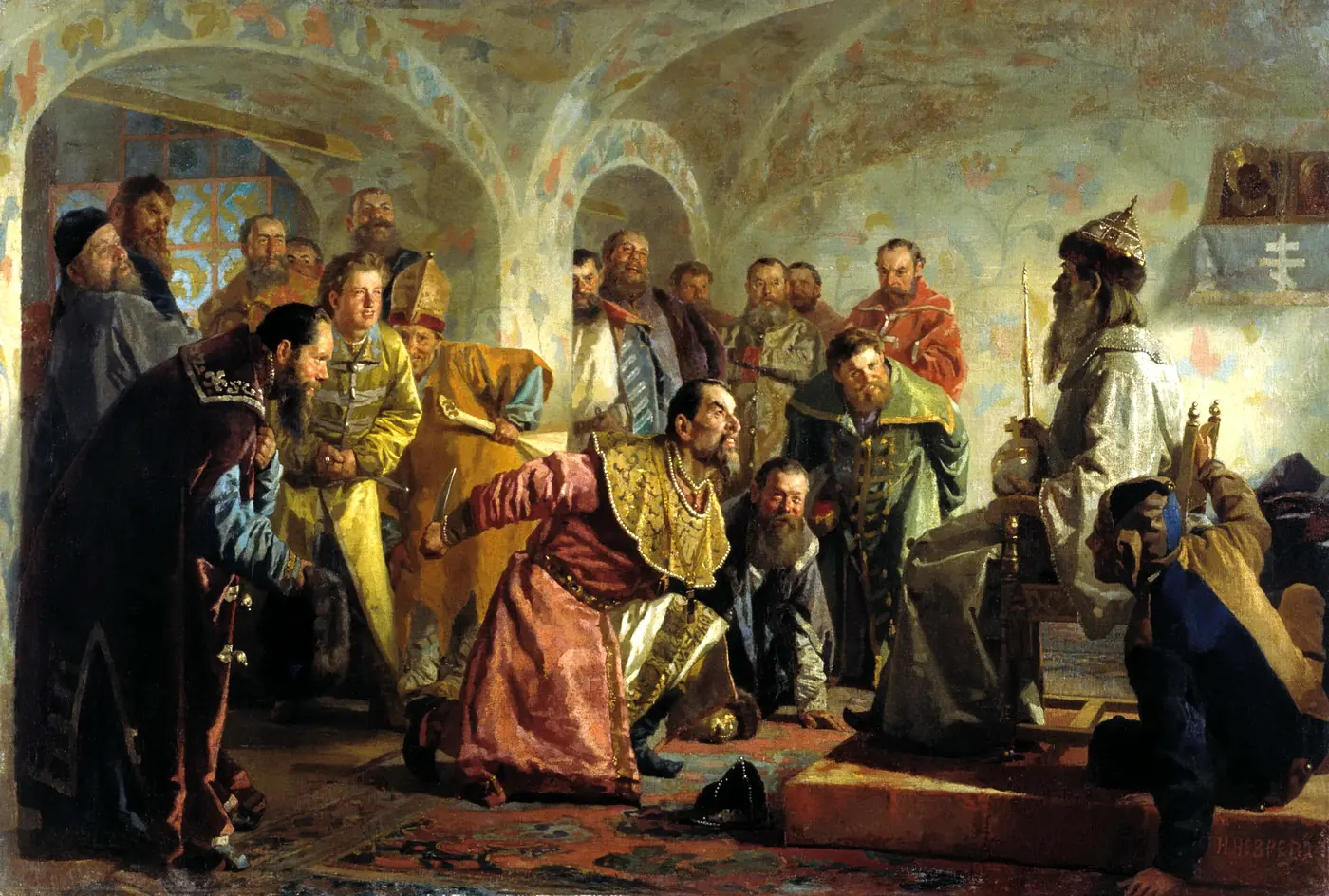
The oprichnina was a seven-year campaign of state terror carried out by Ivan IV, the tsar of Russia later known as Ivan the Terrible. In 1565, Ivan split his realm in two. He set aside the wealthiest territories as his personal domain, answerable only to him, and staffed it with a corps of enforcers called the oprichniki. Their targets were the boyars, Russia's hereditary aristocrats, whose independent power Ivan considered a direct challenge to his authority. Over the next seven years the oprichniki seized estates, executed families, and destroyed one of Russia's wealthiest cities. Ivan abolished the oprichnina in 1572, but its design, a ruler creating a zone beyond the law and filling it with personal loyalists to crush the old elite, became a template that later Russian rulers studied and reused.
How Ivan created the oprichnina
Ivan came to the throne in 1533, when he was three years old. He spent his childhood watching rival boyar factions fight for influence over his government, and the experience left him with a deep suspicion of the aristocracy that never went away. In 1547, at sixteen, he was crowned as Russia's first tsar.
By the early 1560s, Ivan's distrust of the boyars had grown sharper. In 1564, Prince Andrei Kurbsky, one of Ivan's best military commanders, defected to Poland-Lithuania. Kurbsky's betrayal confirmed Ivan's fear that even his closest allies might turn against him.
In December 1564, Ivan left Moscow with his family and a train of treasure. He sent a letter accusing the boyars and the clergy of treason and announced that he intended to give up the throne. The people of Moscow, led by the clergy, begged him to return. Ivan agreed on one condition: he would be allowed to deal with traitors however he saw fit. In February 1565, he created the oprichnina, a territory carved out of the Russian state and placed under Ivan's direct control. The word comes from the Russian oprich, meaning "apart from." Its center was the fortified estate of Aleksandrov Sloboda. The rest of the country, called the zemshchina, was nominally governed by a council of boyars, but in practice Ivan controlled both halves.
Ivan filled the oprichnina with men drawn from the lower gentry and from outsiders who had no ties to the old aristocracy. These enforcers, the oprichniki, owed everything to Ivan. They dressed in black and rode black horses. They fixed a severed dog's head and a broom to their saddles, signs that they would hunt down traitors and remove them. The oprichniki started at about a thousand men and grew to as many as six thousand.
The oprichnina and the sack of Novgorod
The oprichniki operated outside ordinary law. They seized boyar estates, executed boyar families, and answered to no court. The violence widened over time until suspicion alone was enough to get someone killed.
The head of the Russian Orthodox Church, Metropolitan Philip, publicly condemned the killings. In November 1568, Ivan had Philip stripped of his position and sent to a monastery. In December 1569, Ivan's chief enforcer, Malyuta Skuratov, strangled Philip in his cell.
The worst violence came in January 1570. Ivan came to believe, based on little evidence, that Novgorod, one of Russia's wealthiest cities, was planning to switch its allegiance to Lithuania. He arrived at the city on January 6, and his oprichniki spent the next six weeks torturing and killing its inhabitants. People were drowned in the Volkhov River and beaten to death in the streets. Modern historians estimate that between 2,000 and 15,000 people died. Novgorod's population at the time was no more than about 30,000. The city never fully recovered.
Ivan later sent lists called sinodiki to monasteries, naming more than 3,000 victims of his reign and asking that they be prayed for.
How the oprichnina ended
In May 1571, a Crimean Tatar army led by Khan Devlet Giray burned Moscow. The oprichniki, who were supposed to be an elite military force, failed to defend the city. They had spent years terrorizing unarmed subjects but could not stop an invading army.
In 1572, Ivan abolished the oprichnina and forbade anyone to speak its name. He merged the oprichnina lands back into the rest of the state.
The oprichnina's legacy in Russian history
The oprichnina's lasting importance is in its design. Ivan created a pattern that would repeat across Russian history. A ruler sets aside part of the state as a zone beyond ordinary law and fills it with loyalists who owe their position entirely to him. He then turns those loyalists against the old elite to concentrate all power in himself.
Historians have drawn a direct connection between the oprichniki and later Russian institutions of internal terror, including the tsarist secret police, Lenin's Cheka, Stalin's NKVD, and the KGB. Stalin admired Ivan the Terrible openly. In a 1947 meeting with the filmmaker Sergei Eisenstein, Stalin called Ivan a great and wise ruler but said one of his mistakes was leaving too many boyar families alive.
The oprichnina established a precedent in Russian politics: that a ruler could turn the state's full violence inward against people he chose to call enemies.