
Orange Revolution
The Orange Revolution was a wave of peaceful 2004 protests that overturned a rigged Ukrainian presidential election and made Viktor Yushchenko president.
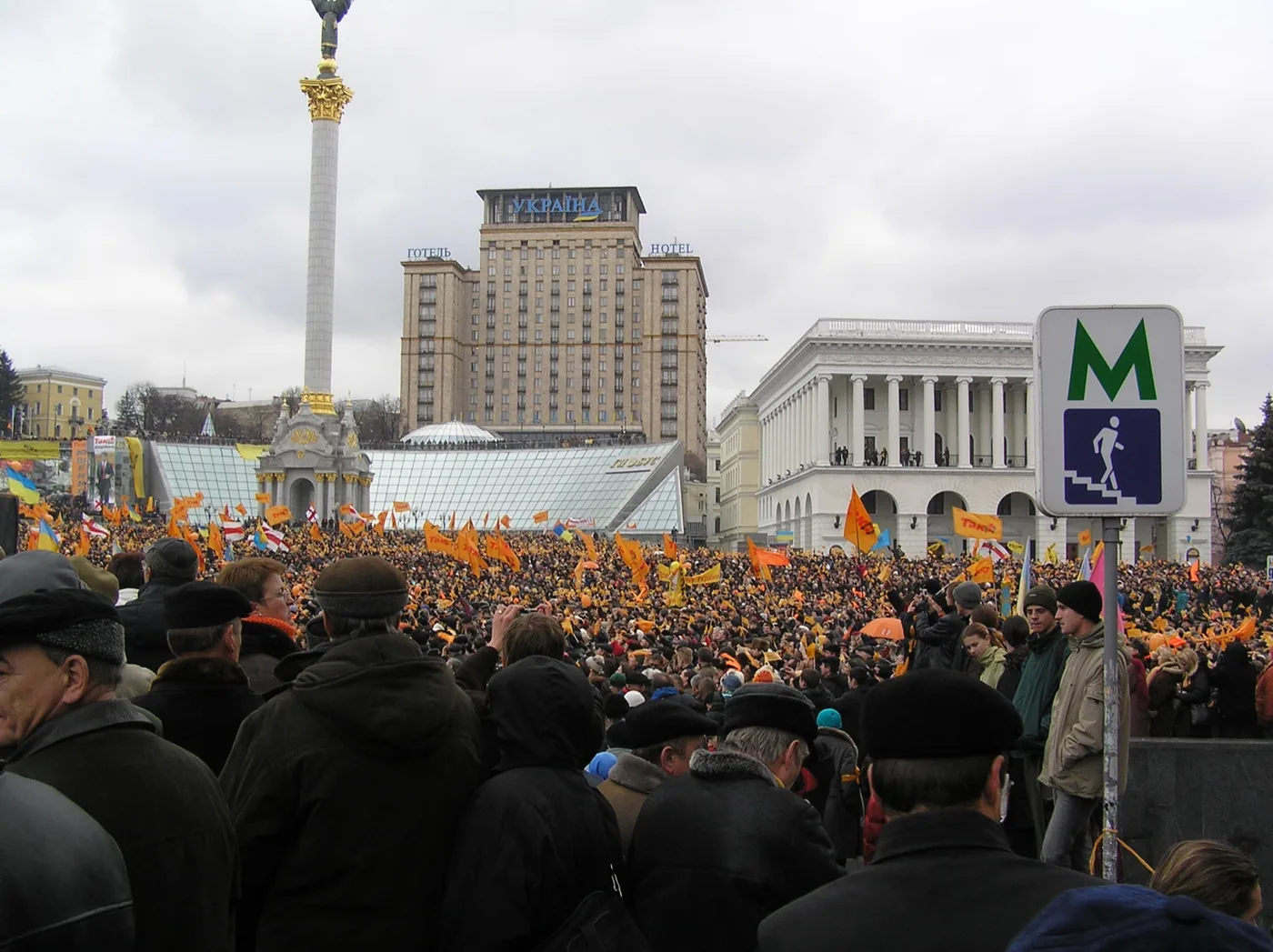
The Orange Revolution was a wave of peaceful protests in Ukraine from November 2004 to January 2005 that overturned a rigged presidential election. After the government declared Prime Minister Viktor Yanukovych the winner of a fraudulent runoff vote, hundreds of thousands of Ukrainians filled Kyiv's Independence Square wearing orange, the color of opposition candidate Viktor Yushchenko's campaign. They stayed for weeks in sub-zero cold until the courts intervened. Ukraine's Supreme Court annulled the results and ordered the vote held again. Yushchenko won the rerun and took office in January 2005, his face still visibly scarred from a dioxin poisoning two months before the election.
How Yushchenko was poisoned
On September 5, 2004, Viktor Yushchenko had dinner at the dacha of Volodymyr Satsiuk, the deputy head of Ukraine's Security Service. Within days, Yushchenko's face erupted in cysts and severe swelling. Doctors at a Vienna clinic found that his blood contained TCDD, the most toxic form of dioxin, at the second-highest concentration ever recorded in a human being. No one has been convicted. Yushchenko has said he believes the poisoning was ordered from Russia, but no concrete evidence has confirmed who was behind it.
Yushchenko survived and kept campaigning. He was 50 years old, a former head of Ukraine's National Bank who had served as prime minister from 1999 to 2001 before breaking with President Leonid Kuchma's government. He was known for his love of Ukrainian folk traditions and kept bees at his country home. By 2004, he had become the country's most prominent opposition figure, running on a platform of closer ties with Europe. His opponent, Viktor Yanukovych, was the current prime minister, supported by Kuchma and openly backed by Russia's president, Vladimir Putin. Putin visited Ukraine twice during the campaign. In late October, he stood beside Yanukovych at a military parade and appeared on Ukrainian television to praise Yanukovych's government.
How Ukrainians overturned a stolen election
The first round of the presidential election on October 31 ended in a near tie, with Yushchenko receiving 39.9 percent of the vote and Yanukovych 39.3 percent. The runoff on November 21 was supposed to settle it. Exit polls showed Yushchenko winning by roughly eleven points. The official count gave Yanukovych a three-point victory. International observers documented massive fraud: ballot-stuffing, falsified tallies, and turnout figures that were physically impossible. In some districts of Donetsk, Yanukovych's home region, recorded turnout approached 100 percent.
Ukrainians refused to accept the result. Within hours, crowds began gathering at Independence Square, known in Ukrainian as the Maidan. A tent city went up along Kyiv's main avenue. At the peak, close to a million people filled the capital, dressed in orange and chanting against the fraud. The protests continued through weeks of freezing weather, and they stayed entirely peaceful.
European mediators stepped in to prevent a violent crackdown. Poland's president, Aleksander Kwasniewski, along with the EU's foreign policy chief, Javier Solana, and Lithuania's president, Valdas Adamkus, brokered round-table talks between the government and the opposition. On December 3, 2004, Ukraine's Supreme Court annulled the fraudulent runoff and ordered it held again. The rerun on December 26 was monitored heavily by domestic and international observers. Yushchenko won with 52 percent to Yanukovych's 44 percent. He was inaugurated on January 23, 2005.
What happened after the Orange Revolution?
Briefly, Ukraine seemed like a model of peaceful democratic change in the post-Soviet world. Yushchenko appointed his ally Yulia Tymoshenko as prime minister in February 2005. The two fell out within months over policy and corruption allegations, and Yushchenko fired her that September. The broad coalition that had carried the revolution splintered into rival factions.
Yanukovych, the man the revolution had defeated, came back. His Party of Regions won the 2006 parliamentary elections, and Yushchenko was compelled to name him prime minister again. In 2010, Yanukovych won the presidency in a vote that international observers considered free and fair. A year later, Yanukovych had Tymoshenko prosecuted and imprisoned on charges that Western governments called politically motivated. The Orange Revolution showed that Ukrainians would fight for democratic elections, but the political change it brought did not last.
How the Orange Revolution shaped Putin's response to Ukraine
The Orange Revolution changed how Vladimir Putin dealt with Ukraine. He had openly backed Yanukovych and watched a friendly candidate lose to street protests that Putin believed the West had organized. He placed Ukraine's uprising alongside Georgia's Rose Revolution in 2003 as part of a series of "color revolutions" that he believed Western governments had engineered to topple leaders friendly to Russia, with Moscow itself as the final target.
That conviction shaped what came next. When Ukrainians rose again in the 2013–14 Euromaidan protests that removed Yanukovych from power, Putin responded by annexing Crimea and supporting separatist forces in eastern Ukraine. The belief that Western governments were behind these uprisings, which Putin first developed during the Orange Revolution, became central to the justifications Russia offered for its full-scale invasion of Ukraine in 2022.