
Euromaidan Revolution
The Euromaidan was a 2013–14 uprising in Kyiv that removed Ukraine's president and led to Russia's annexation of Crimea.
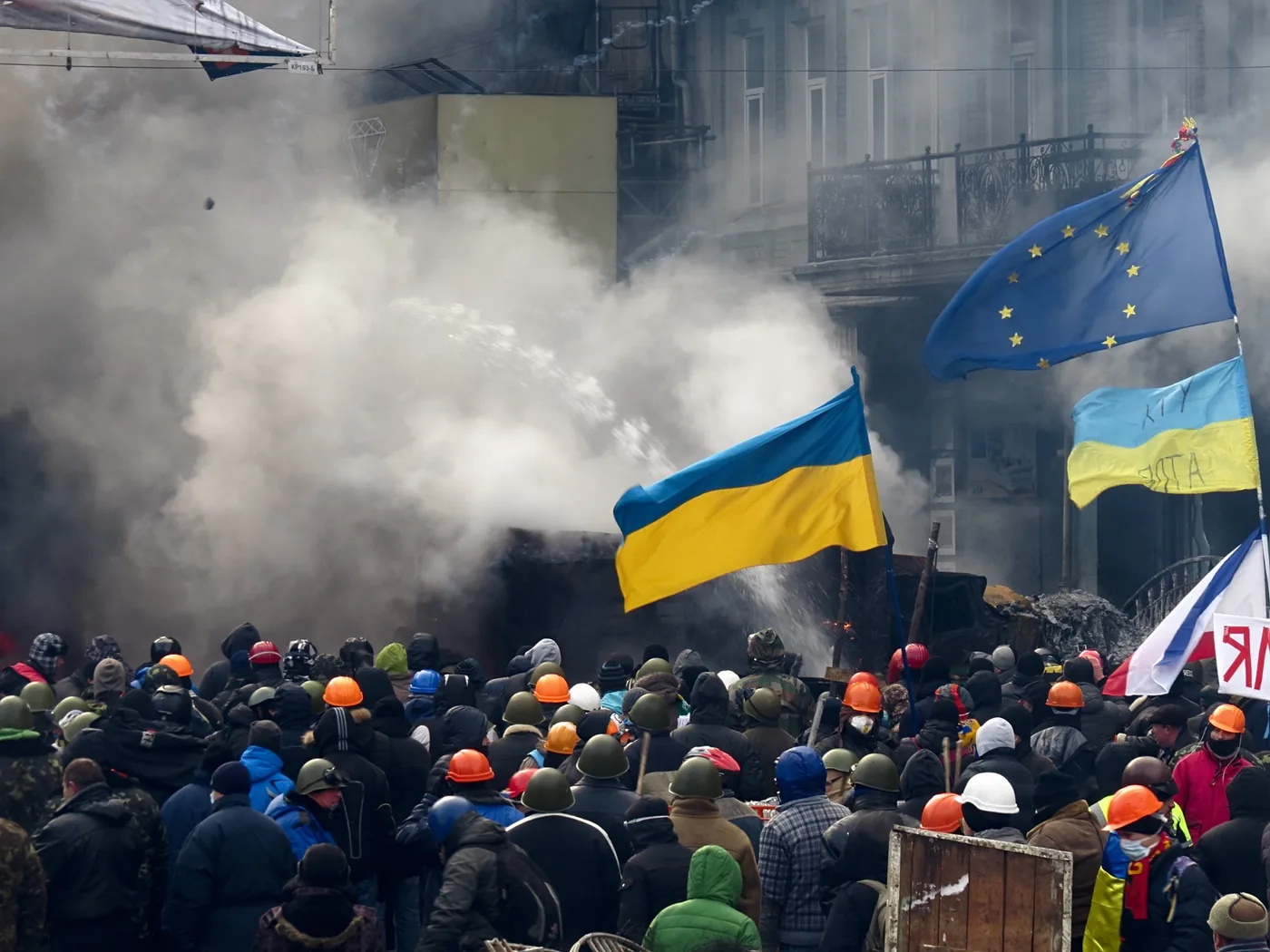
The Euromaidan was an uprising in Kyiv, Ukraine, that lasted from November 2013 to February 2014. It started when President Viktor Yanukovych refused to sign a trade agreement with the European Union, and it ended when he fled to Russia after more than a hundred people were killed in the streets. Ukrainians later named it the Revolution of Dignity. The consequences came fast: Russia annexed Crimea within a month, a war broke out in eastern Ukraine, and the country has been fighting over the choice made on the Maidan ever since.
How the Euromaidan began
For years, Ukraine had been negotiating an association agreement with the European Union. The deal promised closer trade, steps toward visa-free travel, and a path toward the kind of governance Ukrainians saw in Poland and the Baltic states. Ukraine had been through a similar moment before. In 2004, the Orange Revolution overturned a fraudulent election and brought a pro-Western government to power, but that government collapsed in infighting. Viktor Yanukovych, who had lost that earlier contest, won the presidency in 2010. He had grown up in the industrial east, been convicted of robbery and assault as a young man, and risen through regional politics to become governor of the Donetsk region before entering national office.
Yanukovych was expected to sign the EU agreement at a summit in Vilnius, Lithuania, in late November 2013. On November 21, his government announced it was walking away from the deal. Russia's president, Vladimir Putin, had threatened trade restrictions if Ukraine moved closer to Europe. Weeks later, Putin would offer Yanukovych a $15 billion loan and a steep cut in the price of Russian natural gas.
That same evening, Mustafa Nayyem, an Afghan-born journalist working in Kyiv, posted on Facebook asking anyone who was fed up to meet him at the Maidan, Kyiv's central square, at 10:30 p.m. More than a thousand people showed up. Within days the crowd grew to tens of thousands. On November 30, at 4 a.m., riot police from the Berkut special unit attacked the remaining demonstrators, most of them students, and beat them with batons in the streets around the square. Television footage of bloodied students spread across the country. The next day, hundreds of thousands filled central Kyiv.
How the Euromaidan turned deadly
The protesters occupied the square through the winter. They stacked barricades out of tires and paving stones, ran field kitchens, and organized self-defense units. On December 8, a crowd toppled Kyiv's statue of Lenin. Organizers called the rally the March of a Million.
On January 16, 2014, Yanukovych's allies in parliament pushed through a package of anti-protest laws that sharply restricted demonstrations and banned the wearing of helmets at rallies. Parliament repealed the laws twelve days later, but the confrontation kept escalating. The first protester deaths came on January 22 in clashes on Hrushevsky Street.
The worst violence came on February 18 through 20. Security forces, including snipers, opened fire on demonstrators near Instytutska Street in central Kyiv. Over those three days, dozens of people were killed. In all, more than a hundred protesters and at least thirteen police officers died during the Euromaidan. The slain protesters are honored in Ukraine as the Heavenly Hundred, Nebesna Sotnia.
On February 21, Yanukovych signed a compromise brokered by the foreign ministers of Germany, Poland, and France. It called for early elections, a unity government, and a return to the 2004 constitution. That same night, he left the capital. He surfaced days later in Russia and has not returned. On February 22, Ukraine's parliament voted 328 to 0 to remove him from office.
Why is it called the Revolution of Dignity?
The protests began under the name Euromaidan, combining "Euro" with "Maidan," the Ukrainian word for the square where the crowds gathered. In December 2013, Ukrainians began calling it the Revolution of Dignity. The name reflected what the movement had become. It started over a trade agreement, but it turned into a stand against a government that sent riot police to beat students at 4 a.m. The core demand was no longer the EU agreement. It was the right to hold power accountable.
What happened after the Euromaidan?
Within days of Yanukovych's departure, soldiers in unmarked uniforms appeared across Crimea. Russia annexed the peninsula in March 2014 after a referendum held under military occupation, breaking the security assurances it had given Ukraine in 1994 when Ukraine gave up the world's third-largest nuclear arsenal. Weeks later, Russian-backed separatists seized government buildings in the Donetsk and Luhansk regions of eastern Ukraine, starting a war that killed an estimated 14,000 people over eight years.
Russia's government called the Euromaidan a Western-backed coup against a legitimate president and used that framing to justify its interventions. Ukraine's new government signed the EU association agreement that Yanukovych had refused and has pursued European integration ever since.
On February 24, 2022, Russia launched a full-scale invasion of Ukraine, the largest land war in Europe since 1945. The question at the center of the Euromaidan was whether Ukraine would look toward Europe or toward Russia. It is the question the war is still being fought over.