
Panmunjom
Panmunjom is the site in the Korean DMZ where the 1953 armistice was signed and where North and South Korea still meet.
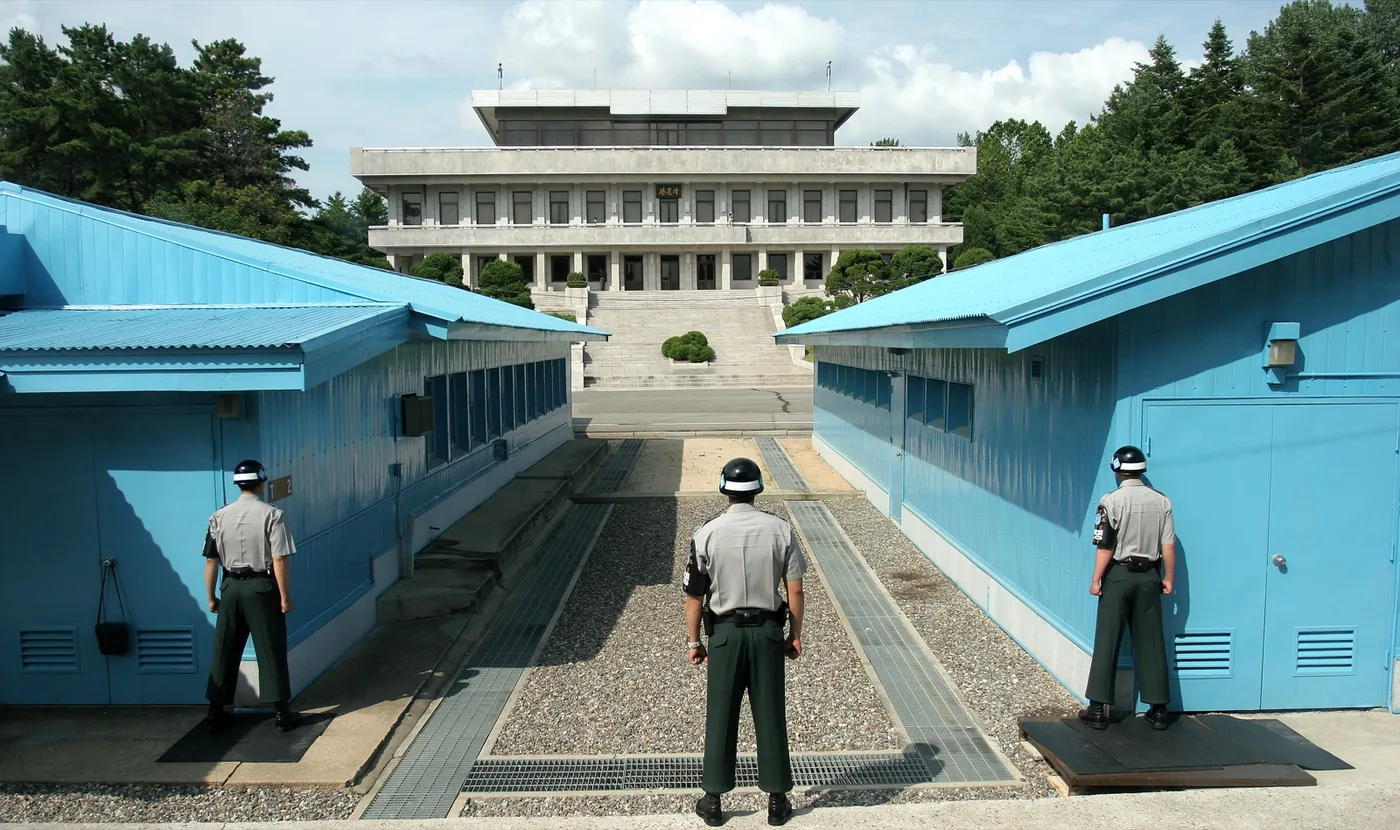
Panmunjom is a former farming village in the Korean Demilitarized Zone where the armistice that stopped the Korean War was signed on July 27, 1953. The village itself was destroyed during the fighting. About 800 meters from where it stood, a cluster of light blue conference huts marks the Joint Security Area, the one place where North and South Korean soldiers stand meters apart. A line runs along the center of the conference tables inside the huts and marks the border between the two countries. No peace treaty was ever signed after the armistice, so North and South Korea are still technically at war. For more than seventy years, Panmunjom has been the one place on the border where the two Koreas meet face to face.
How Panmunjom became the truce site
Armistice negotiations between the United Nations Command and the North Korean and Chinese forces began at Kaesong in July 1951, a year into the Korean War. After disputes over security at Kaesong, the talks moved to the village of Panmunjom in October 1951. They went on for nearly two more years, mostly over the question of whether prisoners of war should be forced to return home.
On July 27, 1953, Lieutenant General William K. Harrison Jr. of the United Nations Command and General Nam Il of the Korean People's Army signed the armistice in a purpose-built hall at Panmunjom. South Korea's president, Syngman Rhee, refused to sign. He wanted the war to continue until Korea was reunited. The armistice stopped the shooting but left the two countries without a peace treaty. That has not changed.
To manage the ceasefire, the two sides that signed the armistice established the Joint Security Area near the old village. The JSA is the only place along the 38th parallel where the two Koreas can meet face to face. Freedom House sits on the southern side. The pillared Panmungak faces it from the north. Between them sit the blue conference huts that have appeared in photographs of the DMZ for decades. At the western edge of the JSA lies the Bridge of No Return, where prisoners of war were exchanged after the armistice. Each prisoner had to choose a side, and the crossing was permanent.
The killing that divided the Joint Security Area
For years after the armistice, soldiers from both sides moved freely across the Joint Security Area. That changed on August 18, 1976.
That morning, a work party went out to trim a poplar tree near the Bridge of No Return that blocked the line of sight between a United Nations checkpoint and an observation post. North Korean guards told the party to stop. When it continued, the guards attacked with axes and killed First Lieutenant Mark Barrett and Captain Arthur Bonifas, both American officers.
Three days later, the United States and South Korea sent 813 troops, backed by B-52 bombers, fighter aircraft, and dozens of helicopters, to fell the tree, a display of force called Operation Paul Bunyan. North Korea did not intervene.
After the killings, the JSA was divided along the Military Demarcation Line. Neither side crosses it. A United Nations Command camp just south of the DMZ was later renamed Camp Bonifas in honor of the captain.
Summits and defections at Panmunjom
The Joint Security Area has been the site of both desperate escapes and carefully staged diplomacy.
On November 13, 2017, a North Korean soldier named Oh Chong-song drove a vehicle to the border, jumped out, and ran south under fire. North Korean guards fired about 40 rounds and hit him five times. South Korean soldiers dragged him to safety, and he survived after emergency surgery.
On April 27, 2018, South Korea's president, Moon Jae-in, and North Korea's leader, Kim Jong-un, met at the Peace House on the southern side of the JSA. They shook hands over the concrete border marker and walked together across the line, first north, then south. The two leaders signed the Panmunjom Declaration, pledging to work toward a peace treaty. No treaty followed.
On June 30, 2019, Donald Trump walked about 20 steps into North Korea at Panmunjom, becoming the first sitting American president to enter North Korea. He and Kim Jong-un spoke for about 50 minutes. No deal came of it. Nuclear talks between the two countries broke down that October and have not resumed.
In July 2023, an American soldier named Travis King ran across the border into North Korea during a tour of the JSA. North Korea expelled him two months later. The United Nations Command suspended civilian tours of the JSA after the incident, and as of 2026 visitors can no longer enter the blue conference huts.
Seven decades after the fighting stopped, no peace treaty has been signed. Panmunjom remains the place where the two Koreas manage a war that never officially ended.