
Kim Dynasty
The Kim dynasty is the family that has ruled North Korea since 1948, passing power from grandfather to father to son.
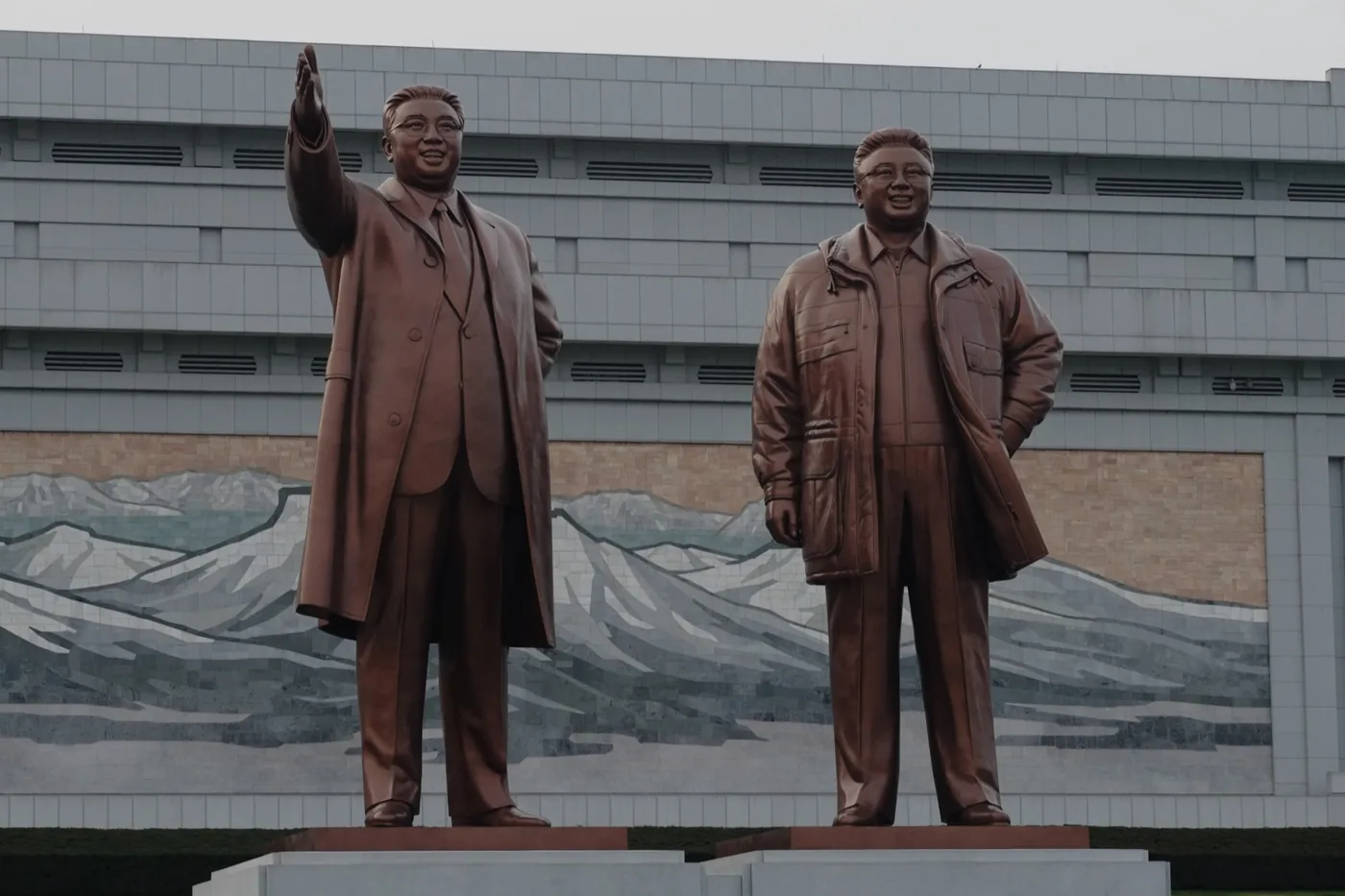
Three men named Kim have ruled North Korea since 1948. Kim Il-sung founded the state, Kim Jong-il inherited it, and Kim Jong-un runs it today. Together they have held absolute power for more than 75 years, making theirs the longest-ruling family in any communist country and the only one where power became hereditary. The regime calls the family the "Mount Paektu bloodline," after the sacred mountain on the Chinese-Korean border, and treats their right to rule as something close to a religious claim. North Korea is a nuclear-armed state with an estimated 60 warheads, a population of about 26 million, and an economy smaller than Cambodia's.
How Kim Il-sung came to power
Kim Il-sung was born Kim Song-ju near Pyongyang on April 15, 1912. His family moved to Manchuria in the 1920s to escape Japanese-occupied Korea. As a young man he joined communist guerrilla units fighting the Japanese, and by his mid-twenties he commanded a few hundred fighters. When Japanese pressure grew too strong, he crossed into the Soviet Union around 1940 and served in the Red Army's 88th Separate Rifle Brigade.
After Japan's surrender in 1945, the Soviet Union occupied the northern half of Korea above the 38th parallel. Soviet authorities chose Kim, then 33, to lead the new state. He was young, had genuine credentials as an anti-Japanese fighter, and was willing to follow Moscow's direction. On September 9, 1948, the Democratic People's Republic of Korea was officially proclaimed with Kim as premier.
Kim spent the next four decades building one of the most controlled societies in history. He made Juche, his own ideology of national self-sufficiency, the state's guiding idea. He gave the leader, called the Suryong, an almost divine role: the one mind that directs the entire nation. Portraits of Kim hung in every home, statues stood in every city, and in 1997 the country adopted a new calendar that begins with his birth year. By the time he died on July 8, 1994, the personality cult was so total that the constitution was later rewritten to name him "Eternal President," a title given to a dead man.
How power passed through three generations
Kim Il-sung's son, Kim Jong-il, was designated successor in 1980 and took full control after his father's death in 1994. The regime claimed Kim Jong-il had been born in 1942 at a guerrilla camp on Mount Paektu, Korea's highest and most sacred mountain. Soviet records show he was actually born in 1941 in a village near Khabarovsk, in the Russian Far East, while his father was training with the Red Army.
Kim Jong-il's early years in power were catastrophic. The Soviet Union, North Korea's main trading partner and aid source, had collapsed in 1991. The economy followed. Between 1994 and 1999, a famine the regime later called the "Arduous March" killed between 240,000 and a million people out of a population of about 22 million. While the population starved, Kim Jong-il spent heavily on missiles and a program to build nuclear weapons. North Korea tested its first nuclear device on October 9, 2006.
The pattern set during the famine has not changed: the state's survival comes before the population's survival.
When Kim Jong-il died on December 17, 2011, power passed to his youngest son, Kim Jong-un, who was about 27 or 28. His exact birth year is disputed. Kim Jong-un had spent part of his childhood at a private school near Bern, Switzerland, under a false name. He had almost no public profile before being named a four-star general in 2010.
The young leader moved quickly to remove anyone who might challenge him. In December 2013, he had his uncle Jang Song-thaek, the country's second most powerful official, arrested, tried by a military tribunal, and executed within days. In February 2017, Kim Jong-nam, his half-brother who had been living in exile, was killed at Kuala Lumpur International Airport when two women smeared VX nerve agent on his face. South Korean and American intelligence blamed North Korean agents.
Kim Jong-un has pushed the nuclear program further, to hydrogen bombs and intercontinental ballistic missiles. As of 2026, outside estimates put North Korea's arsenal at about 60 assembled warheads, with enough fissile material for more. The country funds its military through Chinese trade, arms sales to Russia, cryptocurrency theft, and wages from workers sent abroad. The Orbis blog covers where North Korea gets its money in detail.
What is the Mount Paektu bloodline?
The regime calls the Kim family the "Mount Paektu bloodline," tying their authority to Korea's most sacred mountain. The term is more than symbolic. North Korea's entire system of control is built around the idea that the Kim family's right to rule is inherited and absolute.
Every North Korean citizen is classified under songbun, an inherited caste system based on how loyal the state considers a person's ancestors to have been. Songbun determines where a person can live, what work they can do, and whether they can attend university. A large security service watches for dissent. Political prison camps, known as kwanliso, hold people accused of disloyalty and, under a principle of guilt by association, their families. Estimates of the prison population range from about 80,000 to 120,000.
The cult around the Kim family reaches into daily life. Portraits of Kim Il-sung and Kim Jong-il hang in every home and office. Citizens wear pins bearing the leaders' images. The official story presents the Kims as the rightful and permanent guardians of the Korean people.
Why has the Kim dynasty survived?
The Kim family has survived longer than the Soviet Union, the state that built North Korea in the first place. It endured a famine that killed hundreds of thousands of its own people and has defied repeated predictions of collapse.
Part of the answer is the control system: songbun, the security services, and the prison camps leave little room for organized opposition. But the regime also drew a lesson from what happened to other leaders who lacked nuclear weapons. Iraq's Saddam Hussein was overthrown by the United States in 2003 and executed in 2006. Libya's Muammar Gaddafi gave up his nuclear program in 2003 and was overthrown and killed in 2011. North Korea's leadership concluded that giving up nuclear weapons means death.
The nuclear arsenal serves one purpose above all others: making sure no foreign power can overthrow the Kim family. The regime treats the bomb not as something to give away in negotiations, but as the guarantee that the dynasty continues.