
Socrates
Socrates was an Athenian philosopher who never wrote anything, questioned people in the marketplace, and was executed by Athens in 399 BC.
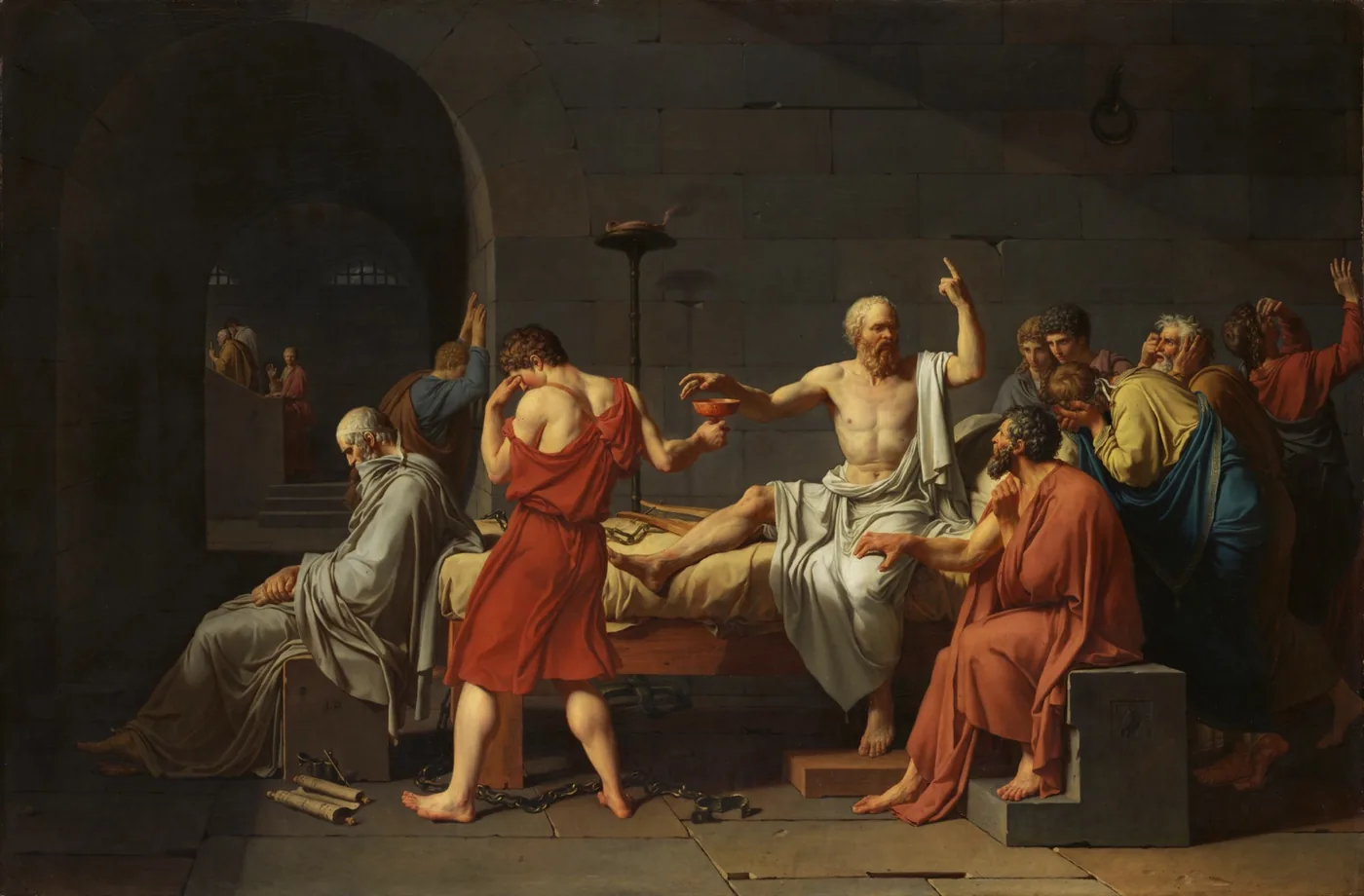
Socrates was an Athenian philosopher born around 470 BC. He never wrote a single word. He held political office only once and owned little. Most days he could be found barefoot in the agora, Athens's central public square. He approached generals, politicians, and craftsmen and asked them to define concepts like courage, piety, and what it means to live rightly. Then he took apart their answers one question at a time. This technique, which became known as the Socratic method, made him one of the most influential figures in the history of Western thought. In 399 BC, Athens's own democracy put him on trial and sentenced him to death. His student Plato turned him into the main character of philosophical dialogues that shaped the field for the next two thousand years.
How Socrates lived
Socrates was the son of Sophroniscus, a stonemason, and Phaenarete, a midwife. He probably learned his father's trade as a young man before turning to philosophy full time. He married Xanthippe, who was much younger than him and had a reputation for being difficult. In a dialogue by the writer Xenophon, Socrates's friend Antisthenes calls her the hardest woman alive to live with. They had three sons.
Socrates served as a hoplite, an armored foot soldier, during the Peloponnesian War. He fought at the siege of Potidaea in 432 BC, where he saved the life of a young soldier named Alcibiades. He fought again at the battle of Delium in 424 BC, where the Athenian general Laches praised his courage during a difficult retreat. His last known battle was at Amphipolis in 422 BC. People who served with him described Socrates as physically tough and indifferent to cold, hunger, and drink.
Socrates gave up his trade and spent his time walking through the agora, talking to anyone who would engage. He did not open a school or charge fees. He would ask a person to define something they claimed to understand, then follow up with questions that exposed contradictions in their definition. One question at a time, the person's certainty would collapse. Socrates said his only advantage over other people was that he knew he knew nothing, while they were confident about things they could not explain.
Why Athens put Socrates to death
In 399 BC, a poet named Meletus charged Socrates with two crimes: impiety, meaning he failed to honor Athens's gods and introduced new ones, and leading young people astray. The formal charges were religious, but the actual motive was political. For decades, Socrates had publicly questioned whether average citizens were fit to govern. Some of the people he had taught went on to do serious harm to Athens. Alcibiades, the same man Socrates had saved at Potidaea, defected to Sparta. Critias led the Thirty Tyrants, a violent junta that Sparta installed over Athens after Athens lost the Peloponnesian War in 404 BC. An amnesty passed after the war made it illegal for prosecutors to name these associations directly, so the charges were framed around religion instead.
A jury of 501 Athenian citizens heard the case. Socrates served as his own defense. He told the jurors he was like a gadfly on a horse: the horse was Athens, and his job was to sting it awake. He said the city should be thanking him, not prosecuting him. The jury convicted him by a vote of 280 to 221. Under Athenian law, the convicted person could then propose an alternative punishment. Socrates could have suggested exile, and the jury might well have accepted. Instead, he proposed that Athens reward him with free meals at the Prytaneum, an honor reserved for Olympic victors and great benefactors. The jury voted for death by a wider margin than it had voted for guilt.
Socrates's friends arranged for him to escape from prison, but he refused. He said that a man who had spent his whole life under Athens's laws could not run away when those laws turned against him. He drank a cup of poison hemlock and died surrounded by his students. He was about 70 years old.
What is the Socratic method?
The Socratic method is a way of teaching and arguing by asking questions rather than making statements. Socrates did not lecture or present a system of ideas. He started by asking someone to define a concept, then asked follow-up questions that forced the person to examine their own assumptions. When the answers contradicted each other, the person had to either refine the definition or admit they did not know. Scholars call this process elenchus, a Greek word for cross-examination.
The purpose was not to embarrass. Socrates believed that most people, including powerful and educated ones, hold beliefs they have never tested. Admitting ignorance was, in his view, the first real step toward understanding. The method survived him. Law schools, medical schools, and philosophy departments still use versions of it, and the basic idea, that questioning your own assumptions teaches more than collecting new facts, has shaped Western education ever since.
How do we know what Socrates said?
Everything known about Socrates comes from other people. He wrote nothing himself. Plato made him the main speaker in dozens of philosophical dialogues, but Plato had strong ideas of his own and used Socrates as a voice for them. Xenophon, a soldier and writer who also knew Socrates, left a more practical portrait. The comic playwright Aristophanes mocked Socrates in his plays as an absurd figure who talked endlessly about nothing. These three sources disagree with each other so deeply that scholars have a name for the puzzle: the Socratic problem. No one can be sure where the historical Socrates ends and the literary character begins.
What is clear is that Socrates spent decades asking questions that made powerful people uncomfortable, and when Athens punished him for it, he accepted death rather than stop. His trial remains one of the oldest and most discussed examples of a democracy punishing someone for speaking freely.