
Battleship Potemkin Mutiny
The 1905 mutiny aboard the Russian battleship Potemkin, sparked by rotten meat and put down after eleven days.
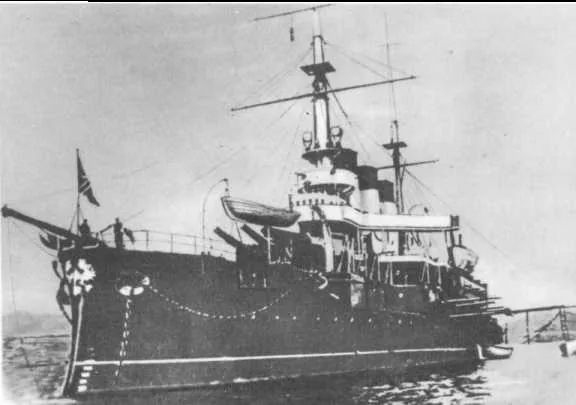
The Battleship Potemkin mutiny was a revolt by sailors aboard the Russian battleship Potemkin in June 1905. The crew refused to eat meat crawling with maggots, an officer shot and killed a sailor who objected, and the rest of the crew seized the ship and killed seven of its officers. They sailed to the port of Odessa, where troops fired on crowds of civilians, and then fled to Romania after failing to spark a wider revolt across the Black Sea Fleet. The mutiny lasted eleven days and failed. But a 1925 silent film by Sergei Eisenstein, Battleship Potemkin, turned the story into a founding myth of the Russian Revolution and made it the best-known naval revolt of the twentieth century.
How the mutiny on the Potemkin began
In June 1905 the Russian Empire was in crisis. Russia had just lost a war against Japan, and strikes and uprisings were spreading across the country. The Potemkin, the newest battleship in the Black Sea Fleet, was anchored off Tendra Spit, between Odessa and Crimea, for gunnery practice with a crew of about 730 men.
On a day in late June, the cooks complained that the beef delivered for the crew's borscht was infested with maggots. The ship's doctor inspected the meat and declared it fit to eat. At the midday meal, most of the crew refused to touch the food. The ship's second-in-command, Commander Ippolit Giliarovsky, threatened to shoot anyone who would not eat.
Two sailors had been organizing a mutiny for months. Afanasy Matushenko, a torpedo quartermaster, and Grigory Vakulenchuk, a sailor and socialist organizer, had been recruiting sympathizers aboard the ship and across the fleet. The rotten meat forced their hand early. When Giliarovsky ordered the marine guards to fire on the men who refused to eat, the marines would not obey. In the struggle that followed, Giliarovsky shot Vakulenchuk in the chest, killing him. The enraged crew grabbed rifles and turned on the officers. They killed Giliarovsky, the captain (Evgeny Golikov), the doctor, and four other officers, throwing some of the bodies overboard. The rest of the officers were locked below. The crew raised a red flag and elected a committee to run the ship, with Matushenko as chairman.
The Potemkin at Odessa
The committee sailed the Potemkin to Odessa, where a general strike was already under way. They carried Vakulenchuk's body ashore and laid it on the quayside with a note pinned to his chest. Thousands of people came to see it. The crowd grew through the day, and anger at the government spread through the city.
The authorities sent troops. Soldiers and Cossacks fired on the crowds in the streets near the harbor, and the killing went on for hours. Estimates of the dead range from several hundred to more than a thousand.
Tsar Nicholas II's government also sent a squadron of warships to destroy the Potemkin. When the two forces met at sea, the sailors in the government squadron refused to fire on the mutineers and let the Potemkin pass through their line. The mutineers had hoped this meant the rebellion would spread to the whole fleet, but the fleet as a whole did not join them.
How the Potemkin mutiny ended
The Potemkin was running low on coal and fresh water. No port would supply the ship with coal. After eleven days, the crew sailed to Constanța in Romania and surrendered on July 8, 1905. The Romanian government gave most of the crew political asylum, and the ship was returned to Russia, where the navy renamed it Panteleimon.
Matushenko lived in exile in Romania, Switzerland, the United States, and France. In 1907 he returned to Russia under a false name. He was caught, tried by a military court in Sevastopol, and hanged at the age of 28.
The mutiny had failed to start a revolution, but it frightened the tsarist government. The armed forces were supposed to be the regime's last reliable tool for keeping order. When sailors started refusing orders and killing their officers, the government could no longer count on force alone to hold power. The 1905 revolution forced Nicholas II to grant a constitution and a parliament. Twelve years later, in 1917, the regime collapsed for good.
Eisenstein's Battleship Potemkin and the Odessa Steps
Most people know the Potemkin mutiny through a film, not through the history. In 1925 the Soviet government asked the director Sergei Eisenstein to make a film marking twenty years since the 1905 Revolution. The result, Battleship Potemkin, is now considered one of the most important films in cinema history.
The film's most famous sequence is the Odessa Steps scene. Tsarist soldiers march in formation down the wide stone staircase above Odessa's harbor, firing into a crowd of unarmed civilians. A mother is shot carrying her child. A baby carriage breaks loose and rolls down the steps among the bodies. The sequence lasts about six minutes and has been studied, copied, and parodied by filmmakers for a century.
The scene is invented. There was real killing in Odessa in June 1905, but it did not happen on those steps and not in the way the film shows it. Eisenstein created the scene for dramatic effect, and the Soviet government was happy to let the film replace the actual history in public memory.
The real mutiny was a chaotic revolt by hungry sailors that lasted less than two weeks and failed. The film turned it into a simple story of the people rising against a tyrant. That version became the one most of the world remembers, but it is not the same story.