
Qassem Soleimani
Qassem Soleimani commanded Iran's Quds Force and directed its wars across the Middle East for two decades until a US drone strike killed him in 2020.
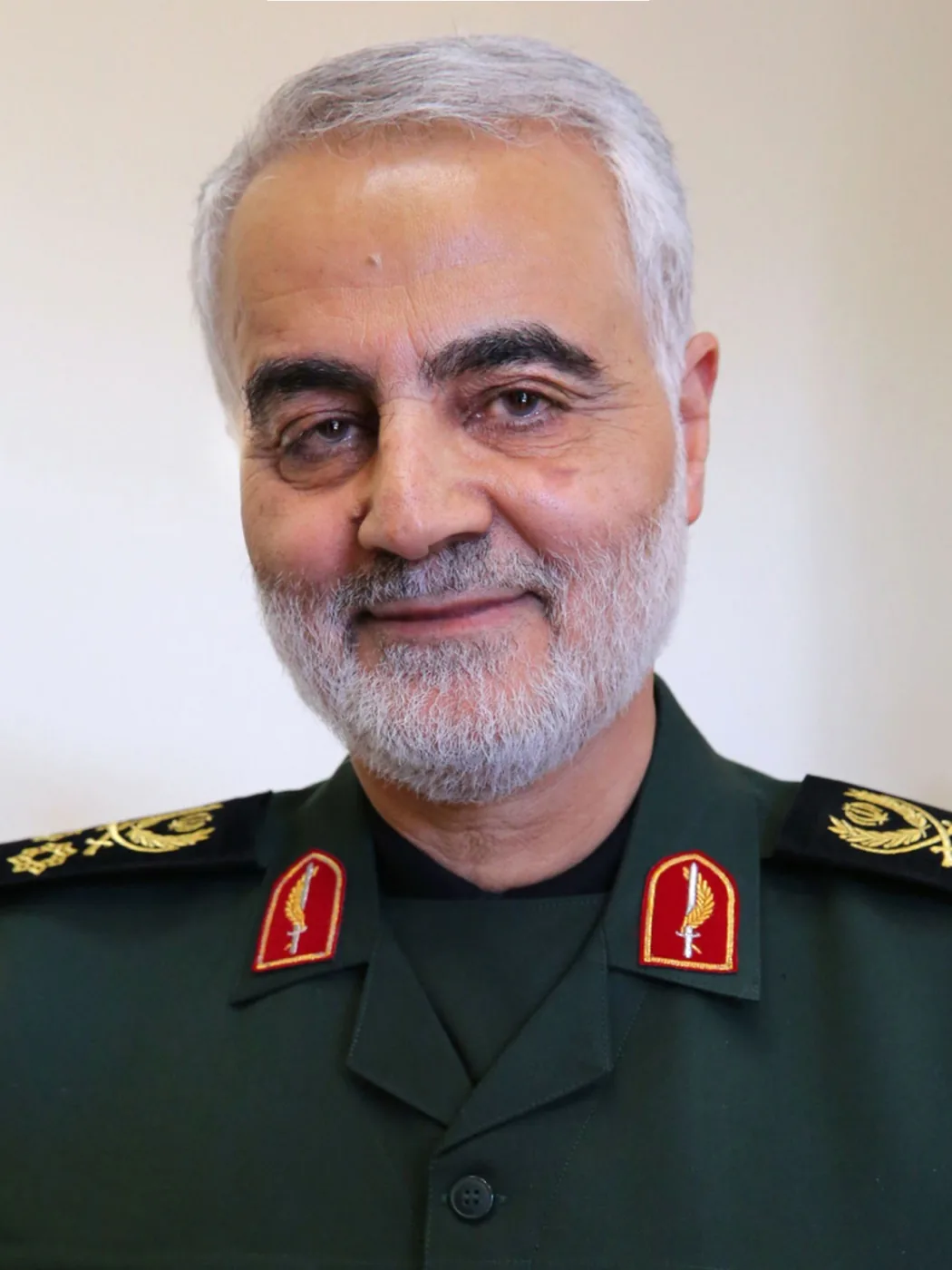
Qassem Soleimani was an Iranian military commander who led the Quds Force, the branch of the Islamic Revolutionary Guard Corps (IRGC) responsible for operations outside Iran. He held the post from 1998 until a United States drone strike killed him near Baghdad's airport on January 3, 2020. He was 62 years old. For most of those two decades, Soleimani worked out of public view. He gave few interviews and avoided cameras while directing wars in Lebanon, Syria, Iraq, and Yemen through networks of armed groups rather than Iranian soldiers. By many accounts, he was the second most powerful person in the country, behind only Supreme Leader Ali Khamenei.
How Soleimani rose through Iran's military
Soleimani was born in 1957 to a poor farming family near Rabor, in Iran's Kerman province. As a teenager he traveled to the city of Kerman to work as a construction laborer, paying off a debt his father owed. He had no more than a high school education and worked for the local water department before the 1979 revolution. During that period he began attending sermons by a preacher close to Ali Khamenei, which drew him toward the revolutionary movement.
After the revolution he joined the newly formed IRGC and fought through the Iran-Iraq War (1980–1988). Eight years of combat earned him a reputation for courage and frontline leadership. Between late 1997 and early 1998, he was appointed commander of the Quds Force. Under Soleimani, it became Iran's main tool for projecting power across the Middle East. His approach was consistent: find, train, arm, and direct armed groups in other countries so that Iran could fight its rivals without sending its own army across a border. The network he built included Lebanon's Hezbollah, Iraqi Shia militias, the Houthis in Yemen, and armed Palestinian groups.
Soleimani's campaigns in Syria and Iraq
Soleimani's largest operation was in Syria. When Bashar al-Assad's government was close to collapse in 2012 and 2013, Soleimani traveled to Syria to assess the situation, then to Lebanon to ask Hezbollah's leader, Hassan Nasrallah, to send fighters. He organized Hezbollah units, Shia militias recruited from Iraq, Afghanistan, and Pakistan, and Iranian military advisers into a force that kept Assad in power through years of civil war. Assad held on until December 2024, when rebel forces finally overthrew him.
When the Islamic State (ISIS) swept across northern Iraq in 2014, Soleimani helped coordinate the Shia militias that stopped its advance. He appeared in person at front lines in Tikrit, Aleppo, and other contested cities, and photographs of him at the front spread across Iranian social media and billboards. Many Iranians came to see him as a national figure, a poor farmer's son who had risen to defend the country at its borders. To American military officials, he was the person behind the militia attacks and roadside bombs that had killed hundreds of US troops in Iraq.
Why did the United States kill Soleimani?
The killing followed months of escalation. On December 27, 2019, rockets hit a military base near Kirkuk in northern Iraq, killing an American contractor and wounding several US service members. The United States blamed Kata'ib Hezbollah, an Iranian-backed Iraqi militia. Two days later, American airstrikes hit the militia's positions in Iraq and Syria. On December 31, militia supporters stormed the US embassy compound in Baghdad, breaching the outer walls and setting fires before withdrawing.
President Donald Trump ordered the drone strike that killed Soleimani on January 3, 2020, as his convoy left Baghdad's international airport. Abu Mahdi al-Muhandis, the deputy commander of Iraq's Popular Mobilization Forces and one of Soleimani's closest Iraqi allies, died in the same attack. The administration said Soleimani had been planning further attacks on American personnel.
What happened after Soleimani was killed?
Supreme Leader Khamenei declared three days of national mourning and vowed retaliation. Millions of Iranians filled the streets for funeral processions across several cities. In Kerman, Soleimani's hometown, a stampede during the burial procession killed 56 people and injured more than 200.
On January 8, Iran fired ballistic missiles at Ain al-Asad Air Base in western Iraq, which housed US troops. Iran warned Iraq's government before the strike. No one was killed immediately, but more than 100 American service members were later diagnosed with traumatic brain injuries from the blasts. In the tense hours after the missile strikes, Iran's air defenses mistakenly shot down Ukraine International Airlines Flight 752 shortly after it took off from Tehran, killing all 176 people on board.
The United States and Iran pulled back from further escalation in January 2020. Six years later, in February 2026, a wave of American and Israeli strikes killed Khamenei along with the head of the IRGC and several other senior military officials. Open war between Iran and the United States followed.
Soleimani spent two decades building the network of armed groups that gave Iran the ability to fight across the Middle East without using its own conventional army. That network shaped conflicts in four countries and outlasted him.