
Ulysses S. Grant
Ulysses S. Grant commanded the Union armies in the Civil War and served two terms as the 18th president of the United States.
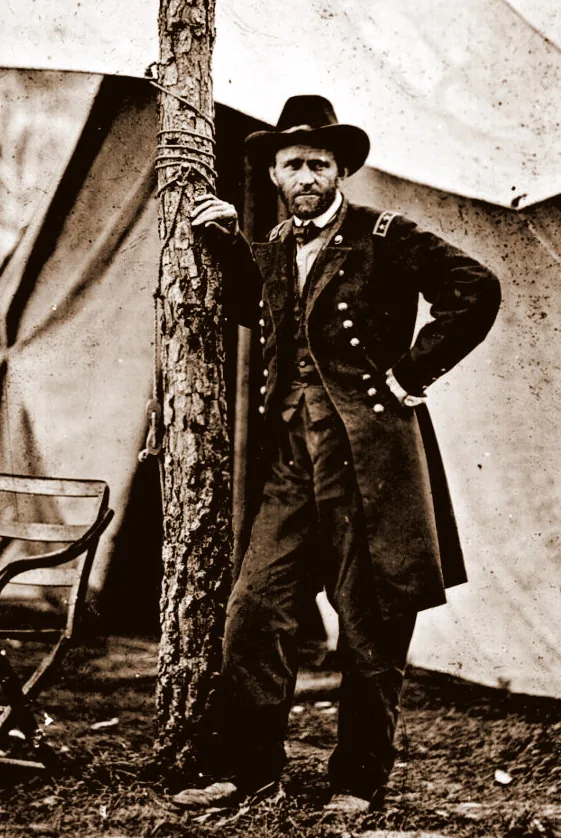
Ulysses S. Grant commanded the Union armies to victory in the American Civil War and then served two terms as the 18th president of the United States. He was born in Point Pleasant, Ohio, in 1822. His given name was Hiram Ulysses Grant, but a clerical mistake in his West Point nomination turned it into Ulysses Simpson Grant, and the academy refused to change it. He graduated in 1843, fought in the Mexican-American War, and resigned from the army in 1854 after his commanding officer at Fort Humboldt, California, gave him a choice between a court-martial for drinking and a quiet departure. By the spring of 1861, Grant was 38 and selling goods behind the counter of his father's leather shop in Galena, Illinois. He had tried farming, bill collecting, and real estate and come up short every time. By 1865, the Confederacy had surrendered to him.
How Grant won the Civil War
Grant rose quickly because he grasped what the war required better than anyone above him. At Fort Donelson in February 1862, the Confederate commander asked what terms Grant would offer. Grant answered that only "unconditional and immediate surrender" would do. His initials, U.S., fit the phrase so neatly that newspapers began calling him Unconditional Surrender Grant.
Two months later at Shiloh, Union troops were beaten badly on the first day. Grant told General William Tecumseh Sherman, "Lick 'em tomorrow, though," and the next morning they did. At Vicksburg, Grant cut loose from his own supply lines, swung his army around the city, and forced its surrender on July 4, 1863. Losing Vicksburg split the Confederacy in two along the Mississippi River.
Grant saw a fact that other Union commanders had missed: the Confederacy could not replace the men and equipment it lost, but the Union could. Once Abraham Lincoln made him general-in-chief of all Union forces in 1864, Grant ran the war as a single coordinated campaign. Sherman marched into Georgia. Philip Sheridan burned the Shenandoah Valley. Grant kept himself pressed against Robert E. Lee's army in Virginia, absorbing terrible losses at the Wilderness, Spotsylvania Court House, and Cold Harbor. Opponents labeled him a butcher. But across the full war, the share of Grant's soldiers killed or wounded relative to the forces he fielded was actually smaller than Lee's. Grant looked costlier because he never pulled back after a battle, so his losses piled up in the headlines all at once.
On April 9, 1865, at Appomattox Court House, Grant set terms that were designed to end the fighting for good. Confederate officers kept their sidearms. Soldiers who owned horses could take them home for the spring planting. Nobody faced treason charges so long as they stayed peaceful. The generosity helped prevent the war from splintering into years of irregular fighting.
Grant's presidency and Reconstruction
Elected president in 1868, Grant held office for eight years and used them to defend the civil rights gains of the war. He championed the Fifteenth Amendment, which protected Black men's right to vote. He signed the Enforcement Acts, which made it a federal offense to use terror or threats to keep people from the polls. In 1870 he established the Department of Justice, in large part to wage this legal campaign. Its first attorney general, Amos T. Akerman, focused the new department on the Ku Klux Klan. The following year Grant deployed federal troops and marshals across South Carolina, suspended the right of habeas corpus in nine of its counties, and broke the Klan's first incarnation. Federal prosecutors brought more than 1,000 indictments. No occupant of the White House between Grant and Dwight Eisenhower, some 80 years later, would act as forcefully on civil rights.
Grant also tried a different approach to Native nations, rejecting extermination in favor of what he called a peace policy. It was condescending and frequently fell short in practice, but it represented a conscious decision to stop treating entire peoples as enemies to be destroyed.
Reconstruction did not survive long after Grant left office. It was dismantled by a weary Northern public, a series of hostile Supreme Court rulings, and the backroom deal that resolved the contested 1876 presidential election.
Was Grant a good president?
For most of the 20th century, historians ranked Grant near the bottom of the presidential list. The main charge was corruption. His administration was stained by the Whiskey Ring fraud, the Credit Mobilier affair, and the indictment of his private secretary, Orville Babcock. Grant was personally honest but repeatedly gave his trust to people who did not deserve it. The Panic of 1873, a severe financial crisis, hit during his second term and deepened the case against him.
That verdict has changed sharply. Biographies by Ronald C. White in 2016 and Ron Chernow in 2017 argued that the old ranking ignored Grant's central purpose as president: protecting the rights of formerly enslaved people. A 2024 poll of 154 presidential scholars placed Grant 17th overall, far above the bottom tier where he had sat for decades. The new consensus is that his commitment to Reconstruction was the most important thing any president did for Black Americans between Lincoln and Lyndon Johnson.
Grant's memoirs and final year
In May 1884, the Wall Street firm of Grant & Ward collapsed. Grant's business partner, Ferdinand Ward, had been operating a Ponzi scheme, and the failure wiped out everything Grant had. Within months, Grant learned he had throat cancer.
The publisher and humorist Mark Twain proposed a book deal on favorable terms and pushed Grant to write. For nearly a year, Grant worked on his memoirs through worsening pain, often scrawling notes on slips of paper when his voice gave out. He completed the manuscript just days before he died, on July 23, 1885, at a cottage on Mount McGregor in upstate New York. He was 63 years old.
Personal Memoirs of U.S. Grant sold over 300,000 two-volume sets and brought Grant's widow, Julia, about $450,000. The writing is direct, precise, and completely without vanity. It is still considered the best military memoir produced by an American.