
Rwandan Genocide
The Rwandan genocide killed about 800,000 people, mostly Tutsi, in a hundred days in 1994.
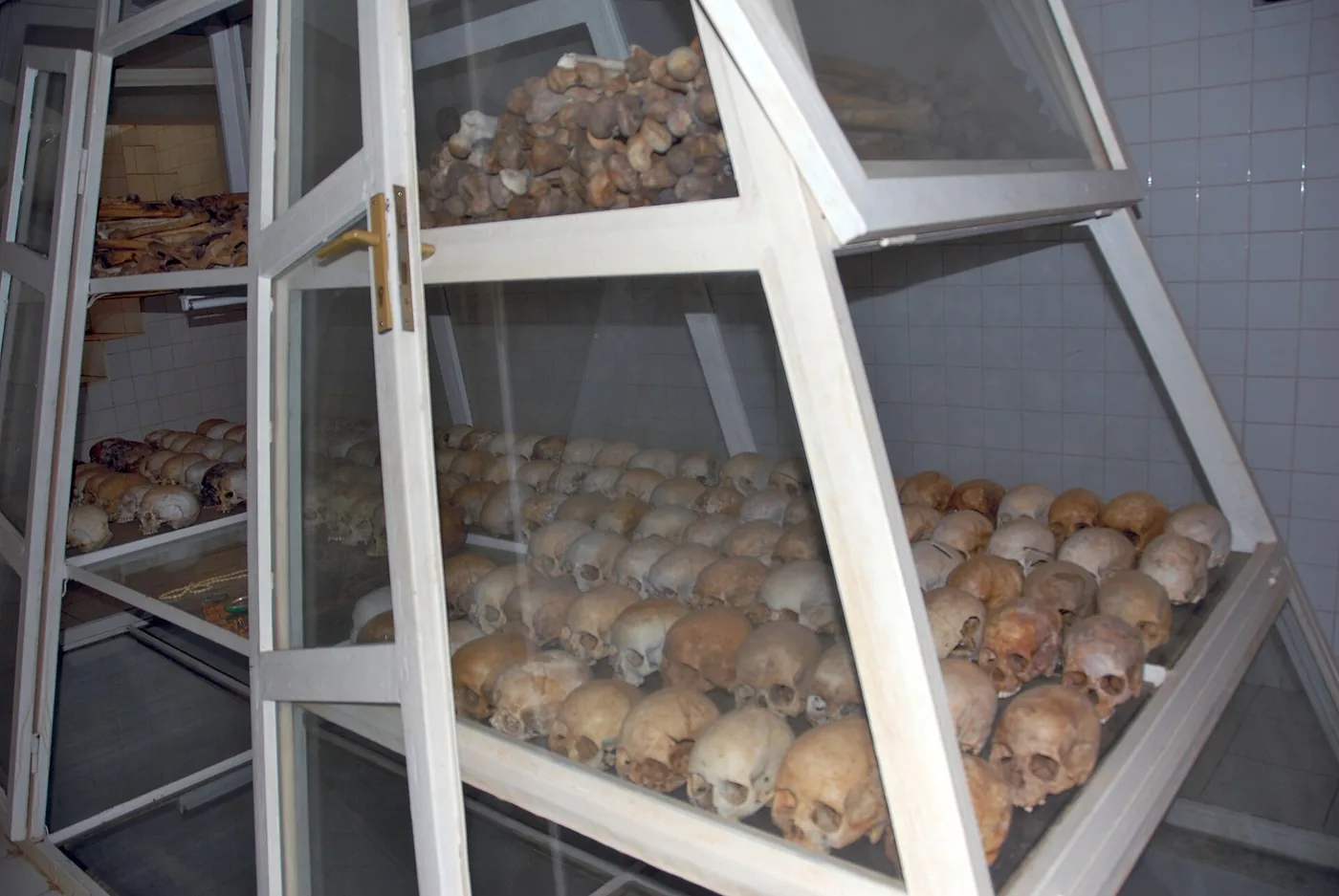
Between April and July 1994, Hutu extremists in Rwanda organized the killing of about 800,000 people in roughly a hundred days. Most of the dead were Tutsi. Most were killed not by soldiers but by people they knew, using machetes and clubs. The daily death rate rivaled that of the Nazi death camps during the Holocaust. A United Nations peacekeeping force was already in the country when the killing started, and the Security Council voted to shrink it while the genocide was underway. The violence ended only when a Tutsi-led rebel army, the Rwandan Patriotic Front, advanced through the country and captured the capital.
How Belgium created the divide that made the genocide possible
Hutu and Tutsi were not separate peoples with different languages or homelands. They shared a language, a set of religious practices, and the same villages. The distinction between them had once worked more like a class label, and people could cross from one group to the other. Belgian colonial administrators hardened it into something permanent. Influenced by a pseudo-scientific belief that Tutsi, who tended to be taller and kept cattle, descended from a superior race originating in northeastern Africa, Belgium governed Rwanda through the Tutsi minority.
In 1933, Belgian officials conducted a census and issued identity cards that stamped every Rwandan as Hutu, Tutsi, or Twa permanently. Sixty-one years later, militias at roadblocks used those same cards to decide who would be killed.
Before independence in 1962, Belgium shifted its backing to the Hutu majority. Between 1959 and 1962, a Hutu uprising forced more than 100,000 Tutsi to flee into neighboring countries. Their children grew up in exile. In Uganda, they formed the Rwandan Patriotic Front (RPF) and invaded Rwanda in 1990. A three-year war ended with the Arusha Accords of August 1993, which called for shared government. Hutu extremists in President Juvenal Habyarimana's inner circle never intended to carry them out.
How the Rwandan genocide was organized and carried out
The killing was planned in the open. The government trained and armed youth militias known as the Interahamwe. Officials compiled lists of people to be killed. A government-backed radio station, RTLM, broadcast for months before the violence began, calling Tutsi "inyenzi" (cockroaches) and urging Hutu to "cut the tall trees," code for killing Tutsi.
On January 11, 1994, Romeo Dallaire, the Canadian general in charge of the UN peacekeeping force in Rwanda, sent a fax to UN headquarters in New York. An informant had revealed weapons stockpiles and target lists. Dallaire requested authorization to raid the caches. Headquarters told him not to act beyond his orders and to notify Rwanda's president instead.
On April 6, 1994, a missile brought down President Habyarimana's plane as it approached Kigali airport. Responsibility for the attack is still disputed. Within hours, roadblocks appeared across the country. Soldiers and Interahamwe began killing Tutsi and moderate Hutu systematically, using the identity cards Belgium had introduced in 1933 to sort people at the checkpoints.
On the first morning, soldiers killed ten Belgian UN peacekeepers. Belgium pulled out its entire contingent. On April 21, the Security Council voted to reduce the UN mission from 2,500 troops to just 270. The RPF, advancing from the north, captured Kigali on July 4, 1994. It was the RPF that stopped the genocide, not the international community.
Why didn't the world stop the Rwandan genocide?
The United States, the most powerful voice on the Security Council, had been shaken by the deaths of American soldiers in Somalia six months earlier. Bound by a new policy on peacekeeping, US officials were told to avoid using the word "genocide" because the 1948 Genocide Convention could have required the United States to act. State Department spokesperson Christine Shelley told reporters that "acts of genocide" were taking place but would not say the word on its own. When a journalist asked how many acts of genocide it takes to make genocide, Shelley said she was not in a position to answer.
France had long backed the Habyarimana government. In late June 1994, near the end of the genocide, France sent troops under Operation Turquoise and established a safe zone in southwestern Rwanda. The zone protected about 13,000 civilians. It also gave some of the people who had organized the killings a path of escape into neighboring Zaire.
The failure in Rwanda, combined with the Srebrenica massacre during the Yugoslav Wars the following year, led to the Responsibility to Protect principle. Under it, the international community has a duty to intervene when a government will not protect its own people.
What happened after the Rwandan genocide?
More than a million Hutu fled into eastern Zaire after the RPF took power. Among them were soldiers and militia members who had carried out the genocide. The refugee camps became launching points for new attacks. Rwanda invaded Zaire twice, helping bring down the country's dictator, Mobutu Sese Seko. The wars in Congo that grew out of this displacement killed millions of people and are often described as the deadliest conflict since World War II.
Inside Rwanda, the formal courts could not handle nearly two million genocide-related cases. Between 2002 and 2012, community gacaca courts, based on a traditional practice, processed more than 1.9 million of them.
Paul Kagame, who commanded the RPF during the genocide, has governed Rwanda since 2000. He won a fourth term in July 2024 with over 99 percent of the vote. Under Kagame, Rwanda has had stability and strong economic growth. His government does not allow meaningful political opposition.