
Satsuma Rebellion
The Satsuma Rebellion of 1877 was the last armed revolt by Japan's samurai, led by Saigo Takamori against the Meiji government that he helped create.
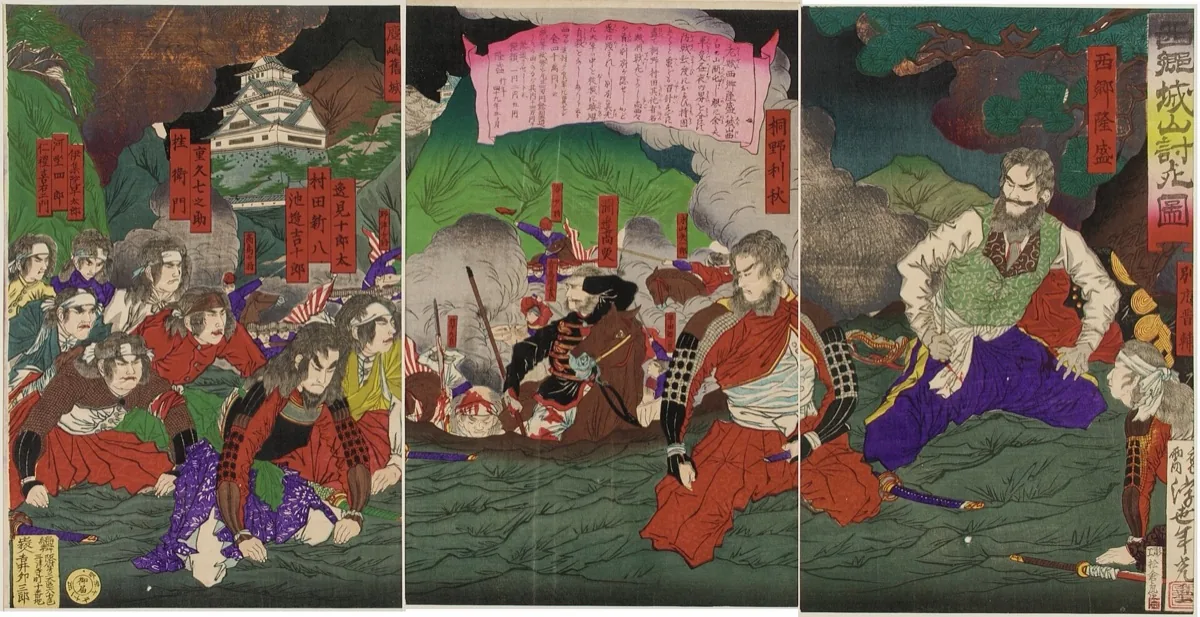
The Satsuma Rebellion was an eight-month war fought in 1877 between the new Meiji government of Japan and a force of samurai from Satsuma province, in the country's far southwest. The rebels were led by Saigo Takamori, one of the men most responsible for overthrowing the Tokugawa shogunate just nine years earlier. About 13,000 samurai marched north to fight a conscript army that eventually grew to more than 65,000. The rebellion ended on September 24, 1877, when Saigo and his last few hundred followers died at the Battle of Shiroyama. It was the last armed uprising by Japan's samurai class and ended them as a political and military force.
How Saigo Takamori turned against the government he built
Saigo was born in 1828 in Kagoshima, the castle town of Satsuma domain, to a low-ranking samurai family. He was physically imposing for his era, nearly six feet tall and about 200 pounds, with large eyes and a broad build that made him hard to miss in a crowd. As a boy he injured his right arm in a scuffle and could never fully bend it again, which pushed him away from swordsmanship and toward study and politics.
He entered the service of Shimazu Nariakira, the lord of Satsuma, and became his confidant. Months after Nariakira died suddenly in 1858, Saigo attempted suicide by drowning. He survived, but the new domain leadership exiled him to a remote island for about three years. He returned, was exiled again, and finally came back to Kagoshima in 1864, in time to help lead the movement to overthrow the shogunate.
In 1868, Saigo led the imperial army to victory in the Boshin War and ended Tokugawa rule. Afterward he held a leading role in the new Meiji government. But between 1871 and 1876, the government he had helped create dismantled the samurai class piece by piece. It abolished the feudal domains. It ended the samurai monopoly on military service with a conscription law in 1873. It converted the samurai's hereditary rice stipends into government bonds that quickly lost value. In 1876 it banned samurai from carrying swords in public, the most visible mark of their status.
Saigo left the government in 1873 over a different issue. He proposed sending a diplomatic mission to Korea, which others in the leadership saw as a step toward war. They blocked him, and he resigned. He went home to Kagoshima and founded private military academies called shigakko. The schools drew young samurai from across the province. They drilled, studied, and increasingly governed Satsuma like a parallel authority.
In January 1877, the Tokyo government sent agents to remove the weapons from a Kagoshima arsenal. Saigo's students seized them first. Saigo had not planned the uprising, and most historians believe he did not expect to win. He agreed to lead it regardless.
From Kumamoto Castle to Shiroyama
About 13,000 men marched north from Kagoshima in February 1877. Their first target was Kumamoto Castle, held by a government garrison of conscript soldiers. The rebels besieged it and launched direct assaults, but the castle held. While they were stuck at Kumamoto, they fought weeks of heavy combat on Tabaruzaka ridge as imperial reinforcements arrived by steamship. Both sides lost thousands of men at Tabaruzaka.
To crush the rebellion, the Meiji government mobilized its entire standing army and reserves, eventually putting more than 65,000 troops into the field. These soldiers had been conscripted under the 1873 military service law. They learned Western drill, received their orders by telegraph, moved by steamship, and carried breech-loading rifles and field artillery. The rebels, cut off from resupply, ran out of ammunition. By the end they fought with swords because they had nothing left to fire.
By September the surviving rebels had been pushed back to Kagoshima. On September 24, 1877, about 300 to 400 of them charged down Shiroyama hill into roughly 30,000 imperial troops. Nearly all of them were killed. Saigo, badly wounded by a bullet, killed himself on the hillside. He was 49.
The eight-month war cost about 13,000 lives on both sides and 42 million yen, roughly 80 percent of the government's annual budget.
What the Satsuma Rebellion changed
After the rebellion, no samurai uprising of any size challenged the government again. The war proved that a conscript army with modern weapons could defeat the warrior class that had ruled Japan for centuries. The samurai were finished as a military and political force.
The financial cost nearly broke the government. Spending 42 million yen forced the treasury to print large amounts of paper currency, and the resulting inflation lasted years. The crisis reshaped Japanese finance and led to the founding of the Bank of Japan in 1882.
Saigo Takamori's reputation recovered quickly. On February 11, 1889, the same day it promulgated Japan's first constitution, the Meiji government pardoned Saigo posthumously and restored his court rank. In 1898 a bronze statue of Saigo walking his dog was erected in Tokyo's Ueno Park, and it remains there today. Saigo became one of Japan's most admired historical figures, honored for the sincerity of his losing cause.
The government drew its own conclusion from the war. Having proved that the old warrior tradition could not stand against modern weapons, it began borrowing from that tradition for its own purposes. The samurai ideals of loyalty and self-sacrifice, the values Saigo's men had died for, became part of the mythology that Japan asked its modern soldiers to live by in the wars that followed.