
Kaiser Wilhelm II
Kaiser Wilhelm II was Germany's last emperor, whose dismissal of Bismarck and naval rivalry with Britain helped lead Europe into World War I.
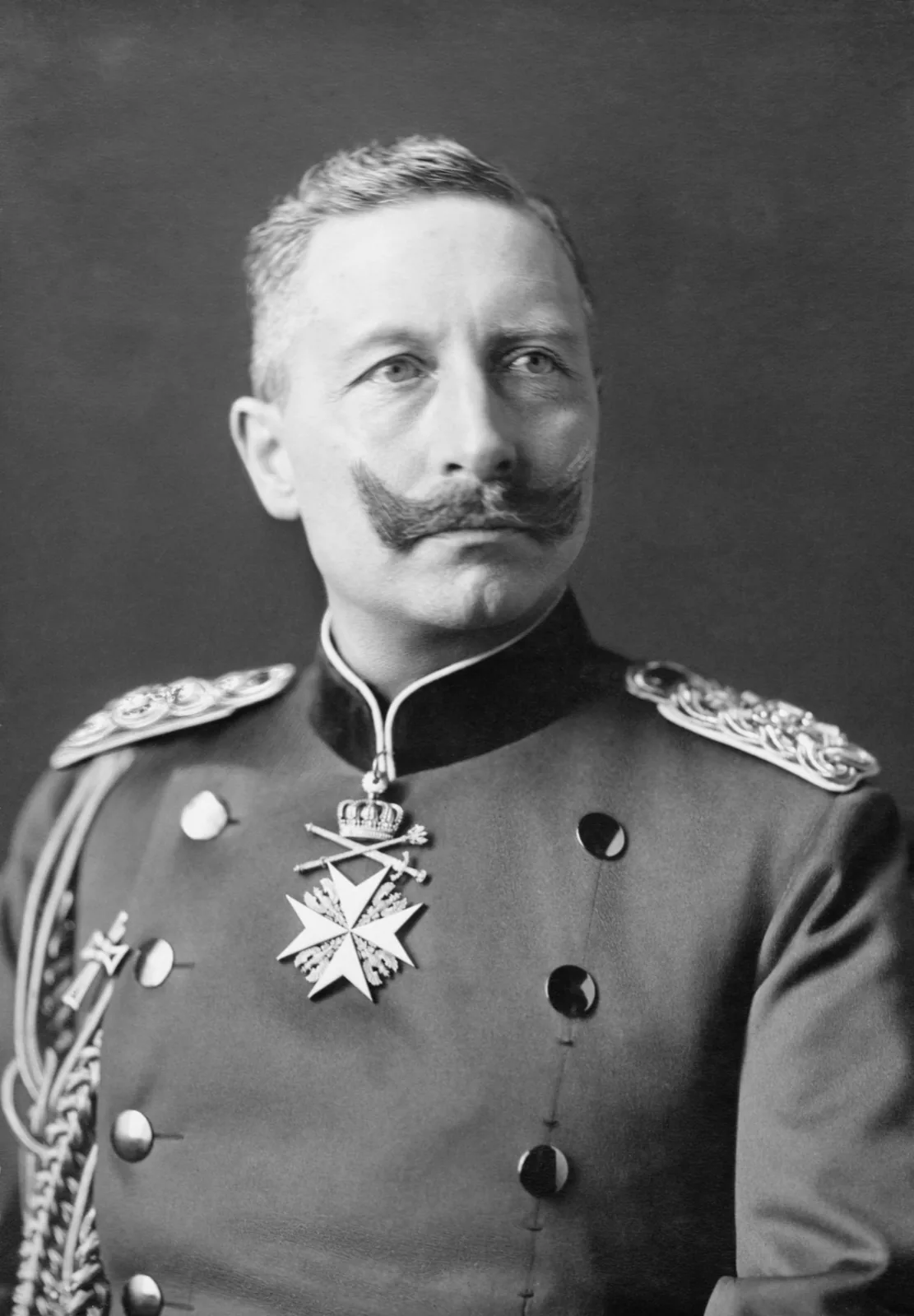
Kaiser Wilhelm II was the last German emperor. He ruled from 1888 to 1918, a period in which Germany went from the strongest military power in Europe to defeat, revolution, and the end of its monarchy. Wilhelm was born on January 27, 1859, the eldest grandson of Britain's Queen Victoria. A breech birth damaged the nerves in his left arm, which never developed properly and was about six inches shorter than his right. He posed carefully in photographs, tucking the arm behind his back or placing his left hand on a sword hilt. He filled his public life with uniforms, medals, and military ceremony. He was known for volatile moods, a short attention span, and a constant need for admiration. He inherited the most powerful army in Europe and, from Chancellor Otto von Bismarck, a system of alliances designed to keep Germany safe. Within a decade, he had undone most of it.
How Wilhelm undid Bismarck's alliance system
Wilhelm dismissed Bismarck from the chancellorship in 1890, just two years after taking the throne. Bismarck had unified Germany through three wars and then worked for two decades to keep Germany's neighbors from joining together against it, using a careful web of treaties. The most important was the Reinsurance Treaty with Russia, a secret agreement meant to prevent Germany from having to fight France and Russia at the same time. Wilhelm let the treaty lapse when it came up for renewal in June 1890. By 1894, Russia and France had signed a military alliance, the outcome Bismarck had worked his entire career to prevent.
Wilhelm then pursued a policy called Weltpolitik. Germany would become a global power with overseas colonies and a navy to match. In 1897, his foreign secretary, Bernhard von Bülow, told the Reichstag that Germany demanded its "place in the sun." Wilhelm appointed Admiral Alfred von Tirpitz to construct a fleet large enough to challenge Britain's Royal Navy. The First Naval Law of 1898 committed Germany to a fleet of nineteen battleships. The Second Naval Law of 1900 doubled that number to thirty-eight. Britain, which until then had no particular quarrel with Germany, began building dreadnoughts and moved toward alliances with France and Russia. By 1907, Germany faced the Triple Entente on three sides.
Wilhelm and the July Crisis of 1914
On June 28, 1914, Archduke Franz Ferdinand of Austria-Hungary was assassinated in Sarajevo. On July 5, Wilhelm told Austria-Hungary's ambassador that Germany would support whatever action Vienna took against Serbia. Historians call this promise the "blank cheque." Wilhelm then left Berlin for his annual summer cruise along the Norwegian coast while the crisis deepened.
Austria-Hungary issued an ultimatum to Serbia on July 23. By the time Wilhelm returned to Germany on July 27, the situation was close to war. Within a week, most of Europe was at war.
Once the fighting began, Wilhelm had little real power over it. By 1916, Generals Paul von Hindenburg and Erich Ludendorff controlled military strategy and most domestic policy. They ran, in practice, a military dictatorship. Wilhelm signed whatever orders they put in front of him.
Did Kaiser Wilhelm cause World War I?
No single person caused the war. The decisions that turned a Balkan assassination into a continental conflict were made by governments in Vienna, St. Petersburg, Paris, and London as well as Berlin. But Wilhelm's choices over the previous twenty-four years had put Germany in a far worse position than the one he inherited. He dismissed the chancellor who had kept Europe's alliances in balance and let the treaty that prevented a two-front war expire. He then launched a naval build-up that pushed Britain toward alliance with Germany's rivals. His "blank cheque" to Austria-Hungary in July 1914 removed the last restraint on Vienna's decision to attack Serbia.
Wilhelm himself often talked more aggressively than he acted, and several accounts describe him panicking as the July Crisis escalated. But the system of alliances that Bismarck built was designed to prevent a general European war. By 1914, that system was gone, and many of the decisions that destroyed it had been Wilhelm's.
What happened to Kaiser Wilhelm after World War I?
In November 1918, with Germany losing the war and revolution spreading through its cities, the army told Wilhelm it would no longer fight for him. He abdicated on November 9, 1918, and crossed the border into the Netherlands by car. The Weimar Republic replaced the monarchy.
Wilhelm spent the last twenty-three years of his life in exile, most of them at Huis Doorn, a manor house in the Dutch countryside. He chopped firewood, received visitors, and wrote memoirs. He blamed Jews, foreigners, and others for Germany's defeat. He never accepted responsibility.
In May 1940, Germany invaded the Netherlands. Wilhelm, then 81, watched the country where he had lived for more than twenty-one years come under Nazi occupation. German soldiers stood guard at his gates. He died of a pulmonary embolism on June 4, 1941, at the age of 82. The Hohenzollern dynasty, which had ruled Brandenburg and Prussia for more than five hundred years, lost its throne with him.