
Gold Standard
The gold standard fixed each country's currency to a set weight of gold so paper money could be exchanged for metal on demand.
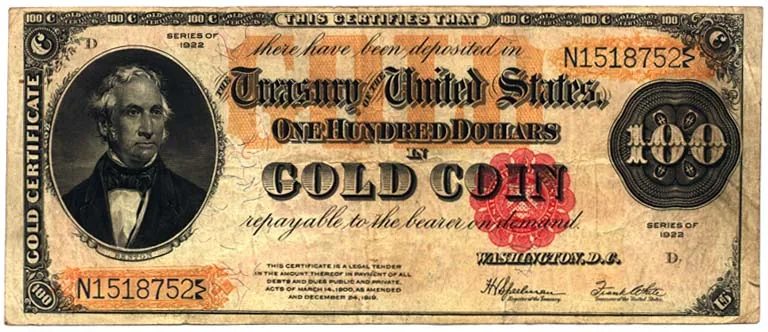
The gold standard was a monetary system in which each country's currency was worth a fixed weight of gold. Anyone holding a banknote could take it to a bank and exchange it for gold coins or bullion. Because every major currency was defined as a specific amount of gold, exchange rates between them barely moved. The British pound, the French franc and the American dollar each represented a fixed quantity of metal, so their values relative to each other stayed nearly constant.
The system organized global trade and finance from the 1870s to 1971, though it took very different forms over that century. In its strongest version, before the First World War, it delivered stable prices, fixed exchange rates and free-flowing capital. But the system was rigid: governments could not expand the money supply during a recession, which made downturns deeper and longer.
How Britain put the world on gold
The gold standard began in Britain. In 1717, Sir Isaac Newton, then Master of the Royal Mint, set the price of the gold guinea at 21 silver shillings. The ratio overvalued gold compared to silver on international markets, so gold flowed into Britain and silver flowed out. Over the following century, Britain shifted from a system based on both metals to one based on gold alone. Parliament made it official with the Coinage Act of 1816, and in 1821 Britain became the first country to formally adopt the gold standard.
For fifty years Britain was the only major economy formally on gold. That changed in the 1870s. Germany adopted gold after its unification in 1871, using French war indemnity payments to build its reserves. Other countries followed over the next three decades: France, the Scandinavian countries, Japan, the United States. By the 1890s most of the industrialized world had joined.
The decades before 1914 are called the classical gold standard. The Bank of England acted as the system's unofficial central bank, and London was the center of global finance. The pound sterling was considered as reliable as gold itself, and most of the world's trade was settled in pounds. Prices barely moved over decades. A wool exporter in Argentina and a financier in the City of London could settle accounts without worrying about currency swings, because both knew exactly what a pound was worth in gold.
How the gold standard collapsed
The First World War ended the classical gold standard. Every belligerent government needed far more money than its gold reserves could support, so they suspended convertibility and printed what the war required. Britain, France, Germany and most other European powers left gold within weeks of the fighting starting in August 1914.
After the war, country after country tried to restore gold. The attempt failed. Britain returned in 1925 at the prewar exchange rate, which overvalued the pound and forced painful deflation. Then the Great Depression hit, and the gold standard made it worse. Countries on gold could not expand their money supply to fight the downturn. When gold flowed out of a country, the rules required higher interest rates and lower wages, the opposite of what a shrinking economy needed.
Countries that left gold first recovered first. Britain abandoned the standard in September 1931 and stopped shrinking within months. The Scandinavian countries and Japan left that same year. The United States followed in 1933 under President Franklin Roosevelt, and France held on until 1936, suffering longest. Economists today broadly agree that the gold standard's rigidity deepened what might have been an ordinary recession into a global catastrophe.
After the Second World War, the Bretton Woods system created a weaker version. Other currencies were pegged to the US dollar, and only the dollar remained convertible to gold, at a fixed rate of $35 per ounce. By the late 1960s, the United States was running large deficits for the Vietnam War and domestic programs, and foreign governments were exchanging their dollars for American gold faster than Washington could afford. On August 15, 1971, President Richard Nixon ended convertibility. The event is known as the Nixon shock. Every major currency today is fiat money, meaning it has no fixed link to gold and is backed only by the government that issues it.
Why did the United States leave the gold standard?
The United States left the gold standard in two stages. In 1933, President Franklin Roosevelt took the dollar off gold domestically because the shrinking money supply was deepening the Depression. Banks were failing across the country, and unemployment had reached about 25 percent. The government could not put more money into the economy while every dollar had to be partly backed by gold in the vault. Roosevelt made it illegal for Americans to hold monetary gold and raised the official price from $20.67 to $35 per ounce, devaluing the dollar by about 40 percent.
The second departure came in 1971. Under the Bretton Woods system, foreign governments could still trade dollars for gold at $35 per ounce. But years of heavy spending had put far more dollars into circulation than American gold reserves could cover. In the 1960s, France under President Charles de Gaulle began demanding gold for its dollars, and other central banks followed. Rather than let the reserves run out, President Nixon ended convertibility on August 15, 1971. No country has operated on a gold standard since.