
Nicholas Spykman
Nicholas Spykman was a Dutch-American political scientist who argued that Eurasia's coastal Rimland, not its interior, was the key to world power.
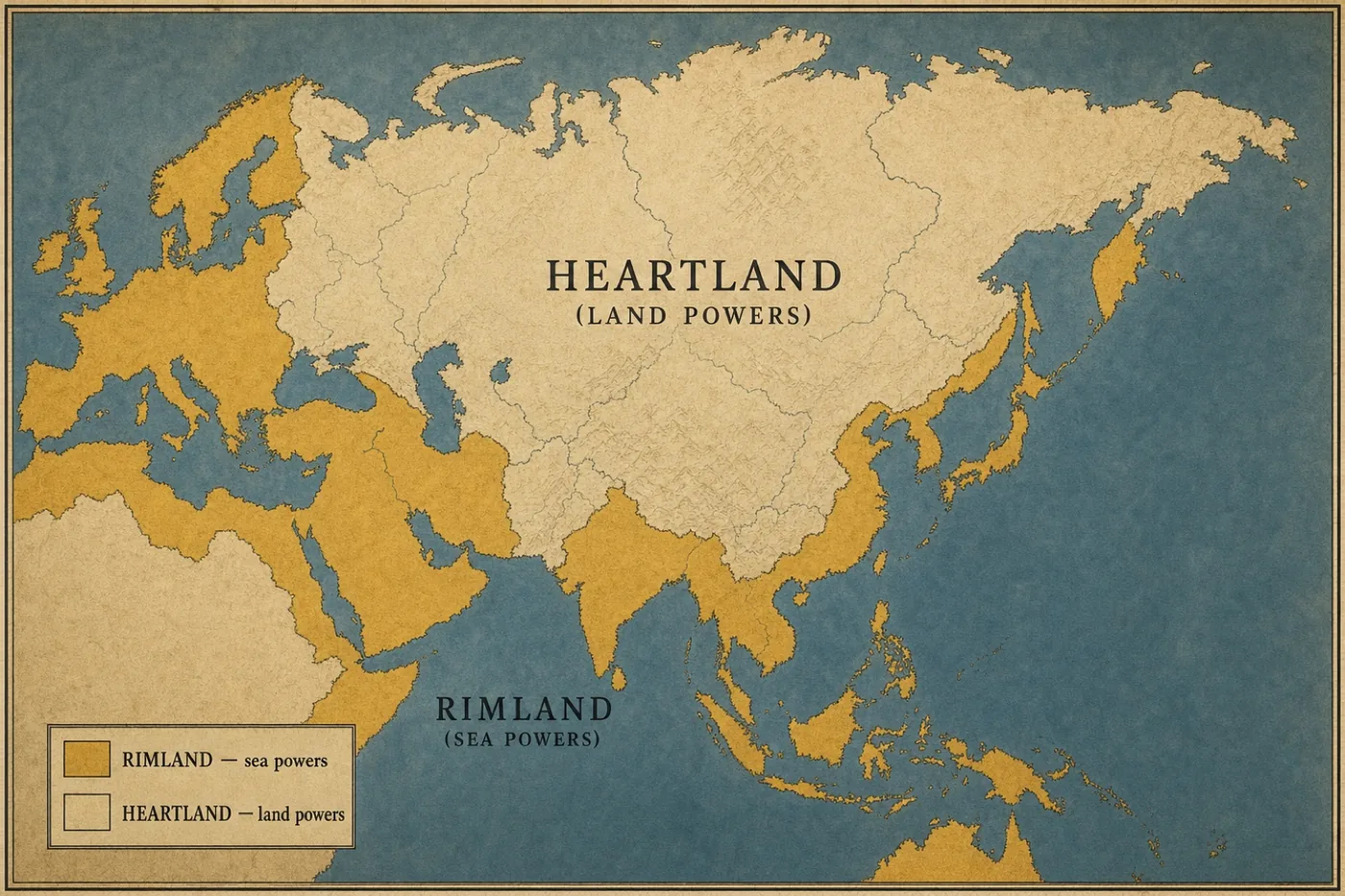
Nicholas Spykman was a Dutch-American political scientist who taught at Yale and died in 1943 at the age of 49. During the Second World War, he argued that the most important territory on Earth was not the vast interior of Eurasia, as Halford Mackinder had claimed, but the arc of densely populated, ocean-facing lands wrapped around it. He called this arc the Rimland. It stretched from the coasts of Western Europe through the Mediterranean, the Persian Gulf, India, and Southeast Asia to China. Before becoming an academic, Spykman spent seven years as a journalist in the Near and Middle East and in Asia. He concluded that the United States had one overriding interest: to prevent any single power from dominating these coastal lands. The network of alliances Washington assembled in the late 1940s and 1950s, linking Western European allies to partners around the Persian Gulf and military bases in the western Pacific, traces almost exactly the line Spykman drew. Many historians consider him the intellectual architect of containment.
How Spykman came to geopolitics
Spykman was born in Amsterdam on October 13, 1893. He worked as a foreign correspondent for seven years. He reported from the Near East between 1913 and 1916, the Middle East until 1919, and the Dutch East Indies and the Far East until 1920. He watched colonial governments up close.
He emigrated to the United States in the early 1920s and became an American citizen. He earned a PhD at the University of California, Berkeley in 1923, joined Yale in 1925, and by 1928, at the age of 34, Yale had promoted him to a full professorship in international relations. In 1935 he established the Yale Institute of International Studies, one of the first academic centers devoted to realist thinking about foreign policy. Yale also gave him its highest faculty title, Sterling Professor. One of his priorities was making his students geographically literate. Geopolitics, he believed, was impossible without understanding geography first.
Spykman married Elizabeth Choate in 1931. They had two daughters. After his death, Elizabeth became a well-known children's novelist under the name E.C. Spykman, publishing her first book, "A Lemon and a Star," in 1955.
Spykman published his major work, "America's Strategy in World Politics," in 1942, less than a year after the United States entered the war. His last book, "The Geography of the Peace," was published in 1944, completed from his notes by his colleague Helen Nicholl after Spykman died of cancer on June 26, 1943 in New Haven, Connecticut.
What is the Rimland theory?
Spykman took the map that the British geographer Halford Mackinder had drawn and reversed Mackinder's conclusion. Mackinder argued that the power controlling the Heartland, the vast interior of Eurasia from the Volga to the Yangtze, would dominate the world. Spykman disagreed. The Heartland was cold, landlocked, and had little industry. The real prize was the Rimland: the crescent of populous, productive, sea-facing lands stretching from the Atlantic coast of Europe around Eurasia's southern and eastern edges to the Pacific.
These coastal regions held most of Eurasia's people, most of its factories, and most of its access to the sea. Whoever controlled the Rimland, Spykman concluded, not the Heartland, would control Eurasia and therefore the world.
From this, Spykman drew a conclusion that mattered for American foreign policy. The United States, a sea power separated from Eurasia by two oceans, had one overriding interest: to prevent any single state from organizing the Rimland. That meant the United States would need to stay involved in Eurasian affairs permanently, not retreat into isolation after the war ended.
Spykman also argued in 1942 that the United States would eventually need to rebuild Germany and Japan to balance the Soviet Union and China's growing power. Many Americans found the idea outrageous. Germany and Japan were the countries the United States was fighting. Within a few years of Spykman's death, that is exactly what Washington did.
Why Spykman is called the godfather of containment
Spykman did not invent the word "containment." That term came from George Kennan, the American diplomat who sent his famous "Long Telegram" from Moscow in 1946 and published his "X Article" in Foreign Affairs in 1947. Kennan argued that the Soviet Union would keep expanding unless the United States pushed back at every point, and that patient, firm resistance would eventually weaken the Soviet system.
Kennan provided the argument. Spykman had already provided the map. The network of allies and bases the United States assembled in the late 1940s and 1950s traced the Rimland almost exactly as Spykman had described it. NATO covered Western Europe. Turkey and Iran anchored Eurasia's southern flank. Garrisons in Japan and the Philippines held the Pacific side. The Marshall Plan rebuilt Western Europe's economies. Washington rearmed Japan and West Germany, two countries that had been America's enemies just years earlier, the move Spykman had called for in 1942.
Spykman also warned that a strong China would become a strategic challenge for the United States. He wrote this when China was weak, divided, and partly under Japanese occupation. He predicted that a unified China would press outward toward the sea, and that the United States might need to support Japan as a counterweight. Today China's military growth, its claims in the South China Sea, and its investments across Southeast Asia and the Persian Gulf all center on the Rimland.
Spykman believed that geography mattered more than anything else in foreign policy because it outlasted everything else. Governments rise and fall. Coastlines, mountains, and distances between them do not.