
SSBN (Ballistic-Missile Submarine)
An SSBN is a nuclear-powered submarine that carries ballistic missiles, forming the hardest-to-destroy part of a country's nuclear arsenal.
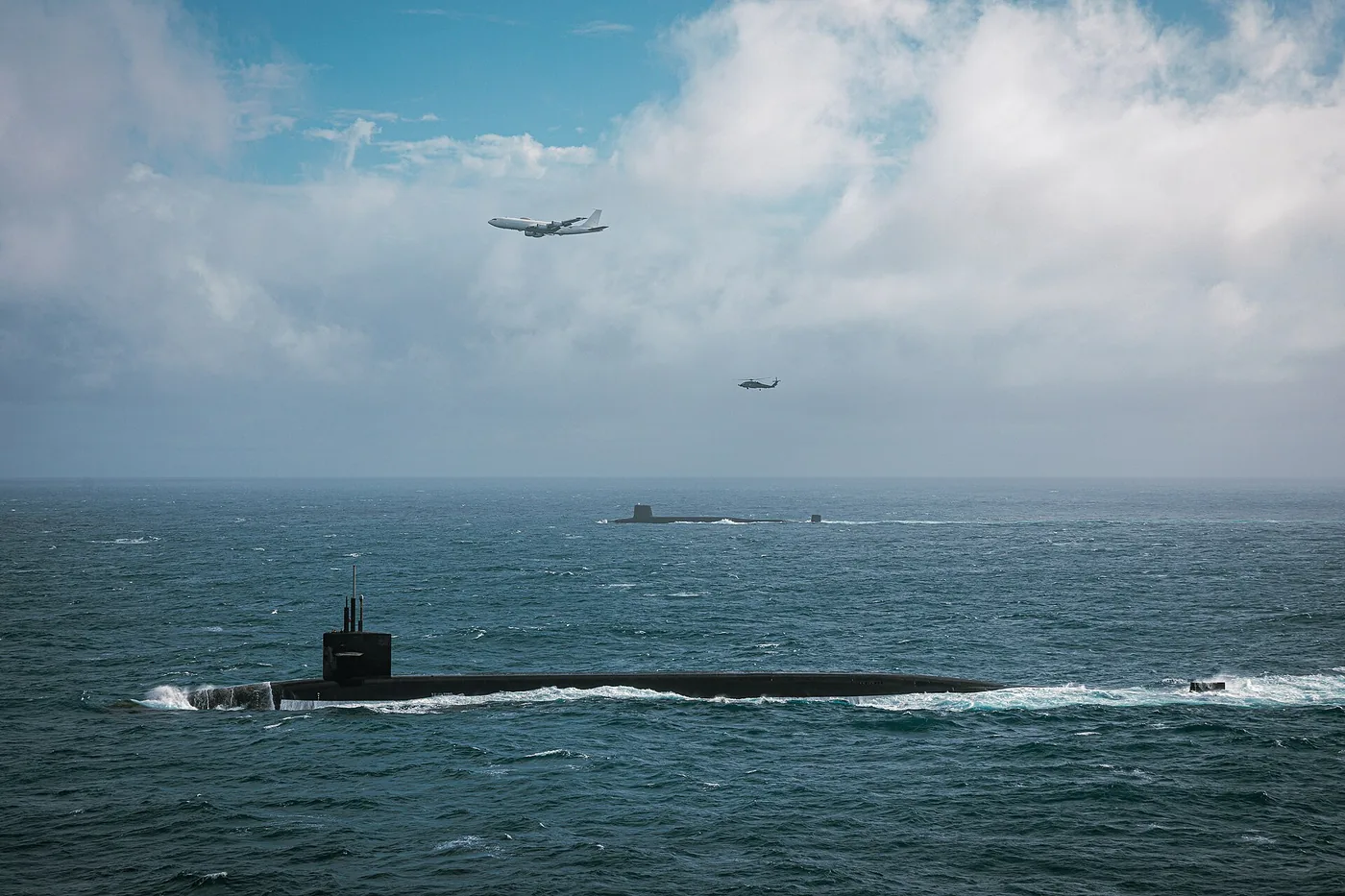
An SSBN is a submarine powered by a nuclear reactor and armed with nuclear ballistic missiles. The letters are the US Navy's hull classification code: SS for submarine, B for ballistic missile, N for nuclear-powered. Crews call them "boomers."
The job of an SSBN is not combat. The submarine exists so that a country can still launch nuclear weapons even after a surprise attack destroys its cities, missile silos, and bomber bases. Strategists call this guaranteed capability an assured second strike, and they consider it the foundation of nuclear deterrence. A missile silo has a fixed, known location that an enemy can target. A bomber can be destroyed before it takes off. But a submarine can hide anywhere in an ocean search area covering roughly two-thirds of the planet, staying silent and underwater for months at a time. More than six decades of anti-submarine warfare research have not solved the basic problem: finding a quiet SSBN on patrol is still close to impossible.
How the first SSBNs were built
In the late 1950s, the United States needed a nuclear weapon that could survive a Soviet first strike. Land-based ICBMs sat at launch sites with known coordinates. Bombers could be destroyed on the ground. A submarine carrying missiles would be invisible, mobile, and impossible to target all at once.
The Navy created the first SSBN by slicing open an attack submarine's hull and inserting a 130-foot missile section. The result was USS George Washington. On July 20, 1960, George Washington became the first submarine to launch a ballistic missile from underwater, firing a Polaris missile from beneath the Atlantic. Four months later, on November 15, it left Charleston, South Carolina, carrying 16 Polaris missiles and began the first deterrent patrol. The patrol lasted 66 days. The entire program, from congressional funding to first patrol, took less than four years.
The Soviet Union built its own SSBNs in response: the Yankee class, then the Delta class, and then the Typhoon class. The Typhoon remains the largest submarine ever built, displacing 48,000 tons submerged, more than twice the weight of an American Ohio-class boat. By the mid-1980s both superpowers kept multiple armed submarines at sea around the clock.
The six countries that operate SSBNs
Six countries operate SSBNs in 2026.
The United States fields 14 Ohio-class submarines, the backbone of America's sea-based nuclear deterrent since the 1980s. Each carries 20 Trident II missiles, and each missile can deliver several warheads to separate targets. The boats originally held 24 missiles each, but the US reduced the number to 20 under the New START arms-control treaty. The Ohio class is nearing the end of its service life, and the Navy is building the Columbia class to replace it. The first boat, USS District of Columbia, is expected to enter service around 2031.
Russia has replaced much of its Cold War SSBN fleet with the Borei class. Eight Borei-class submarines are in service as of 2026, split between the Northern Fleet and the Pacific Fleet. Russia plans to build twelve in total and keep them operational into the 2060s.
The United Kingdom bases its entire nuclear deterrent on four Vanguard-class submarines. Since April 1969, the Royal Navy has kept at least one armed SSBN on patrol without interruption, a streak of more than 57 years called Continuous At-Sea Deterrence. Each British SSBN carries sealed "letters of last resort," handwritten instructions from the prime minister for the submarine's commander if the British government has been destroyed. No one except the prime minister knows what the letters say, and they are destroyed unopened when a new prime minister takes office.
France operates four Triomphant-class submarines and, like Britain, bases most of its nuclear deterrent on them.
China operates Type 094 (Jin-class) submarines and is building the Type 096, which is expected to be quieter.
India commissioned its third Arihant-class SSBN in April 2026, with a fourth undergoing sea trials. India is the newest nuclear-armed country to operate ballistic-missile submarines.
How SSBNs stay hidden on patrol
A submarine on patrol stays underwater for two to three months, moving slowly and making as little noise as possible. Communication with shore is largely one-way: stations on land send orders using very-low-frequency (VLF) radio, which can penetrate seawater. The submarine listens but rarely transmits, because a radio signal could reveal its position. The crew's entire job during a patrol is to remain undetected.
Patrol strategies differ by country. American, British, and French submarines roam the open ocean, making their patrol areas vast and unpredictable. Russian and Chinese submarines have historically stayed in defended waters close to home, called "bastions," where friendly forces can protect them from enemy hunters. This difference shapes where rival navies concentrate their anti-submarine efforts.
Strategists consider the sea-based leg of a nuclear arsenal the most stabilizing part, because a leader who knows their submarines will survive a first strike has no pressure to launch first in a crisis. That stability depends on the ocean remaining hard to search. New technologies, including seabed sensor arrays, satellite surveillance, and AI-powered acoustic processing, have opened the question of whether future navies could find SSBNs in real time. If oceans became searchable, every country that depends on submarines for deterrence would need another way to guarantee retaliation. For now, the ocean is still too large and too deep to monitor, and SSBNs remain the most survivable nuclear weapons on Earth.