
Mutually Assured Destruction (MAD)
Mutually assured destruction is the condition in which both sides of a nuclear standoff can destroy each other even after absorbing a first strike.
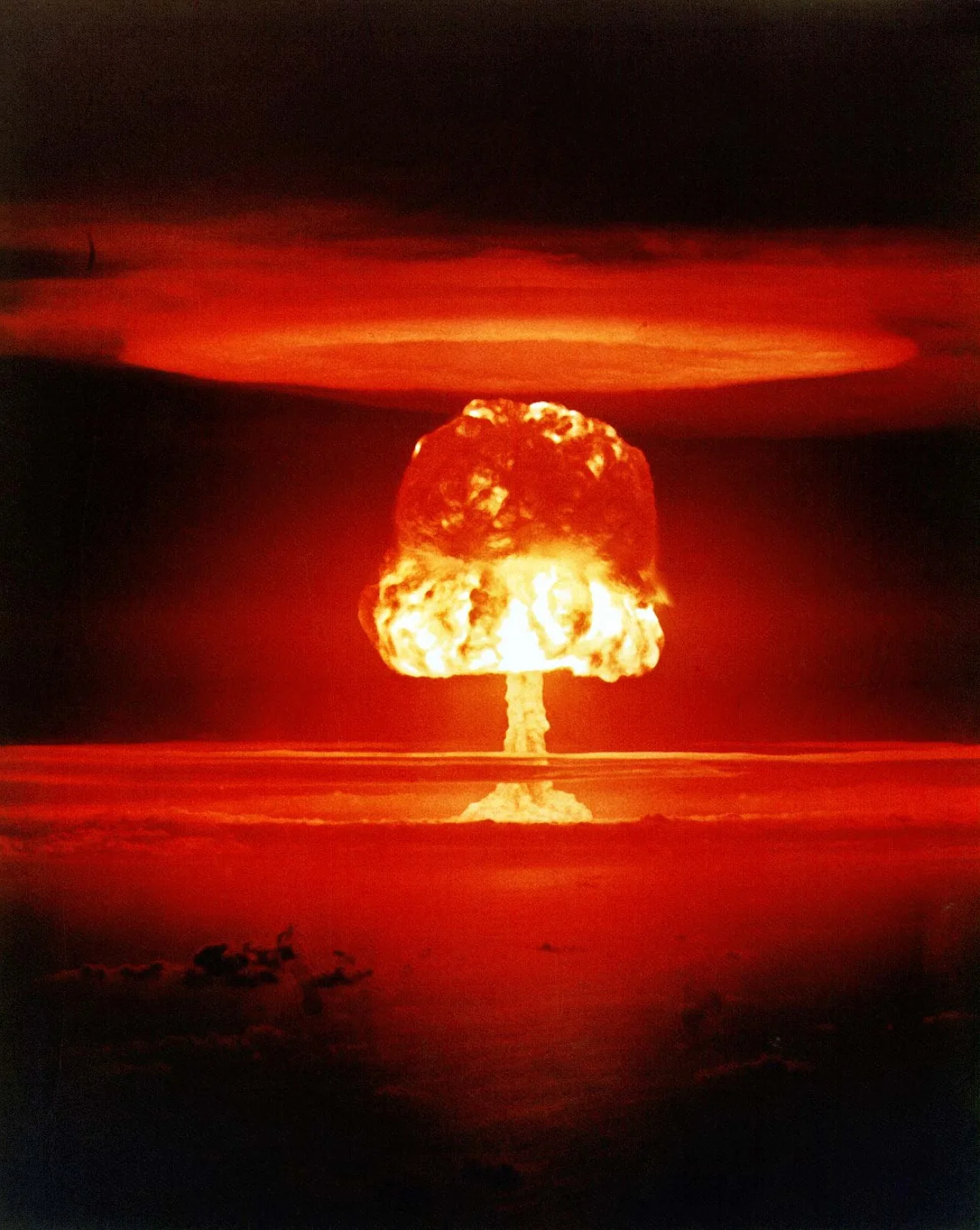
Mutually assured destruction, often shortened to MAD, is the condition in which two nuclear-armed countries can each survive a full first strike and still destroy the attacker in return. Because a first strike cannot disarm the other side, launching one is suicidal. The strategist Bernard Brodie stated the idea in 1946, the year after Hiroshima: "Thus far the chief purpose of our military establishment has been to win wars. From now on its chief purpose must be to avert them." It took about twenty years for the technology to make that condition real. When it did, mutually assured destruction became the central logic of the nuclear standoff between the United States and the Soviet Union, and it still shapes how nuclear-armed states think about war today.
How the United States and Soviet Union built mutually assured destruction
The key requirement was a "second strike," meaning weapons that could survive being hit first. If one side could destroy the other's weapons in a surprise attack, there would be no retaliation, and striking first might be worth the risk. Both sides spent decades making sure that could never happen.
The United States placed intercontinental ballistic missiles in hardened concrete silos, kept bombers on runway alert, and put nuclear warheads on ballistic missile submarines at sea. Submarines were the most important piece, because they are very hard to find. Even a perfect first strike would leave hundreds of warheads at sea, still ready to launch. The United States built this combination, called the triad, to make sure that no single advance in tracking or targeting could wipe out the entire force. The Soviet Union built a similar triad of its own.
In the 1960s, Secretary of Defense Robert McNamara put a number on what "assured destruction" meant. The Pentagon set the bar at being able to kill between 20 and 25 percent of the Soviet population and destroy half of Soviet industry, even after the Soviet Union struck first. McNamara argued that building weapons beyond that point added nothing to deterrence. That argument became a case for capping arsenals rather than expanding them.
That reasoning led to the Anti-Ballistic Missile Treaty of 1972. The treaty limited missile defenses, not offensive weapons. A country shielded from retaliation might be more willing to strike first. A missile shield would also push the other side to build more weapons to overwhelm it. Under the treaty, the United States and the Soviet Union agreed to remain vulnerable to each other on purpose.
The term MAD was invented by Donald Brennan of the Hudson Institute, who meant it as a criticism. Brennan argued that choosing not to defend your own citizens was irrational. The label caught on because people on both sides of the debate found it convenient.
The 1983 false alarm that tested mutually assured destruction
On the night of September 26, 1983, sensors on a Soviet satellite detected what appeared to be American missiles heading toward the Soviet Union. The duty officer that night was Stanislav Petrov, a lieutenant colonel in the Soviet Air Defense Forces. Petrov judged the warning to be a false alarm. He reasoned that a real American attack would involve hundreds of missiles, not the five the satellite was showing. Soviet ground radar also showed nothing. He did not pass the warning up the chain of command. He was right: the satellite had mistaken sunlight reflecting off high-altitude clouds for missile launches.
Mutually assured destruction depends on two assumptions: that decision-makers will behave rationally, and that early-warning systems will function as designed. On that night, the warning system failed. One officer's judgment was all that stood between a false alarm and a possible retaliatory launch. The doctrine has other gaps. It was designed for a full-scale exchange. It does not cover small-scale nuclear use well. If one side used a single tactical nuclear weapon on a battlefield, that would not trigger mutual annihilation. No country has a clear plan for what happens after a limited nuclear strike. This is the gap that Russia's nuclear threats during the war in Ukraine have been aimed at.
Mutually assured destruction today
Mutually assured destruction was built around two countries: the United States and the Soviet Union. Today nine countries have nuclear weapons. The deterrence logic is far more complicated. India must deter both Pakistan and China at the same time. China must deter both the United States and India. When any one of these countries builds new weapons, it can shift two deterrence relationships at once.
The arms control treaties that managed the original two-player standoff have ended. The Intermediate-Range Nuclear Forces Treaty collapsed in 2019. New START, the final treaty capping the number of American and Russian deployed strategic warheads, expired on February 5, 2026, and no successor treaty was in place. For the first time since the early 1970s, the two largest nuclear arsenals have no binding limit. Russia has said it will keep to the old ceilings as long as the United States does the same, but there is no treaty to enforce that and no inspections to verify it.
China is expanding its arsenal faster than any other nuclear-armed state. As of mid-2026, China has roughly 620 nuclear warheads. The Pentagon projects that number will reach about 1,000 by 2030. The United States withdrew from the ABM Treaty in 2002 and is building missile defenses again. Under the logic of mutually assured destruction, missile defenses are destabilizing, because they could make a first strike look survivable.
The core logic of mutually assured destruction still holds. As long as several hundred warheads on submarines and in hardened silos would survive any attack, striking first remains suicidal. What is disappearing is the verification regime: the on-site inspections, data exchanges, and caps that allowed each country to confirm what the other actually possessed. Deterrence depends on each side believing the other's weapons and intentions are what they claim. That belief is harder to maintain without verification.