
Strategic Ambiguity
Strategic ambiguity is the US policy of deliberately not saying whether it would defend Taiwan militarily.
Strategic ambiguity is the United States' policy of not stating whether it would use military force to defend Taiwan. The United States has maintained this position deliberately since 1979, and its purpose is to keep two governments guessing at the same time. If Washington promised to defend Taiwan, Taiwan's leaders could declare formal independence, knowing the American military would back them up. That declaration is what China says would trigger an invasion. If Washington promised to stay out, China could invade whenever it chose. By refusing to commit either way, the United States tries to prevent both moves. Strategists call this logic dual deterrence: one policy, aimed at two audiences, discouraging opposite actions.
How the United States built strategic ambiguity
The policy rests on a set of documents, each carefully worded to avoid committing the United States to a military response.
In three joint communiques with Beijing, signed in 1972, 1979, and 1982, Washington notes Beijing's claim that Taiwan belongs to China without agreeing with it. American diplomats chose the word "acknowledge" instead of "accept." That distinction is the foundation of the One China policy, and every administration since has defended the exact wording.
The Taiwan Relations Act, passed in 1979, requires the United States to sell Taiwan defensive weapons and to maintain the ability to resist any coercion directed at the island. It does not require the United States to send troops or ships.
In 1982, President Ronald Reagan privately delivered six assurances to Taiwan's president, Chiang Ching-kuo. Among them: the United States would not put a deadline on weapons sales to Taiwan, and it would not pressure Taiwan into negotiations with Beijing. The assurances were given orally, not in writing, and the cables containing them were not declassified until 2020.
Every piece of this framework is designed to keep the question of American military intervention open. None of them answers it.
Strategic ambiguity during the 1996 Taiwan Strait crisis
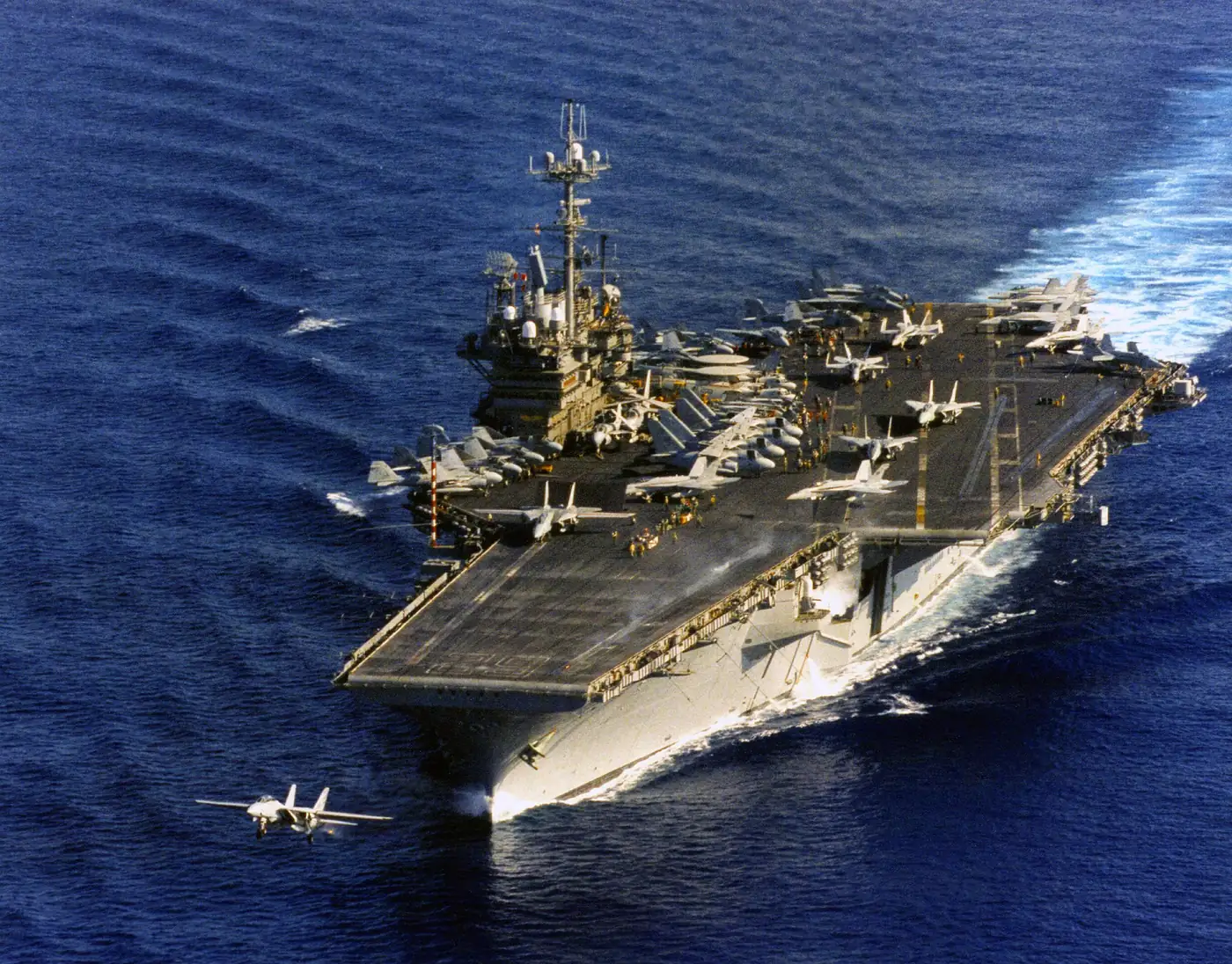
The United States has never been ambiguous about its military power in the region, only about whether it would use that power to defend Taiwan. In March 1996, during Taiwan's first direct presidential election, China fired missiles into waters near the island to pressure voters. President Bill Clinton sent two aircraft carrier battle groups, the USS Independence and the USS Nimitz, toward the Taiwan Strait. It was the biggest show of American naval force in East Asia since the Vietnam War, with the two ships carrying a combined air wing of over 150 aircraft.
China stopped the missile tests. Taiwan held its election on March 23, and the candidate Beijing opposed, Lee Teng-hui, won. The United States never stated what it would have done if China had escalated further.
Why some analysts want to end strategic ambiguity
The doctrine is under sustained criticism, including from people who previously supported it. The main argument for replacing ambiguity with a clear promise to defend Taiwan is that the balance of military power has shifted. China's navy and missile forces have grown large enough that deterrence may now require Beijing to believe that the American military will definitely show up, not just that it might. In this view, ambiguity worked when the United States had overwhelming military superiority in the western Pacific. That superiority is no longer guaranteed, and a clear commitment is now the price of keeping the peace.
The argument for keeping ambiguity is that a formal American defense commitment would give Beijing a political reason to act. Chinese leaders would face domestic pressure to respond to what they would call a provocation. A clear promise would also remove a restraint on Taiwan itself: if Taipei knew the American military would intervene, the incentive to avoid moves toward formal independence would weaken. Supporters of ambiguity also note that any promise could be broken by a future president, making it less binding than it sounds. As long as the policy holds, the United States also avoids being pulled into a war started by decisions made in Taipei.
Is strategic ambiguity still US policy?
The policy has been tested by American presidents themselves. Between 2021 and 2024, President Joe Biden said on at least four separate occasions that the United States would defend Taiwan militarily. Each time, the White House said afterward that official policy had not changed. Whether Biden was breaking with strategic ambiguity or practicing it differently is still debated.
Since Trump took office for a second term in January 2025, the signals have been more mixed. The administration approved a record arms package for Taiwan and pushed Taipei to increase its defense spending substantially. Congress authorized significant funding for Taiwan's defense in the 2026 National Defense Authorization Act. At the same time, President Trump has described the security relationship in transactional terms, calling it an insurance policy that Taiwan should pay for. He has complained that Taiwan "stole" America's semiconductor industry. When asked in February 2025 whether the United States would defend Taiwan, Trump said, "I never comment on that."
Some analysts argue that the American position has lost the deliberateness that made ambiguity effective as a strategy. The concern is that the current ambiguity looks more like confusion than deliberate policy. That kind of uncertainty could invite the miscalculation the doctrine was built to prevent. For now, no administration has formally abandoned strategic ambiguity, and none has replaced it with a clear commitment to defend Taiwan.