
Suez Crisis
The Suez Crisis was a 1956 war in which Britain, France, and Israel invaded Egypt over the Suez Canal and were forced to withdraw by the United States.
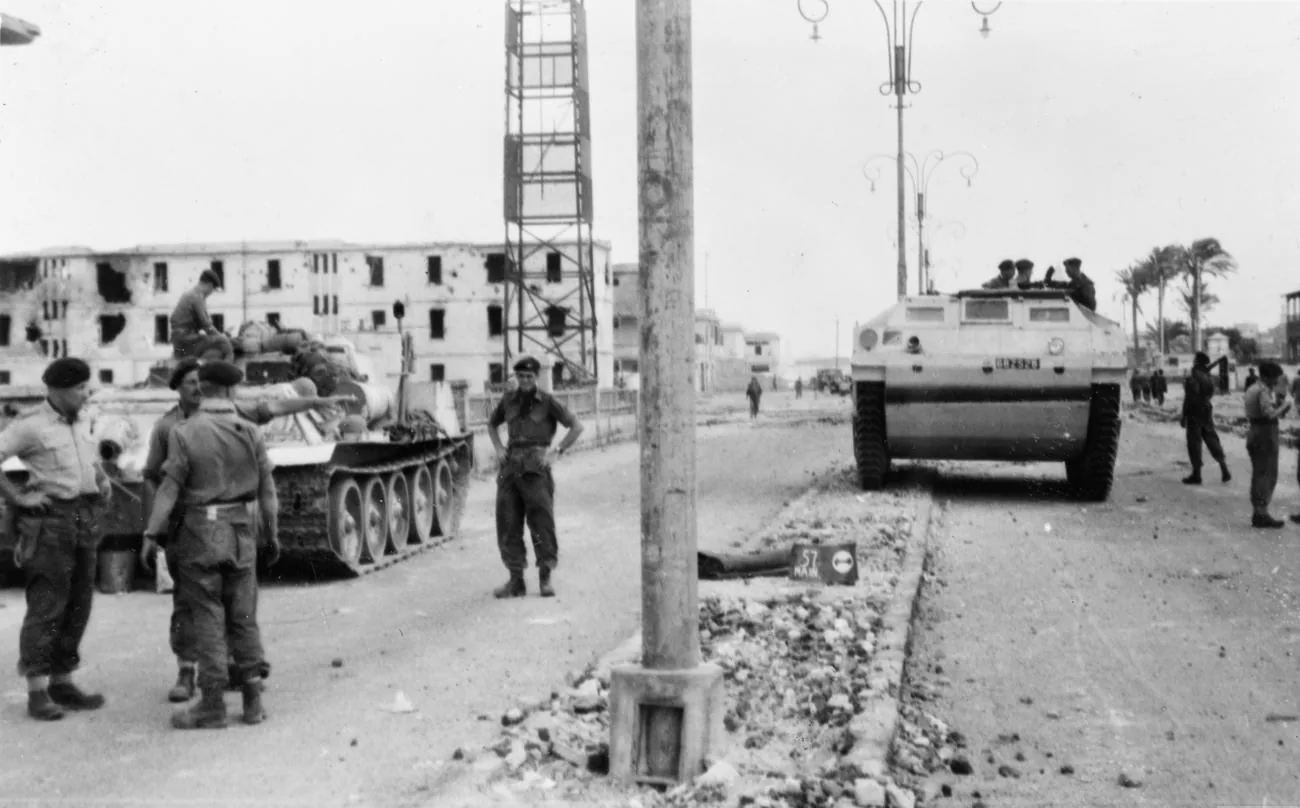
The Suez Crisis was a 1956 war in which Britain, France, and Israel invaded Egypt after Egypt's president, Gamal Abdel Nasser, seized control of the Suez Canal. The invasion succeeded militarily but collapsed politically. The United States refused to support its allies, and President Dwight Eisenhower threatened Britain's economy until it accepted a United Nations ceasefire. Britain and France withdrew their forces. Nasser kept the canal and became the most prominent leader in the Arab world. The crisis showed that Britain and France could no longer carry out a major military operation if the United States opposed it. In British politics, the word "Suez" is still used as shorthand for a government that overreaches abroad and is forced to back down.
Why Nasser nationalized the Suez Canal
The Suez Canal had been operated by a mostly British-and-French-owned company since its opening in 1869. By the 1950s the canal carried much of Europe's oil. Egypt provided the land and the labor, but the profits went to London and Paris.
Nasser was a career military officer, the son of a postal clerk. As a teenager in the 1930s he was hit in the forehead by a police bullet during a street protest against British rule in Egypt. He graduated from Egypt's military academy and fought in the 1948 Arab-Israeli war, where he was wounded and later besieged at Faluja. In 1952, at age 34, he helped lead a group of young officers who overthrew King Farouk. By 1954 Nasser was Egypt's leader.
In late 1955 the United States and Britain offered to help fund Nasser's most ambitious project, the Aswan High Dam on the Nile. But Nasser also bought weapons from Czechoslovakia, a Soviet ally. In July 1956, Secretary of State John Foster Dulles withdrew the funding offer. A week later, on July 26, 1956, Nasser nationalized the Suez Canal Company. Egypt would run the canal itself and use the toll revenue to build the dam.
How Britain, France, and Israel invaded Egypt
Britain's prime minister, Anthony Eden, was determined to reverse the nationalization. Eden had resigned as Britain's foreign secretary in 1938 over the government's policy of appeasing dictators, and he told colleagues he would not appease another one. But Britain could not simply invade a sovereign country to take back a canal.
France and Israel provided a pretext. In late October 1956, British, French, and Israeli representatives met secretly at a villa in Sevres, outside Paris, and signed an agreement. Israel would attack Egypt through the Sinai Peninsula. Britain and France would then issue an ultimatum to both sides, demanding that they pull back from the canal zone. When Nasser refused, as he was certain to, British and French forces would occupy the canal as supposed peacekeepers.
On October 29, Israeli forces crossed into Egypt. An Anglo-French ultimatum followed the next day. British and French paratroopers landed at Port Said on November 5, at the northern end of the canal. The military operation went as planned, but the collusion behind it was obvious to the world.
President Eisenhower was furious that his allies had started a war without telling him. They had done it in the final week of his reelection campaign. At the same time, Soviet tanks were crushing an uprising in Hungary, and the invasion of Egypt gave Moscow a propaganda gift: the Western powers looked no better than the Soviet Union.
The Soviet Union threatened rocket attacks on London and Paris. But American economic pressure, not Soviet missiles, is what ended the war. Investors were selling the British pound, driving its value down. Eisenhower refused to provide emergency financial support until Britain agreed to a ceasefire. On November 6, the same day Eisenhower won reelection, Britain accepted a UN ceasefire. France had no choice but to follow. British and French forces left Egypt by the end of December 1956. Israel withdrew from the Sinai by March 1957.
What the Suez Crisis changed
Nasser lost on the battlefield but kept the canal and survived an invasion by two former imperial powers. He became the leading figure of Arab nationalism, and his influence shaped Middle Eastern politics for the next decade.
Britain and France drew opposite lessons from the crisis. Britain decided it would never again break with the United States on a major foreign policy question. From Suez onward, staying close to Washington became the foundation of British foreign policy. France decided that Europe needed to be more independent. Charles de Gaulle, who came to power in 1958 partly because the crisis weakened the French government that preceded him, built France its own nuclear weapons and later pulled France out of NATO's military command.
Anthony Eden, Britain's prime minister, resigned on January 9, 1957. He cited ill health. A botched bile duct operation in 1953 had left him in chronic pain, and the strain of the crisis made it worse. But the real reason was the political failure. He never held office again.
The canal stayed under Egyptian control. Egypt operates it today. The Suez Crisis did not end British and French influence in the world, but it closed the chapter in which either country could send its military overseas without American approval.