
Charles de Gaulle
Charles de Gaulle was a French general and president who led Free France in World War II and founded the Fifth Republic in 1958.
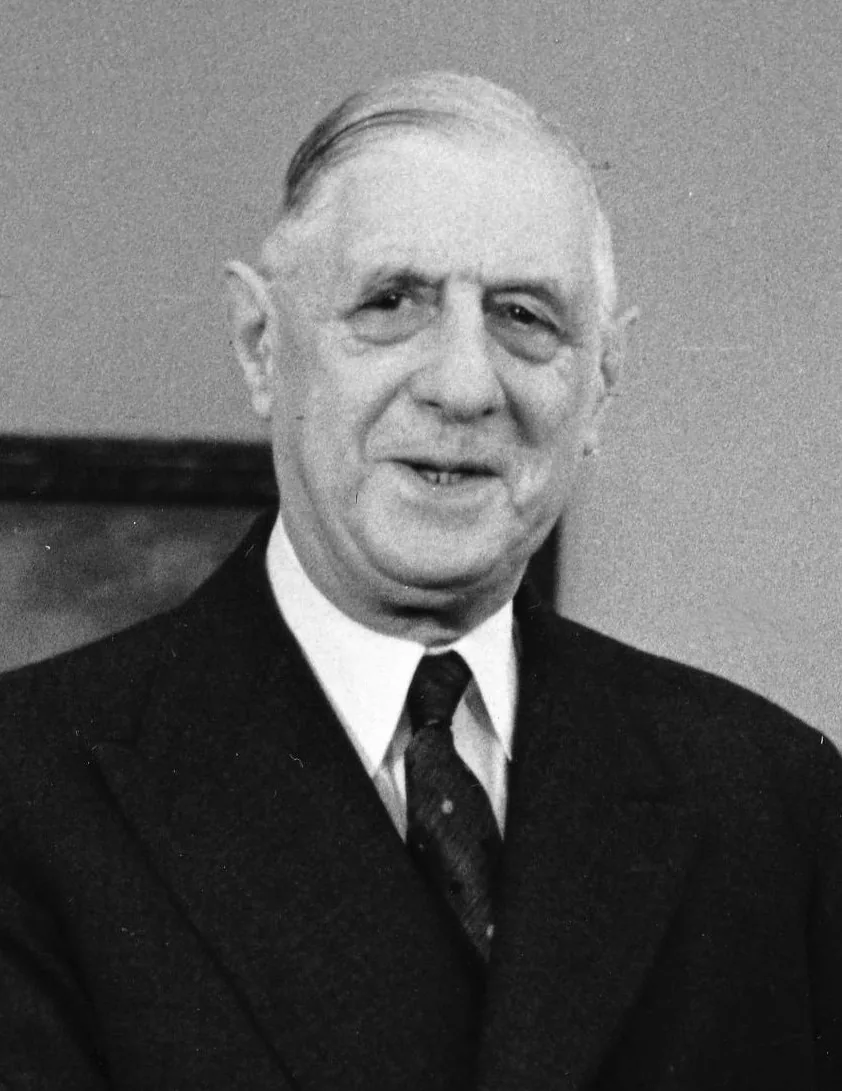
Charles de Gaulle was a French general and statesman who led the Free French movement during World War II and served as president of France from 1959 to 1969. Born in Lille on November 22, 1890, he was a career army officer who refused to accept France's surrender to Germany in June 1940. He flew to London as a brigadier general without troops, without official backing, and without any authority to speak for France. On June 18, 1940, he broadcast an appeal on BBC radio, insisting that the defeat was one lost battle, not a lost war. The Vichy government tried him in absentia and condemned him to death. By 1944 he had turned a small group of exiles into a movement the Allies had to recognize. After the war he spent twelve years out of power, then returned in 1958 during the Algerian war, founded the Fifth Republic, and shaped French foreign policy around nuclear independence and distance from the United States.
How de Gaulle became the leader of Free France
When de Gaulle reached London in June 1940, he was the most junior general in the French army. He had no troops, no money, and no authority. Most senior French officers stayed with the Vichy government. Franklin Roosevelt found de Gaulle infuriating and tried more than once to sideline him. Winston Churchill backed him, though Churchill's own circle found working with de Gaulle exhausting.
De Gaulle succeeded by connecting his London-based committee to the resistance networks inside occupied France, which gave him a claim to represent the French people. He also made himself impossible to ignore. On August 26, 1944, the day after Paris was liberated, he walked down the Champs-Élysées while snipers were still firing from rooftops. He stood six feet five inches tall and did not duck.
By 1945, France controlled a section of occupied Germany and held one of the five permanent seats on the UN Security Council. For a country that had surrendered in six weeks in 1940, that result was not a given. De Gaulle's insistence that he spoke for France had helped make it true.
How de Gaulle built the Fifth Republic
De Gaulle resigned in January 1946 rather than lead a government under a constitution that gave the president little power. He spent twelve years at his country home writing memoirs and waiting.
The crisis in Algeria brought him back to power. By 1958, French settlers and army officers had mutinied, and the civilian government in Paris could not restore order. Parliament voted to bring de Gaulle back on his own terms. He wrote a new constitution for the Fifth Republic, built around a strong president who, from 1962, was elected directly by the people. He won the presidency in December 1958 with 78 percent of the vote and took office on January 8, 1959.
The officers who brought de Gaulle back expected him to keep Algeria French. He did the opposite. By 1962 he had negotiated Algerian independence, concluding that the war was unwinnable. Members of the OAS, a group of embittered officers and settlers, tried to kill him repeatedly. The most famous attempt, at Petit-Clamart in August 1962, sprayed his car with gunfire. He survived them all.
With Algeria settled, de Gaulle turned to remaking France's place in the world. In February 1960, France detonated its first nuclear weapon in the Sahara and built an independent nuclear force, the force de frappe, controlled by France alone. The reasoning was straightforward: no American president would risk New York to defend Paris, so France needed its own deterrent. In January 1963, de Gaulle signed the Élysée Treaty with West Germany's Konrad Adenauer, anchoring French foreign policy in a partnership with Germany rather than dependence on the United States.
Why did de Gaulle pull France out of NATO?
In 1966, de Gaulle pulled France out of NATO's unified command structure and ordered the alliance to relocate its headquarters from French territory. France remained a NATO member, but French forces no longer answered to NATO commanders, and all foreign military bases in France were closed.
De Gaulle believed NATO made European defense an American decision. He wanted France to be able to fight, or refuse to fight, on its own terms. He vetoed British entry into the European Common Market twice, in 1963 and 1967, because he believed Britain would act as an American proxy inside Europe. De Gaulle also challenged American financial power by converting France's dollar reserves into gold. His finance minister, Valéry Giscard d'Estaing, coined the phrase "exorbitant privilege" to describe the dollar's outsized role. These moves helped push the Bretton Woods system toward its collapse in 1971.
France did not fully rejoin NATO's integrated command structure until 2009, forty-three years after de Gaulle pulled out.
Why did Charles de Gaulle resign?
In May 1968, student protests and a general strike swept France and caught de Gaulle off guard. Millions of workers walked off the job and students occupied universities across the country. On May 29, de Gaulle left Paris without telling his prime minister and flew to Baden-Baden, Germany, to confirm that the army commander there, General Jacques Massu, would support him. Massu agreed. De Gaulle returned, dissolved the National Assembly, and called new elections. His party won by a large margin.
Less than a year later, on April 27, 1969, de Gaulle held a referendum on regional government reform and changes to the Senate. He announced in advance that he would resign if voters rejected it. They did, 52 percent to 48. He resigned the next day and retired to his home at Colombey-les-Deux-Églises. He died there on November 9, 1970, at the age of 79. He had turned down both a state funeral and burial in the Panthéon.
De Gaulle's foreign policy outlasted him. A nuclear deterrent under sole French control, a Europe that makes its own decisions, and a wariness of Anglo-American influence became the baseline for French governments of both left and right. French presidents who call for European strategic autonomy or who decline to follow the United States into a war are still working within de Gaulle's framework.