
Suzerainty
Suzerainty is an arrangement in which a powerful state controls a weaker state's foreign affairs while leaving it self-governing.
Suzerainty is a relationship between two states in which the stronger one controls the weaker one's foreign affairs while leaving it to govern itself at home. The weaker state, called a vassal, keeps its own ruler, its own laws, and its own taxes. It gives up the right to make treaties or go to war on its own. In return, the stronger state gets a guarantee that the territory stays closed to rival powers, and usually receives tribute.
For most of recorded history, suzerainty was the standard way large empires organized their borders. Ruling a distant territory directly required officials who understood local customs, soldiers stationed across the land, and the burden of running courts, collecting taxes, and feeding people during shortages. Suzerainty avoided those costs by leaving a local ruler in place, someone who already had authority and the loyalty of the population.
How China's tributary system worked
The Chinese tributary system was the most fully developed version of suzerainty. States including Korea, Vietnam, and Siam sent periodic missions to the Chinese emperor bearing gifts. The envoys performed ritual prostration, received investiture, and returned home with more valuable gifts than they had brought. China did not tax these states or station troops in their territory. What China received was acknowledgment of its place at the top of the hierarchy. In the Confucian understanding of the world, that acknowledgment was the substance of the relationship, not a formality.
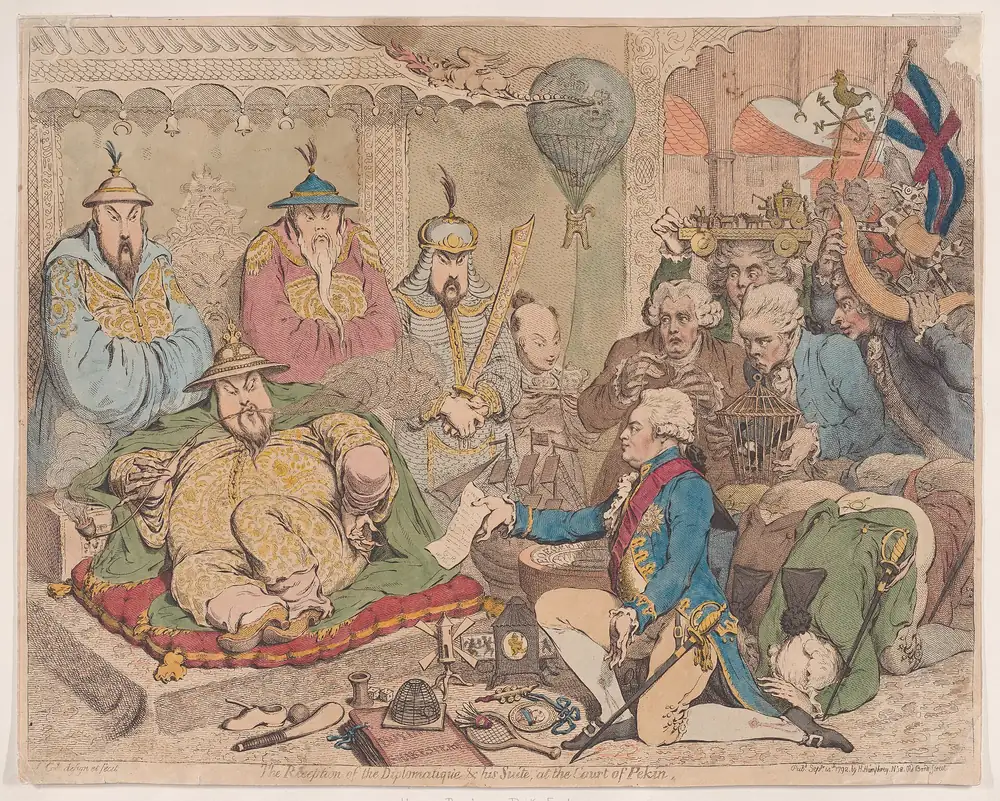
The gap between suzerainty and sovereignty showed up sharply when Lord Macartney arrived at the Qing court in 1793. Macartney was a 56-year-old diplomat who had governed British territories from the Caribbean to India, and he came as one sovereign's representative to another, seeking permanent envoys and open ports. The 82-year-old Qianlong Emperor received him politely but as a tribute bearer. Macartney refused the full prostration expected of tribute bearers and bent one knee instead, as he would before his own king. The emperor rejected every British request. The two sides were not confused about the gifts being exchanged. They disagreed about what kind of relationship could exist between their states at all.
How European empires used suzerainty
European empires relied on suzerainty just as heavily. In India, roughly 40 percent of the subcontinent, more than 560 princely states, remained outside direct British administration. Maharajas and nizams stayed on their thrones through a system the British called paramountcy. The larger states each had a British political officer stationed at court. None could conduct diplomacy with other states, and none maintained a military large enough to act independently. The arrangement cost Britain far less than governing the territory itself, and it produced a set of local rulers whose power depended on the survival of the British Raj.
Egypt, Tunisia, and the Danubian principalities, roughly modern Romania and Moldova, all spent long periods as Ottoman suzerainties. Each territory had its own ruler and collected its own taxes but in principle answered to Istanbul on matters of war and diplomacy. After 1945, the Soviet Union applied the same logic to the Warsaw Pact. Member states were formally sovereign, with their own flags and seats at the United Nations, but had no way to withdraw from the bloc. Hungary tried to leave in 1956 and was invaded. Czechoslovakia tried political reforms in 1968 and was invaded again.
What is the difference between suzerainty and sovereignty?
A sovereign state controls both its internal affairs and its foreign relations. Under suzerainty, the weaker state controls only its internal affairs. It governs itself and keeps its own laws and taxes, but it cannot make treaties, declare war, or choose its own allies without the suzerain's permission.
Modern international law does not recognize suzerainty as a category. Under it, a state is either sovereign or it is not. This binary hides arrangements that fall in between. For most of the twentieth century, Britain called China's position in Tibet suzerainty, not sovereignty. The choice of word mattered: if Tibet was sovereign Chinese territory, how Beijing governed it was China's internal affair, but if it was a suzerainty, China's authority had limits. In 2008, Britain dropped the distinction and recognized Chinese sovereignty over Tibet.
Bhutan signed a treaty with India in 1949 that committed Bhutan to be "guided by the advice of the Government of India" in its foreign relations. The treaty was revised in 2007 to give Bhutan greater autonomy, but India still plays a central role in Bhutan's defense and foreign policy.
Suzerainty today
The word suzerainty no longer appears in treaties, but the arrangement it describes has not disappeared. Many states today are formally sovereign but practically unable to choose their own foreign alignment because of military bases, security guarantees, or debt. Debates over the status of Taiwan, Kosovo, and Abkhazia all involve the same gap: the difference between who holds real authority in a place and who holds the legal right to represent it.
Suzerainty is a useful concept because it names something the sovereign-or-not binary cannot. A state can have its own government, its own flag, and its own laws while someone else decides who it can ally with or fight. That arrangement shaped most of political history, and versions of it continue under different names.