
Chinese Tributary System
The tributary system was imperial China's way of managing foreign relations through a hierarchy centered on the emperor.
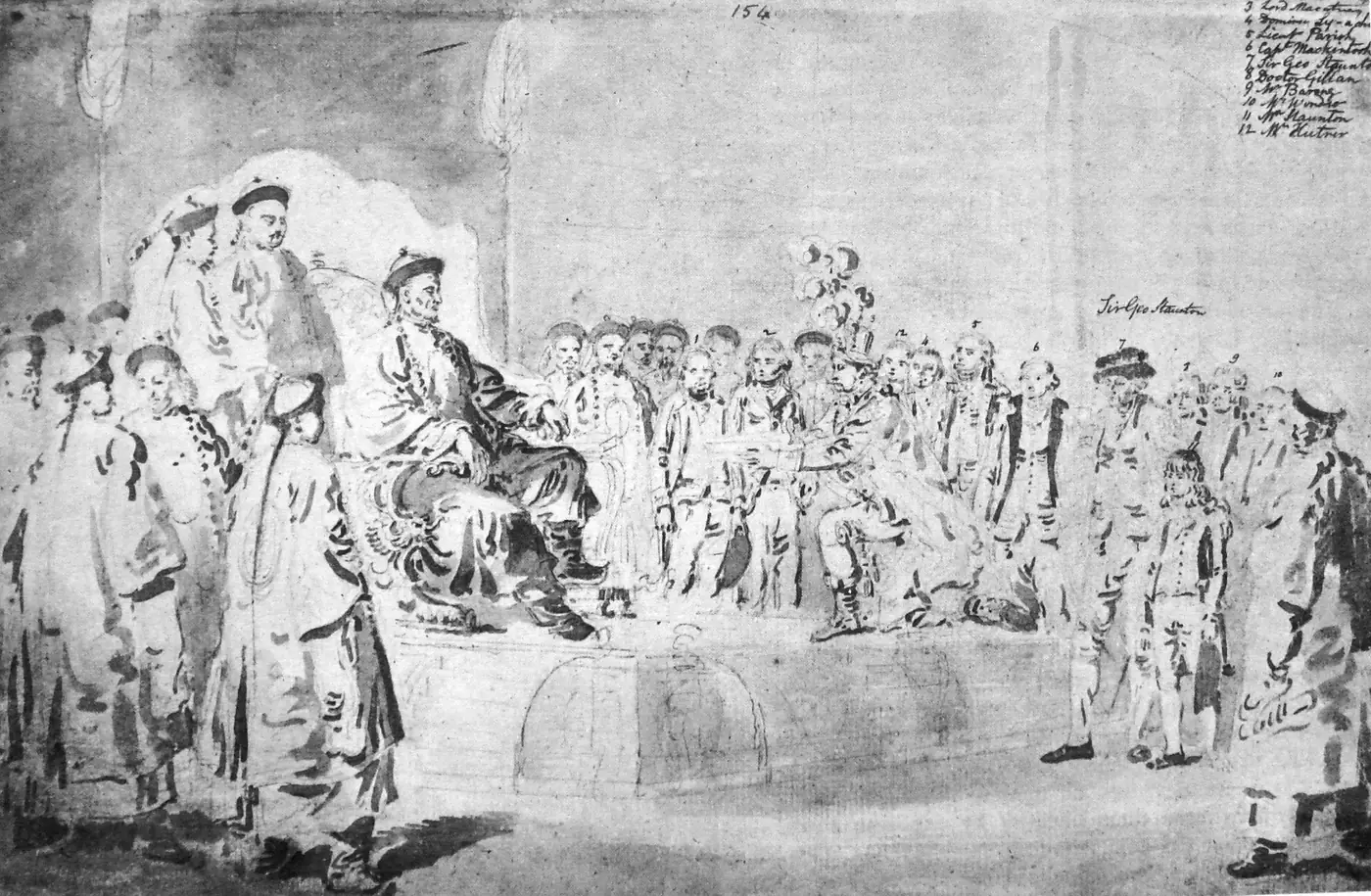
The Chinese tributary system was a way of organizing relations between China and its neighbors that lasted for roughly two thousand years. The Chinese emperor, called the Son of Heaven, held the Mandate of Heaven and claimed authority over tianxia, meaning "all under Heaven." Other rulers were not expected to obey him directly. Instead, they sent tribute missions to his court, acknowledged his higher status, and received formal recognition and trade access in return. No Chinese army needed to cross a border for any of this to work. The system reached its most organized form under the Ming dynasty (1368–1644), when dozens of states from Korea to the islands of Southeast Asia sent regular missions to the imperial capital.
How the tributary system worked
A ruler who wanted to trade with China sent envoys to the imperial capital carrying local goods as tribute. The envoys performed the kowtow before the emperor: three kneelings and nine prostrations, forehead to the floor. The ritual placed the visiting ruler below the emperor in a public hierarchy of states, with China at the center and everyone else ranked by their distance from Chinese civilization.
In exchange, the emperor gave the envoys gifts that were usually worth more than the tribute they had brought. He also issued a formal document called an investiture, confirming that ruler as the rightful sovereign of his own country. This gave the ruler two things he could not easily get elsewhere: legitimacy that strengthened his position at home, and the right to trade with China.
Trade was what made the system work in practice. Until 1567, the Ming dynasty restricted all foreign commerce to the tribute framework, channeling it through approved ports and selected merchants. A state that wanted Chinese silk, porcelain, or tea had to send tribute first. The Ming set a schedule for each participant. Korea's Joseon dynasty sent missions to Beijing three or four times a year. The Ryukyu Kingdom, a chain of islands between Japan and Taiwan, sent them every two years. Vietnam sent them every three years. Over the centuries, Korea alone sent more than 500 missions to the Ming and Qing courts.
The participating states largely kept control of their own affairs. Korea ran its own government, chose its own officials, and fought its own wars. Vietnam did the same. These courts sometimes treated the arrangement as a practical calculation rather than genuine deference, using the emperor's endorsement to strengthen their own thrones while governing as they pleased.
When Lord Macartney refused to kowtow
In 1793, a British diplomat named Lord Macartney traveled to the Qianlong Emperor's summer court at Chengde, north of Beijing. Britain wanted a permanent embassy in China and open trade on equal terms. The Qianlong Emperor expected Macartney to perform the kowtow, as every foreign envoy did.
Macartney refused. He offered to kneel on one knee, the way he would before his own king, but he would not prostrate himself. The two sides reached a compromise, and Macartney knelt. But the real disagreement was not about the gesture. It was about what the gesture meant. In the European system that had grown out of the Peace of Westphalia in 1648, states were sovereign and equal. In the Chinese system, states were ranked, and the emperor sat above them all. Macartney's refusal to kowtow was a refusal to accept that ranking.
The Qianlong Emperor sent a letter to King George III. "As your Ambassador can see for himself, we possess all things," he wrote. "I set no value on objects strange or ingenious, and have no use for your country's manufactures." He rejected every British request.
Within fifty years, Britain settled the question with warships. The Opium Wars (1839–1860) forced China to open its ports to foreign trade and accept a series of unequal treaties. The tributary system collapsed. It had depended on China being the strongest power in the region, and after the Opium Wars, China was not. The system ended with the fall of the Qing dynasty in 1912, and the Chinese still call the period that began with the Opium Wars the century of humiliation.
What is a tributary state?
A tributary state is a country that formally acknowledges the authority of a more powerful state, usually by sending tribute or payments, without being directly ruled by it. The tributary state keeps its own government and makes its own laws. What it gives up is a claim to full equality: it accepts a lower position in exchange for something it needs, such as protection, trade access, or political recognition.
China's system is the most well-known historical example, but tributary arrangements existed elsewhere too. States in the ancient Near East, the Roman Empire, and medieval Europe all practiced versions of the arrangement. What set China's system apart was its scale, its longevity, and the central role that ritual and trade played in holding it together.
The tributary system still matters because it shapes how people think about China's role in Asia today. Some analysts argue that China is building a modern version of the old order, a regional hierarchy in which smaller countries accept some deference toward Beijing in exchange for economic benefits. Others argue that this comparison misleads. Modern China operates within the international system of sovereign states, and its diplomacy follows the rules of that system. Whether the tributary model helps explain China's foreign policy, or projects an outdated past onto the present, remains an open question among scholars.