
Truman Doctrine
The Truman Doctrine was President Truman's 1947 pledge to support free peoples resisting subjugation, making containment official US policy.
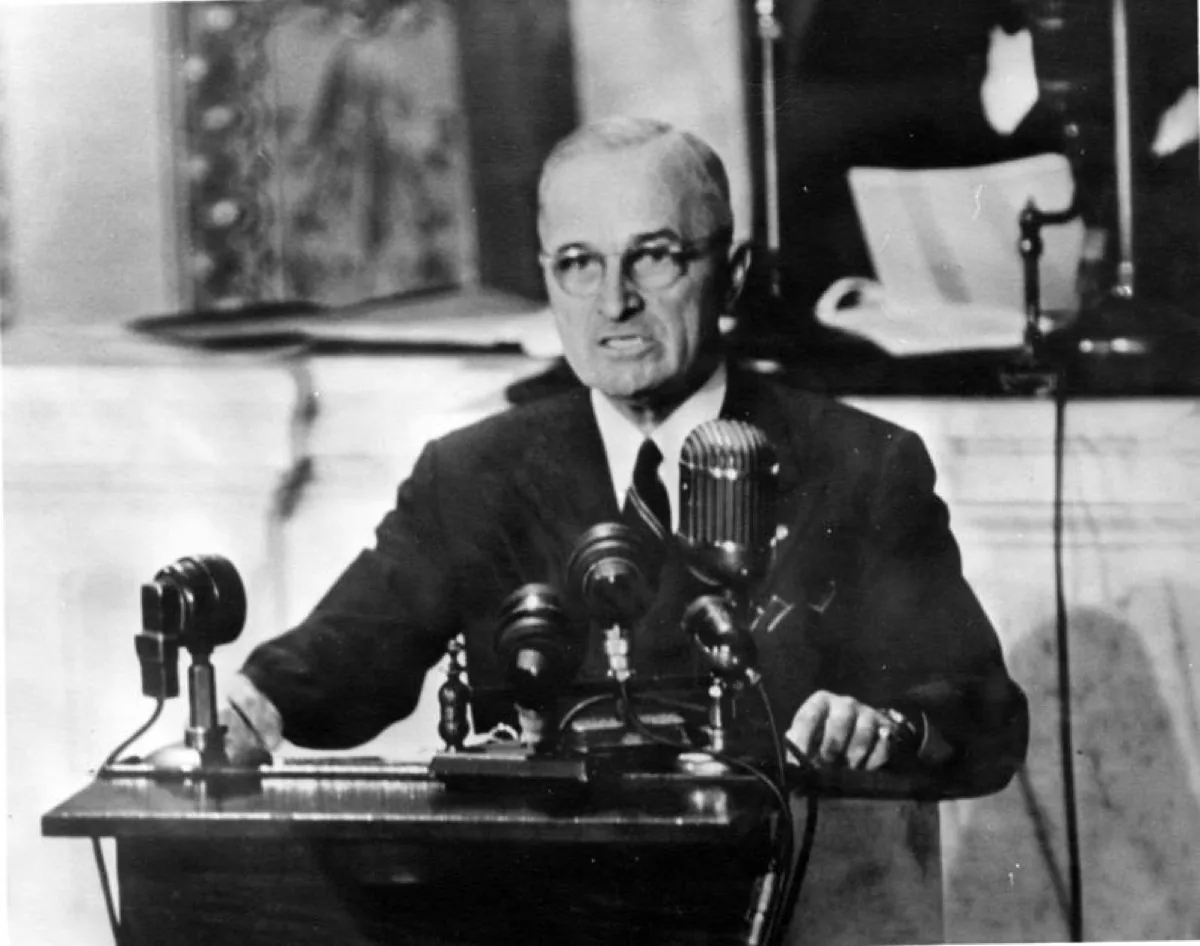
The Truman Doctrine was the foreign policy commitment that President Harry Truman declared on March 12, 1947. He spoke before a joint session of Congress and requested $400 million for Greece and Turkey, roughly $6 billion in today's money. The speech's defining sentence committed the country to defending free peoples facing subjugation, whether from armed groups inside their borders or from foreign powers. It specified no country and drew no line. Over the following four decades, successive presidents invoked it to defend commitments from Korea to Vietnam. The speech is widely regarded as the formal opening of the Cold War.
How Britain's crisis led to the Truman Doctrine
On February 21, 1947, the British government informed the State Department that it was nearly bankrupt and would stop funding Greece within six weeks. The message forced a decision that Washington had been putting off.
Greece was in a civil war. A weak royalist government was fighting guerrillas led by the Communist Party who were armed and supplied from Yugoslavia, Albania, and Bulgaria. Britain had been paying to keep the government in power, and now it could not continue. Turkey faced a different kind of pressure: the Soviet Union wanted bases on Turkish soil and joint control of the Bosporus and the Dardanelles, the straits connecting the Black Sea to the Mediterranean. Behind both crises was a larger strategic question. Would the United States take over the role that a declining British Empire was leaving, and would it do so in peacetime, with no war to justify the expense?
The Congress that would need to approve the money had swept into office on pledges to reduce taxes and demobilize the military. The Truman administration concluded it could not win support by talking about Greece and Turkey alone. Dean Acheson, the under secretary of state, briefed congressional leaders and made the case in sweeping terms. Acheson argued that if Greece fell, the pressure would spread to Iran, then to Asia Minor, then to Egypt, and then to all of Europe, like one rotten apple spoiling a barrel. Republican Senator Arthur Vandenberg's vote was essential because his party held both chambers. Vandenberg told Truman the only way to get the votes was to "scare hell out of" the country.
Truman took the advice. His speech on March 12 left out the complicated realities in Greece, where the government's own troops had carried out reprisals against civilians. Instead, Truman cast the question as a contest between two opposing ways of governing. One rested on majority rule, representative institutions, and individual liberty. The other rested on a ruling minority that imposed its will through terror and repression. He did not name the Soviet Union, but no one in the chamber missed the meaning. Congress approved the funding in May 1947.
Why the Truman Doctrine mattered
The money helped stabilize Greece and relieve the pressure on Turkey. The Greek civil war ended in 1949, partly because Yugoslavia broke with the Soviet Union in 1948 and stopped supplying the insurgents, cutting off their main lifeline. Greece and Turkey both remained outside Soviet influence and joined NATO in 1952.
But the speech did something larger than secure an appropriation. It turned containment, which had been a debate among diplomats championed by people like George Kennan, into the official policy of the United States. Before the speech, actively working to stop Soviet expansion wherever it appeared was one position among several in Washington. After it, containment was what the country did. The Marshall Plan followed three months later as the economic arm of the same approach. NATO followed two years later as the military arm.
The Truman Doctrine and its limits
The doctrine's language was universal, but American resources were finite. A pledge to defend every nation facing coercion created a commitment without a clear boundary. The journalist Walter Lippmann warned at the time that the United States would find itself drawn into conflicts in countries along the Soviet Union's borders. Lippmann's objection was not that the United States should ignore the Soviet Union. It was that a commitment with no geographic or strategic limit would stretch the country beyond what it could sustain.
The word "free" also proved elastic. Turkey had only one legal political party until 1945. The Greek government that the aid was meant to save used force against its own people. In later decades, the doctrine's logic led the United States to back many governments that were not free by any ordinary meaning of the word. The justification was always that those governments opposed the Soviet Union. The distance between the doctrine's stated ideals and the regimes it actually supported lasted through the whole Cold War and damaged American credibility abroad. Vietnam became the most visible example: a war justified by the doctrine's language, fought for twenty years, and lost.
The Truman Doctrine was a promise, not a treaty, and it carried no force of law. Its power came from the fact that its language was broad enough that every later president could read his own crisis into it. That made a single speech, delivered to win $400 million for two countries, one of the most consequential acts of American foreign policy in the twentieth century.