
Twelve Tables
The Twelve Tables were Rome's first written law code, created in 451-450 BC and posted in the Forum for all citizens to read.
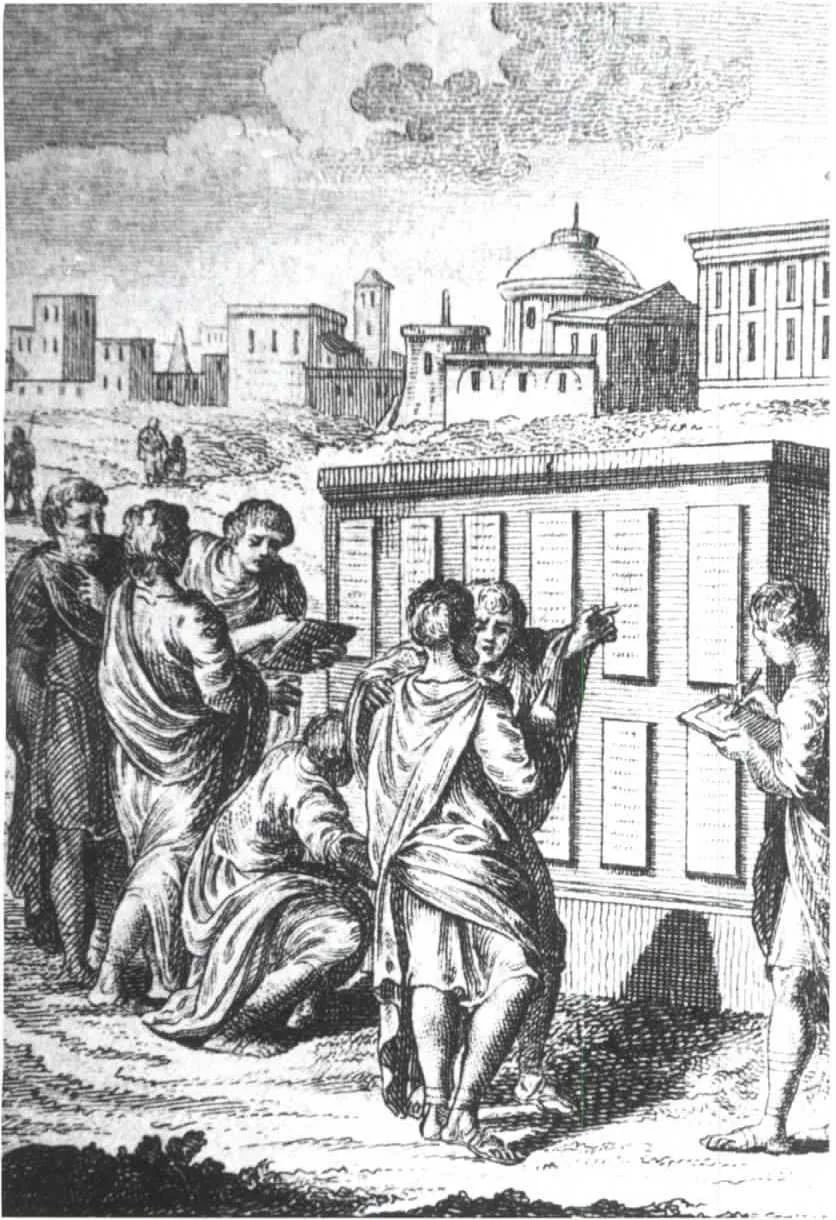
The Twelve Tables were Rome's first written law code. A commission of ten men created them in 451-450 BC, and the finished text was posted on bronze tablets in the Forum, where any Roman could read it. Before that, Rome had no written law at all. Patrician priests and officials judged disputes by custom that only they knew, and an ordinary citizen standing before a magistrate had no way to check the rule being applied to him. The Twelve Tables covered property, debt, marriage, funerals, and court procedure. They did not lay out a theory of justice. But they made the law public, and they applied to everyone.
How Rome got its first written laws
The demand came out of a generations-long political conflict called the Struggle of the Orders, fought between Rome's patricians (the old aristocratic families) and its plebeians (everyone else). Plebeians served in the army, paid taxes, and stood trial, but they could not read the law that governed any of it. Their central argument was simple: a person cannot obey a rule they are not allowed to know.
In 462 BC, a plebeian tribune named Gaius Terentilius Harsa first proposed that the laws be written down. The patricians resisted for nearly a decade. Tradition says Rome sent envoys to Athens and other Greek cities to examine how Solon and others had organized their laws. Around 451 BC, the Roman Senate suspended its normal magistrates and appointed a special commission of ten men, called the decemviri, with full power to draft a written code.
The first commission, led by a patrician named Appius Claudius Crassus, produced ten tables in its first year. A second commission added two more the following year, making twelve. But the second commission refused to give up power. According to the Roman historian Livy, Appius Claudius became tyrannical. He tried to seize a young plebeian woman named Verginia by having one of his followers claim in court that she was a slave. Her father, a centurion named Lucius Verginius, killed his own daughter in the Forum rather than let Appius take her. The resulting outrage drove the plebeians and soldiers to walk out of the city in protest, and the decemviri were forced to resign. The Twelve Tables stayed.
What the Twelve Tables said
Rome was a farming society in 450 BC, and the laws read like it. They set rules for property boundaries, inheritance, contracts, debt, marriage, funerals, and above all the procedures for going to court. Punishments were physical and specific.
The debt rules were severe. If someone owed money and could not pay, they had 30 days to find it. After that, the creditor could seize and chain the debtor and hold them for 60 days, displaying them in the Forum on three market days so that someone might come forward to pay the debt. If no one did, the debtor could be sold as a slave on the far side of the Tiber. An even harsher provision said that if there were multiple creditors, they could, in principle, cut the debtor's body into shares. Ancient and modern scholars have debated for centuries whether this was ever actually done. Most doubt it was.
One provision banned patricians from marrying plebeians. Plebeians resented it immediately, and in 445 BC, only five years later, a law called the Lex Canuleia repealed the ban.
The laws applied to everyone, patrician and plebeian alike. That was the point. Cicero, writing about 400 years later, recalled that in his boyhood Roman schoolchildren still memorized the Twelve Tables as a required exercise.
Where were the Twelve Tables displayed?
The tablets were posted in the Roman Forum, Rome's central public square, probably cast in bronze. The originals were most likely lost when a Gallic army captured and burned Rome around 390 BC. No complete text has survived. What scholars know of the Twelve Tables comes from quotations and references in the works of later Roman writers, including Cicero, the jurist Gaius, and the jurist Ulpian. Over a hundred individual provisions have been reconstructed this way.
Why the Twelve Tables still matter
The Twelve Tables were the foundation of Roman law for the next thousand years. Later Romans treated them with deep respect. Every new law and every legal opinion built on the framework they set down.
In the sixth century AD, the Byzantine emperor Justinian ordered a great codification of all Roman law, the Corpus Juris Civilis. The principles that had started with the Twelve Tables fed into that project. When medieval European universities began teaching law again centuries later, they taught from Justinian's codification. From there, Roman legal concepts spread into the civil-law tradition that governs much of continental Europe, Latin America, and parts of Asia and Africa today. France's Napoleonic Code of 1804, one of the most influential legal codes in history, drew directly on this Roman tradition.
The idea at the center of the Twelve Tables, that law must be written down where the people it governs can read it, seems obvious today. It is easy to forget that someone once had to fight for it. In fifth-century BC Rome, it took a generation of political struggle before the ruling class agreed to write its rules where ordinary citizens could see them.