
Cicero
Marcus Tullius Cicero was a Roman statesman, orator, and philosopher whose speeches and writings shaped Western political thought.
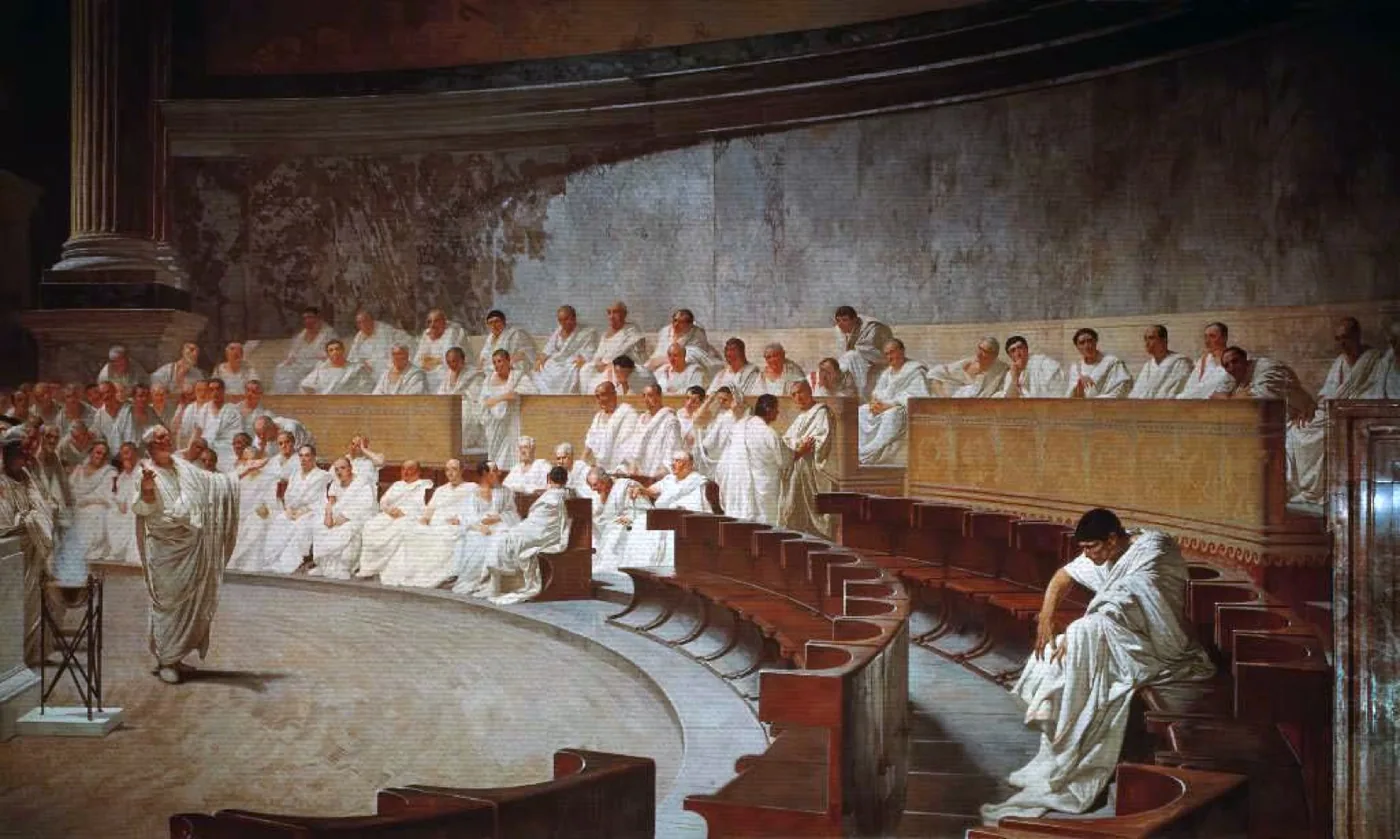
Marcus Tullius Cicero was a Roman statesman, orator, and philosopher who lived from 106 to 43 BCE. He was born in Arpinum, a small town about 100 kilometers southeast of Rome, to a wealthy local family that had never held high office. Romans called someone like him a novus homo, literally "new man," a term that carried more condescension than respect. Cicero reached the top of Roman politics anyway, winning each office at the minimum legal age, relying on his talent as a courtroom speaker rather than family connections or command of an army. His name came from the Latin word cicer, meaning chickpea. Plutarch traced it to an ancestor with a cleft on the tip of his nose. He is remembered as Rome's greatest orator, as the philosopher who created Latin words for ideas that had only existed in Greek, and as a defender of the Roman Republic who was killed for opposing the men who destroyed it.
How Cicero became consul
As a young man, Cicero studied law and philosophy in Rome, Athens, and Rhodes. He made his name in the courts, taking on cases against powerful men and winning. In the Roman system, a politician had to hold a sequence of offices called the cursus honorum, each with a minimum age. Cicero won each one at the earliest legal age, something almost unheard of for a man without consular ancestors.
In 63 BCE, at 43, Cicero served as consul, the highest office in the Roman Republic. That same year, a senator named Catiline organized an armed conspiracy to seize power. Cicero uncovered the plot, confronted Catiline in the Roman Senate, and had the leading conspirators arrested and executed. His four speeches against Catiline became the most famous orations in Latin. The opening line, "Quo usque tandem abutere, Catilina, patientia nostra?" ("How long, Catiline, will you abuse our patience?"), is still read in Latin classes. The Senate honored Cicero with the title pater patriae, "father of the fatherland." He considered it his greatest achievement and brought it up in speeches and letters for years afterward.
But the executions also created enemies. Cicero had put Roman citizens to death without a trial, relying on an emergency decree from the Senate rather than a court verdict. In 58 BCE, a tribune named Publius Clodius Pulcher, who had a personal grudge against Cicero, pushed through a law exiling anyone who had executed citizens without trial. The law was aimed directly at Cicero. He left Rome and spent more than a year in Greece before allies in the Senate secured his recall in 57 BCE.
Cicero against Caesar and Antony
The Republic that Cicero had defended was collapsing. Generals with private armies, not senators with legal authority, decided what happened in Rome. Julius Caesar crossed the Rubicon in 49 BCE and won the civil war that followed. Caesar pardoned Cicero but shut him out of political power. With little else to do, Cicero turned to writing philosophy. His daughter Tullia died in 45 BCE, and he devoted himself to work. In the last two years of his life he wrote most of the philosophical treatises that would be read across Europe for centuries, including De Officiis ("On Duties"), a guide to ethical conduct addressed to his son.
When Caesar was assassinated on March 15, 44 BCE, Cicero was not part of the conspiracy, but he welcomed it. He saw a last chance to restore the Republic and turned against the most powerful man left in Rome: Mark Antony, Caesar's former lieutenant, who was gathering Caesar's soldiers and political allies for himself. Between September 44 and April 43 BCE, Cicero wrote fourteen speeches attacking Antony. He called them the Philippics, after the speeches the Greek orator Demosthenes had given against Philip of Macedon centuries earlier.
The speeches failed. In late 43 BCE, Antony joined forces with Octavian, Caesar's adopted heir and the future emperor Augustus, and a general named Lepidus. The three divided the Roman world among themselves and published proscription lists of enemies to be killed. Antony made sure Cicero was on the list. Soldiers caught Cicero trying to flee by sea on December 7, 43 BCE, and killed him. On Antony's orders, they cut off Cicero's head and his hands and nailed them to the Rostra, the speakers' platform in the Roman Forum where Cicero had given his greatest speeches. The Republic he had spent his life defending did not last much longer.
Why is Cicero famous?
Cicero is famous for three reasons: his speeches, his philosophy, and his letters.
As an orator, he set the standard for Latin prose. His courtroom and political speeches were studied as models of argument and persuasion for centuries. During the Renaissance, European scholars treated Cicero's style as the ideal for Latin writing, and his influence on the development of clear expository prose in European languages lasted well beyond that.
As a philosopher, Cicero translated Greek ideas into Latin and created words that survive in modern languages, including "quality" (from his coinage qualitas) and "moral" (from moralis). His treatise De Re Publica argued that a constitution mixing elements of monarchy, aristocracy, and democracy was the most stable form of government. De Officiis was one of the first books printed after the invention of the printing press and was read as a guide to public duty across Europe for centuries afterward. His ideas about law and republican government influenced the thinkers who designed the American and French constitutions.
Cicero also left behind more than 800 letters to friends, family, and political allies. Most of the letters were never meant for publication. They record the politics of the Republic's final decades in a way no other ancient source does, with gossip, complaints, and real-time reactions to events as they unfolded.
Cicero argued throughout his life that liberty depends on legal order, not on the restraint of powerful individuals. He lost that argument in his own lifetime. But his writings carried it forward to the people who built the republics that came after Rome.