
Vikings
Vikings were Scandinavian raiders, traders, and settlers who from 793 to 1066 reached from Newfoundland to Baghdad and founded states across Europe.
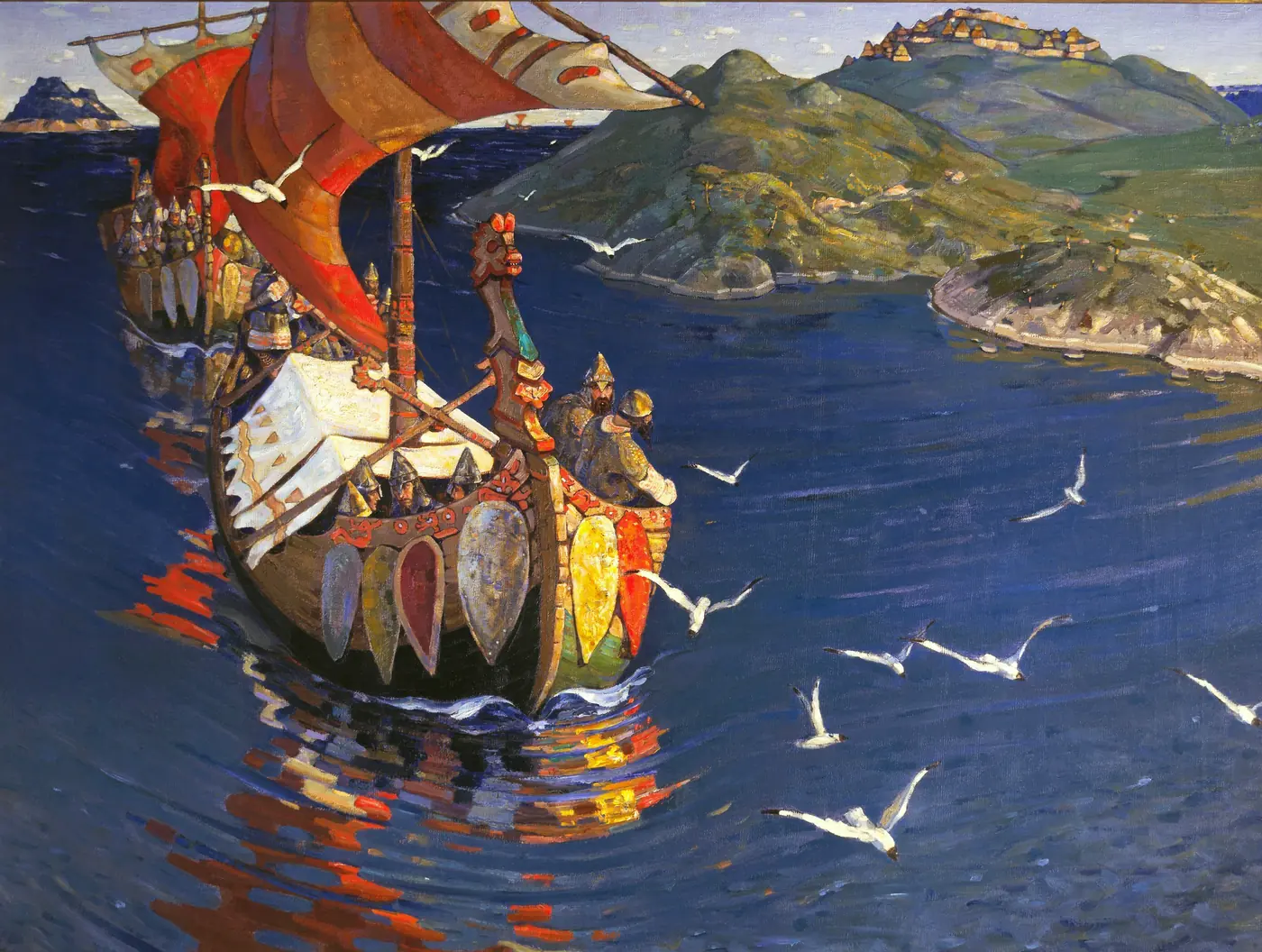
The Vikings were Scandinavian raiders, traders, and settlers active from roughly 793 to 1066. The word "Viking" was not an ethnic identity. The Old Norse word víking referred to the act of raiding, not to a people, and most Scandinavians in this period never went on one. Those who did ranged from Newfoundland in the west to Baghdad in the east. They raided monasteries, traded furs and enslaved people for Islamic silver, settled empty islands in the North Atlantic, and founded states that still exist. Normandy, Iceland, Dublin, and the founding stories of both Russia and Ukraine all trace back to Scandinavian ventures in these three centuries.
How the longship started the Viking age
The conventional start date is 793, the year a raiding party from Scandinavia attacked the monastery at Lindisfarne, a small island off the northeast coast of England. The monks had no warning and no defense. The attack shocked Christian Europe because English monasteries, rich and unguarded, had never faced seaborne assault.
What made these raids possible was the longship. Scandinavian shipbuilders had developed a vessel with a shallow draft, a keel for ocean sailing, one square sail, and banks of oars for use on rivers or in calm weather. A longship could cross the open North Atlantic, land on an open beach with no port, and travel up rivers too shallow for any other oceangoing ship. Places far inland along rivers were now open to attack from the sea.
Vikings killed, burned, and took captives for ransom or for sale. But raiding was one activity among several. The same Scandinavians who raided also traded, and they were among the best long-range traders of the early Middle Ages. They sold furs, walrus ivory, and amber. Their most profitable commodity was enslaved people. Vikings seized captives in Ireland, England, eastern Europe, and from rival Norse groups, then sold them to buyers across the Muslim world. Archaeologists have found tens of thousands of Islamic silver dirhams in Scandinavian hoards. The English word "slave" itself comes from the Medieval Latin word for "Slav," a trace of how many Slavic captives passed through these trading networks.
Where the Vikings settled
Scandinavians settled as well as raided. Norse families colonized Iceland starting in the 870s and reached Greenland around 985. Around 1021, a group built a camp at L'Anse aux Meadows on the northern tip of Newfoundland, the earliest confirmed European presence in the Americas, about five hundred years before Columbus. The Greenland colony survived for more than four hundred years before it disappeared in the mid-1400s as the climate cooled.
In western Europe, Vikings seized a large part of England, a region known as the Danelaw. In 911, the French king Charles granted territory to a Viking leader named Rollo, and that land became Normandy, meaning "land of the Northmen." William of Normandy, a descendant of Rollo, conquered England in 1066. Norman adventurers also took Sicily and southern Italy in the same century.
Going east, Scandinavian traders known as the Rus traveled down the rivers of modern Russia and Ukraine. They settled at Novgorod and then at Kyiv, where they built the state known as Kievan Rus. The Rus sailed to Constantinople many times, as both attackers and traders. Some stayed to serve the Byzantine emperor as the Varangian Guard, an elite corps of Scandinavian axemen that protected the emperor for centuries. Russia and Ukraine both claim Kievan Rus as their founding state, and the question of whether the Rus state was more Norse or more Slavic in character remains politically charged.
Did Vikings wear horned helmets?
No. Horned helmets are a myth from the 1800s, spread by opera costume designers and romantic painters. No Viking-era helmet ever found by archaeologists has had horns. The few surviving examples are simple iron caps, sometimes with a guard around the eyes and nose.
The myth reflects a broader distortion in the historical record. Almost everything written about Vikings at the time came from Christian monks whose monasteries were the primary targets of Viking raids. That one-sided record shaped centuries of popular understanding. Over the last century, archaeology has filled in what the written sources left out, revealing a commercial seafaring society that traded across continents as well as raiding them.
Why did the Viking age end?
The Viking age ended not because the Vikings lost a decisive war but because the conditions that made raiding profitable shifted. English, French, and German kingdoms had grown powerful enough to repel seaborne raiders. Within Scandinavia, power gathered into the three kingdoms of Denmark, Norway, and Sweden, whose rulers converted to Christianity and chose to tax trade instead of sponsoring raids. Christianization also removed the religious difference between the Norse and their targets and reshaped the culture that had encouraged raiding.
The conventional end date is 1066, the year the Norwegian king Harald Hardrada's invasion of England failed at the Battle of Stamford Bridge, just weeks before William of Normandy's invasion succeeded at Hastings. By the twelfth century, the raiders had become kings and townspeople in Denmark, Norway, Sweden, Normandy, and the lands of Rus. Some of the states they built still exist.