
Kievan Rus
Kievan Rus was a medieval state ruled from Kyiv that Russia, Ukraine, and Belarus all claim as their origin.
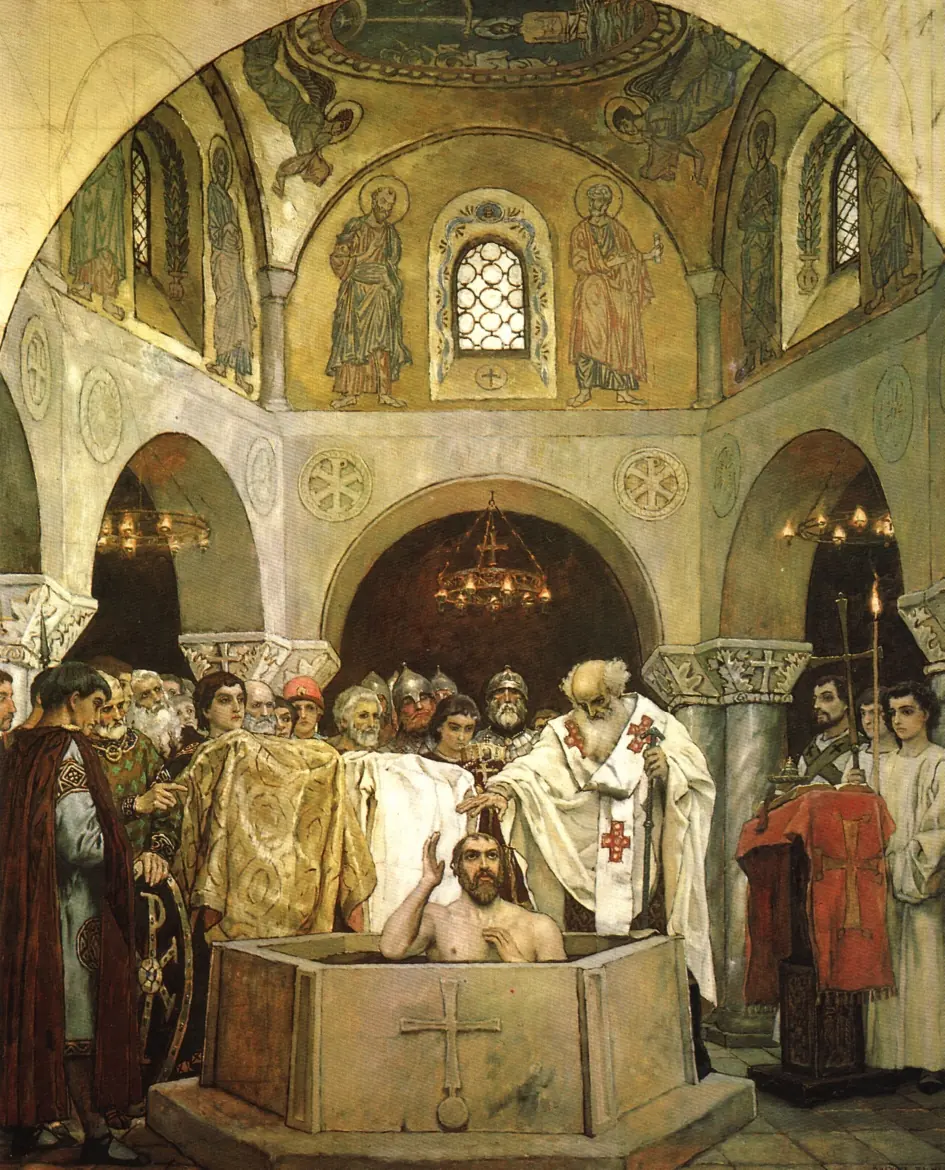
Kievan Rus was a medieval state centered on Kyiv that lasted from about 880 to 1240. It was founded by Viking traders from Scandinavia who worked a river route between the Baltic Sea and Constantinople, and it grew into a loose federation of Slavic principalities across what is now Ukraine, Belarus, and western Russia. In 988, its ruler converted to Orthodox Christianity, a decision that shaped the religion, alphabet, and politics of Eastern Europe for the next thousand years. Russia, Ukraine, and Belarus all trace their origins to Kievan Rus, and the name Russia itself comes from Rus. That shared ancestry makes it one of the most politically contested subjects in the region today.
How Scandinavian traders built a state on Kyiv's rivers
The Rus were Varangians, Norse traders and mercenaries who traveled a network of rivers known as the road "from the Varangians to the Greeks." They carried furs, wax, honey, and enslaved people south to Constantinople and returned with silver. According to the Primary Chronicle, a monastic history compiled in the twelfth century, a Varangian chieftain named Rurik took control of Novgorod around 862. After Rurik died, his kinsman Oleg moved south, captured Kyiv around 882, and declared it the capital. Kyiv sat on the Dnieper River, the main route connecting the Baltic to the Black Sea, and controlling it meant controlling trade between Scandinavia and Byzantium.
Over the following generations, the Norse rulers intermarried with the Slavic population they governed. They adopted Slavic names and the Slavic language. By the late tenth century, the Rurikid dynasty was culturally Slavic, and its politics pointed toward Constantinople and the steppe rather than Scandinavia. The state the Rurikids built was not a centralized kingdom but a chain of river cities ruled by princes of the same clan, with Kyiv as the senior seat.
Vladimir's baptism and the golden age of Kyiv
In 988, Vladimir the Great, the prince of Kyiv, accepted Orthodox Christianity from Byzantium. Before his conversion, the Primary Chronicle describes Vladimir as a ruler with several wives, hundreds of concubines, and a pagan shrine he had built outside his palace in Kyiv. His conversion was partly a diplomatic bargain: he agreed to be baptized at the Byzantine city of Chersonesus in Crimea, in exchange for the hand of Anna, the sister of Byzantine Emperor Basil II. He returned to Kyiv, ordered his subjects baptized in the Dnieper, and had the pagan statues torn down and burned or thrown into the river.
The decision tied Kievan Rus to the richest and most literate empire in the Christian world. It brought the Cyrillic alphabet, Byzantine law, stone architecture, and a church hierarchy based in Constantinople. It also set the Rus apart from the Catholic kingdoms to the west and the Islamic world to the south, a division that persisted long after Kievan Rus itself was gone.
Under Vladimir's son Yaroslav the Wise, Kyiv reached its peak. Yaroslav built the Cathedral of Saint Sophia, founded a library and school beside it, and issued the Russkaya Pravda, the first written law code of the Rus. He married his daughters to kings across Europe: Elizabeth to Harald III of Norway, Anna to Henry I of France, and Anastasia to Andrew I of Hungary.
After Yaroslav died in 1054, the state fractured. The Rurikid clan was large, and succession disputes split the realm into rival principalities that fought each other for generations. When the Mongols arrived under Batu Khan, there was no unified defense. In late 1240, Mongol armies besieged Kyiv, smashing through the walls with catapults after about a week. They destroyed most of the city and killed most of its inhabitants. The Cathedral of Saint Sophia survived, but Kievan Rus as a functioning state did not. The Mongol conquest brought the region under foreign control for more than two centuries.
Was Kievan Rus Ukrainian or Russian?
Both countries claim it, and neither claim is simple. Kievan Rus was centered on Kyiv, which is the capital of modern Ukraine, and its population was mostly East Slavic. But the state existed centuries before distinct Russian, Ukrainian, or Belarusian identities took shape. The term Kievan Rus itself is a modern label, coined by nineteenth-century historians to distinguish the early state from the later principalities that descended from it. Those identities formed gradually, in different regions, under different rulers, long after the Mongols destroyed Kyiv.
After the Mongol conquest, Moscow rose from the northern principality of Vladimir-Suzdal and built the Russian Empire, presenting itself as the true heir of Rus. Ukraine's national identity developed around Kyiv and the Cossack communities of the Dnieper, and Ukraine became an independent country when the Soviet Union collapsed in 1991. Both origin stories trace back to the same medieval state.
In July 2021, Russian president Vladimir Putin published an essay titled "On the Historical Unity of Russians and Ukrainians." He argued that the shared descent from Kievan Rus proved the two nations were "one people." Seven months later, Russian forces invaded Ukraine. Both countries hold ceremonies for the 988 baptism in the Dnieper: Kyiv celebrates it as the start of Ukrainian Christianity, and Moscow celebrates it as the start of Russian Christianity. The dispute over who inherits the legacy of Kievan Rus is not a medieval question. It is part of the politics of Eastern Europe today.