
Bay of Pigs Invasion
The Bay of Pigs invasion was a failed 1961 CIA operation in which Cuban exiles tried to overthrow Fidel Castro.
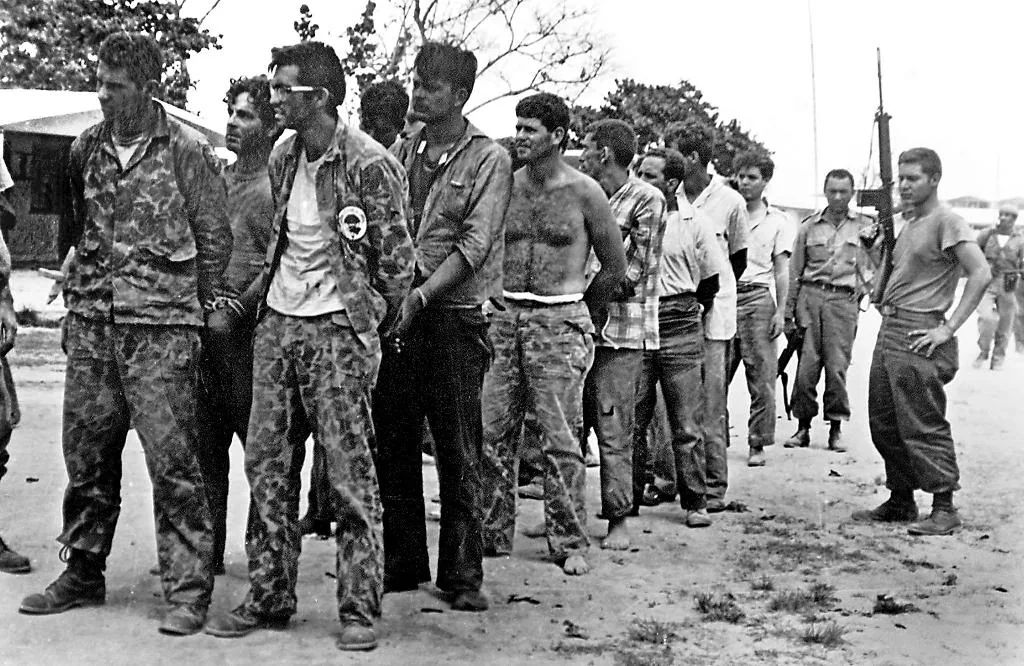
The Bay of Pigs invasion was a failed attempt by the United States to overthrow Fidel Castro's government in Cuba in April 1961. About 1,400 Cuban exiles, trained and armed by the CIA, landed on Cuba's southern coast at a swampy inlet called Bahia de Cochinos. They expected their arrival to trigger a national uprising against Castro. Instead, Castro's military pinned them on the beach and defeated them in less than three days. The invasion humiliated President John F. Kennedy, who had been in office for less than three months. It pushed Castro into an open alliance with the Soviet Union and led directly to the Cuban Missile Crisis in 1962.
How Eisenhower and Kennedy planned the Bay of Pigs invasion
The plan began under President Dwight Eisenhower. In March 1960, Eisenhower approved a CIA program to recruit Cuban exiles and train them to overthrow Castro. The CIA set up a training camp near Retalhuleu, in the mountains of Guatemala, and by late 1960 had assembled several hundred men into a force called Brigade 2506. The brigade was named after the membership number of Carlos Rafael Santana Estevez, a recruit who had died in a training accident.
Kennedy inherited the plan when he took office in January 1961. He was 43 years old, the youngest elected president in American history. The CIA told him the operation would succeed and that if the landing faltered, the exiles could escape into nearby mountains and fight as guerrillas. Kennedy approved the plan but insisted that the American role stay hidden, so that the United States could deny involvement. That restriction would end up costing the operation its air support.
How the Bay of Pigs invasion unfolded
On April 15, CIA-supplied B-26 bombers struck Cuban airfields to destroy Castro's air force before the landing. The planes were painted in Cuban military markings to make the attack look like a defection from within Cuba's own military. The trick did not hold. Reporters at Miami's airport noticed that a B-26 that landed there, supposedly flown by a defecting Cuban pilot, had machine guns that had not been fired. At the United Nations, the American ambassador Adlai Stevenson repeated the cover story without knowing it was false. When the deception fell apart, Stevenson was furious, and Kennedy canceled the follow-up air strikes that were supposed to destroy what remained of Castro's air force.
That cancellation changed the outcome of the invasion. On April 17, the brigade came ashore on the Bay of Pigs at Playa Giron and Playa Larga. The Cuban planes that had survived the first strikes strafed the beaches and sank the freighters carrying the invaders' ammunition and communications equipment. Castro took personal command of the military response and sent roughly 20,000 troops, along with tanks and artillery, against the lightly armed exile force. The national uprising the plan depended on never happened. By April 19, the brigade had run out of ammunition and was surrounded. About 114 exiles were killed and roughly 1,180 were captured.
The captured men were held in Cuban prisons for twenty months. In December 1962, the United States negotiated their release by paying about $53 million in baby food and medicine, roughly $590 million in today's dollars.
Why did the Bay of Pigs invasion fail?
The invasion failed for several reasons that compounded each other. Kennedy canceled the second round of air strikes to protect the cover story that the United States was not involved, but that left Castro's planes free to sink the supply ships and strafe the beach. The CIA had assumed that if the landing struggled, Kennedy would send in the American military rather than accept defeat. Kennedy had assumed that if things went wrong, the exiles could retreat into the mountains and fight as guerrillas. Neither assumption was right. The nearest mountains were more than 80 miles from the landing site, across impassable swamp, and Kennedy never intended to send American troops.
The plan also depended on ordinary Cubans rising up against Castro once the invasion began. That did not happen. Castro's government had been rounding up suspected opponents for weeks before the landing, and whatever opposition existed was not strong enough to produce a revolt.
How the Bay of Pigs changed the Cold War
Kennedy publicly accepted blame for the disaster. At a press conference, he quoted an old saying: "Victory has a hundred fathers and defeat is an orphan." Behind closed doors, he blamed the CIA for assuring him the operation would work.
Castro turned the failed invasion into proof that the United States wanted to destroy his government. He declared Cuba a socialist state and moved openly into alliance with the Soviet Union. The invasion, which was supposed to end his revolution, helped him consolidate it.
The failure also shaped how other leaders saw Kennedy. Soviet leader Nikita Khrushchev concluded that the young president was easy to pressure. That reading led Khrushchev to confront Kennedy over Berlin. In 1962, Khrushchev secretly shipped nuclear missiles to Cuba, ninety miles from Florida. The resulting Cuban Missile Crisis brought the two superpowers closer to nuclear war than they have ever been.
Why is it called the Bay of Pigs?
The name is an English translation of the Spanish Bahia de Cochinos. It may not refer to pigs. In Cuban Spanish, "cochinos" also means the queen triggerfish, which lives on the coral reefs in the bay. The inlet may have been named after the fish, not the animal.