
Nikita Khrushchev
Nikita Khrushchev led the Soviet Union from 1953 to 1964, denounced Stalin, and brought the Cold War to the brink of nuclear war over Cuba.
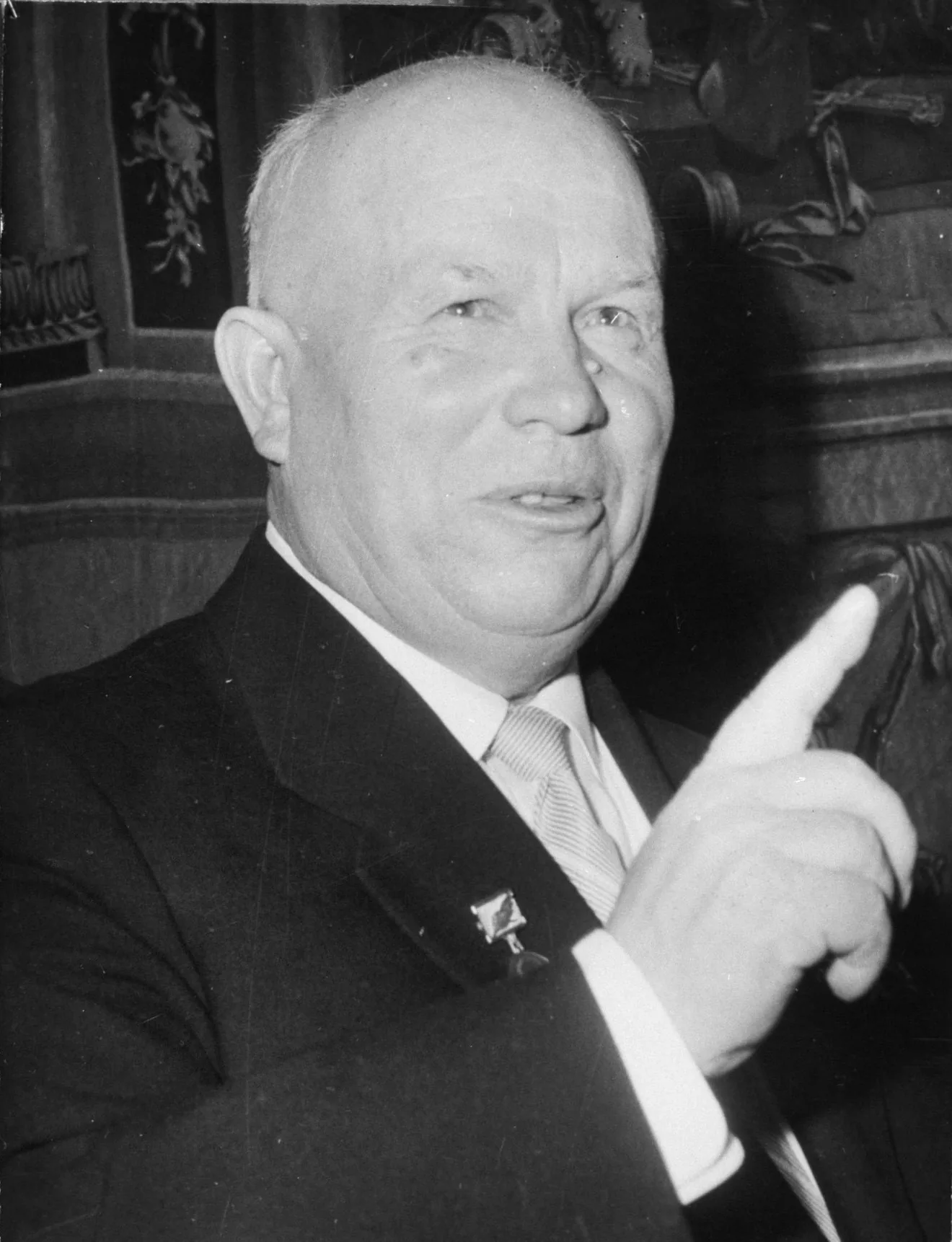
Nikita Khrushchev led the Soviet Union from 1953 to 1964. He denounced Stalin in a speech that shook the communist world, sent tanks into Hungary, launched the space race with Sputnik, and placed nuclear missiles in Cuba, bringing the Cold War to the edge of nuclear war. He was born on April 15, 1894, in Kalinovka, a farming village in Russia's Kursk province, near the Ukrainian border. His family was poor. He had about four years of formal schooling, then went to work as a metal fitter in the coal towns of eastern Ukraine. He joined the Bolsheviks in 1918, the year after the Russian Revolution, and spent three decades rising through the Communist Party, serving Stalin loyally while watching colleagues vanish in the purges. During World War II he served as a political commissar on the front lines, including at the Battle of Stalingrad.
How Khrushchev took power and denounced Stalin
Stalin died in March 1953, and the men around him began competing for control. Khrushchev was crude, earthy, and easy to underestimate. Rivals with better educations and higher positions dismissed him. He outmaneuvered them all.
In February 1956, after the 20th Party Congress in Moscow had finished its public business, Khrushchev addressed the delegates behind closed doors. He spoke for hours about Stalin, cataloguing the mass terror, the purges of loyal Communists, and Stalin's mistakes before the German invasion in 1941. Its official title was "On the Personality Cult and Its Consequences." The Soviet government did not publish the text until 1989, but copies leaked within weeks. The world came to know it as the Secret Speech.
At home, the speech launched a period called de-Stalinization. Millions of prisoners left the Gulag labor camps. Press restrictions eased. The security services lost some of their reach. Abroad, the speech shattered the confidence of communists who had defended Stalin for decades. In Hungary, people took the new openness as a signal to push for independence from Moscow. Khrushchev ordered Soviet troops into Budapest in November 1956 and crushed the uprising. He had loosened the system at home, but he would not let any country leave the Soviet bloc.
Khrushchev and the Cold War
Khrushchev called for "peaceful coexistence" with the West, but he also made threats. At a reception for Western diplomats in November 1956, he said "we will bury you." He later explained that he meant the Soviet system would outlast capitalism, not that he planned an attack. The phrase alarmed Americans for years.
In 1957, the Soviet Union launched Sputnik, the first artificial satellite, and Khrushchev pointed to it as proof that communism was winning the future. In July 1959, he argued with Vice President Richard Nixon about kitchens, washing machines, and which country's workers lived better, at a model American home exhibit in Moscow. The exchange became known as the Kitchen Debate.
His most dangerous move came in 1962, when he placed nuclear missiles in Cuba, ninety miles from the United States. The Cuban Missile Crisis brought the two superpowers closer to nuclear war than they had ever been. After a thirteen-day standoff, Khrushchev agreed to withdraw the missiles. He called the outcome a victory, because the United States agreed not to invade Cuba. Hardliners in Moscow saw it as a humiliation and did not forget.
Why was Khrushchev removed from power?
Khrushchev's domestic record wore down his support inside the Communist Party. His Virgin Lands campaign turned millions of acres of dry steppe in Central Asia into farmland. Early yields were strong, but wind erosion destroyed the exposed topsoil within a few years, and harvests collapsed. He reorganized the government and party structures repeatedly, creating confusion without results. Food shortages continued.
His unpredictable style made things worse. He reportedly pounded a shoe on the table during a United Nations session in 1960, though historians still dispute whether it happened. The Cuban crisis shook Moscow's confidence in his judgment. Senior officials decided he was a liability.
In October 1964, while Khrushchev was on vacation at a Black Sea resort, his colleagues in the Presidium summoned him to Moscow and voted him out. They accused him of reckless decision-making and building his own cult of personality. Unlike Stalin's purged rivals, Khrushchev was not arrested or killed. He was allowed to retire on a state pension.
How did Khrushchev die?
Khrushchev spent his last seven years at a dacha outside Moscow, watched by the KGB but otherwise left alone. He spent his days gardening and recording his memories on tape. The tapes were smuggled to the West and published in 1970 as "Khrushchev Remembers," which embarrassed the Soviet government. He died of a heart attack on September 11, 1971, at the age of 77.
The Soviet state gave him a quiet funeral at Novodevichy Cemetery in Moscow, not at the Kremlin Wall with other Soviet leaders. No senior officials attended. But Khrushchev's removal from power, years earlier, had set a precedent. He was the first Soviet leader to lose power and survive. The Soviet system could transfer power without violence.